Introduction
Textbook scheduling algorithms are useful because they explain the core vocabulary of CPU scheduling. FCFS, SJF, SRTF, Round Robin, Priority Scheduling, MLQ, and MLFQ teach ideas like fairness, response time, priority, queueing, and starvation.
Real operating systems cannot simply copy these algorithms as-is. A real scheduler must handle changing workloads, many users, many runnable tasks, and often many CPU cores while keeping the system responsive.
Why Textbook Scheduling Is Not Enough
Textbook scheduling usually starts with clean assumptions. The number of processes is small, burst times may be known, and the goal of each algorithm is easy to isolate.
Real systems are different. They may run interactive apps, background services, browser tabs, system daemons, real-time tasks, build jobs, and network work at the same time. A direct textbook algorithm can become too rigid, too slow, unfair, or easy for applications to exploit.
What Textbook Algorithms Teach
Textbook algorithms are still important because they provide the base ideas used in real schedulers.
Algorithm | Main Idea |
|---|---|
FCFS | Arrival order and queueing |
SJF | Short-job preference |
SRTF | Preemption based on remaining time |
Round Robin | Time slicing and responsiveness |
Priority Scheduling | Importance-based CPU allocation |
MLQ | Separate queues for separate work classes |
MLFQ | Adaptive queues based on behavior |
These algorithms are models. They simplify scheduling so each idea can be understood clearly before combining ideas in real systems.
Why MLFQ Is an Important Bridge
MLFQ is closer to real scheduler thinking because it is adaptive. It does not treat every task the same forever.
In MLFQ, a task may start in a high-priority queue. If it uses its full time quantum, it can move down. If a task waits too long, priority boosting may move it up again to reduce starvation.
This teaches an important real-world lesson: a scheduler can observe behavior and adjust future decisions. MLFQ is not the same as a modern production scheduler, but it introduces adaptation, feedback, demotion, and starvation control.
Real Scheduler Goals
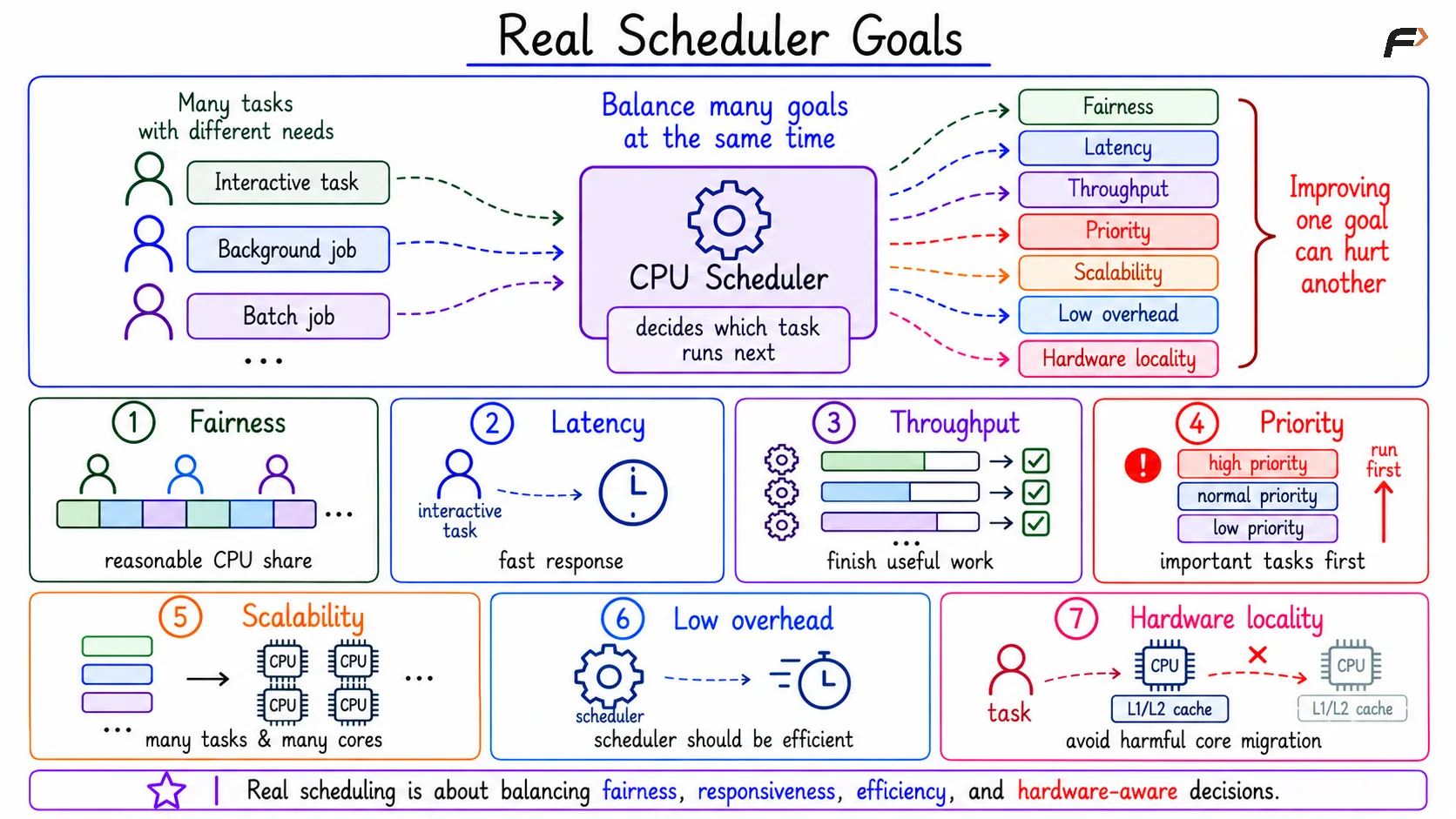
A real scheduler must balance several goals at the same time. Improving one goal can hurt another, so scheduling is not about blindly maximizing one metric.
Fairness: Runnable tasks should receive a reasonable CPU share.
Latency: Interactive tasks should respond quickly.
Throughput: The system should complete useful work efficiently.
Priority: Important work may need more CPU attention.
Scalability: The scheduler must work with many tasks and many cores.
Low overhead: Scheduling decisions should not waste too much CPU time.
Hardware locality: Tasks should not move between cores unnecessarily when it hurts cache behavior.
This is why real scheduling becomes an engineering problem. The scheduler must make practical decisions quickly, repeatedly, and under changing conditions.
Real Scheduler Goals
Linux Scheduler Classes
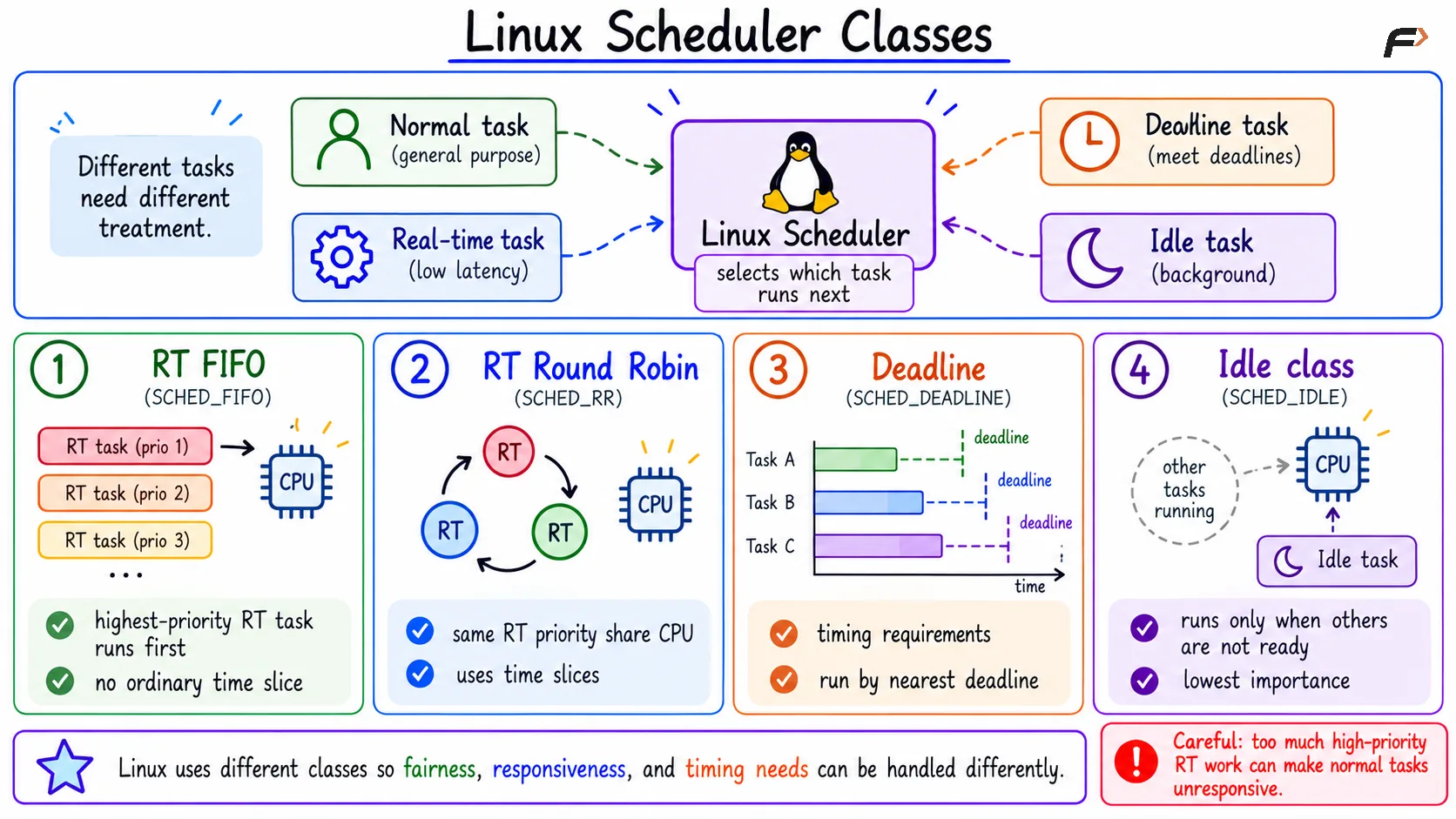
Linux uses scheduler classes and policies because different kinds of tasks need different treatment. A normal desktop task, real-time task, deadline-sensitive task, and idle task should not all be handled by one simple textbook rule.
Common Linux scheduling ideas include:
Class or Policy | Purpose |
|---|---|
Real-time FIFO | Runs real-time tasks in priority order without ordinary time slicing |
Real-time Round Robin | Shares CPU among real-time tasks at the same priority using time slices |
Deadline scheduling | Handles tasks with timing requirements |
Idle class | Runs only when nothing more important is ready |
Real-time priority must be used carefully. If too much work is placed in a high-priority class, normal tasks can become unresponsive.
Linux Scheduler Classes
CFS and EEVDF Intuition
Normal Linux scheduling is not plain Round Robin. It is built around fairness, task weight, and latency-aware decisions.
CFS, or Completely Fair Scheduler, used virtual runtime to approximate fair CPU sharing. A task with less weighted CPU service became a stronger candidate to run, helping distribute CPU time fairly over time.
Modern Linux scheduling has moved toward EEVDF, or Earliest Eligible Virtual Deadline First. The intuition is that eligible tasks receive virtual deadlines, and the scheduler prefers the task with the earliest virtual deadline.
The shared idea is that normal scheduling is not just equal time slicing. It is weighted, fairness-oriented, and designed to keep latency reasonable.
Priority and Nice Values
Priority is an influence, not magic. A more favorable priority or nice value can help a task receive more CPU time, but it does not guarantee immediate execution.
For normal tasks, nice value affects weight:
Lower nice value: Higher weight and more CPU share.
Higher nice value: Lower weight and less CPU share.
Nice value: Influences CPU share, but scheduler class and resource controls still matter.
A task with a better nice value is treated more favorably within normal scheduling, but it is still subject to the scheduler’s broader rules.
Summary
Textbook scheduling algorithms are models. They explain important concepts such as fairness, response time, priority, starvation, preemption, time slicing, and queue movement, but they are usually too simplified to run directly in modern operating systems.
Real schedulers handle dynamic workloads, multicore CPUs, priorities, latency, throughput, hardware locality, and low overhead together. MLFQ is an important bridge because it introduces adaptive scheduling, but production schedulers use broader policy frameworks such as scheduler classes, fair scheduling, real-time policies, deadline scheduling, and idle handling.
Be the first to add a comment.