Introduction
A SQL statement appears simple from the outside. An application sends a command, and the database returns rows or confirms that data was changed. Inside the DBMS, several specialized components cooperate to process that command. The query is parsed, checked, optimized, executed, and translated into operations on memory and persistent storage. Understanding these components makes query performance, transactions, indexes, and database errors easier to explain.
DBMS Components at a Glance
A Database Management System is composed of cooperating subsystems. Component names and boundaries differ between products, but most relational database systems perform the same core responsibilities.
DBMS component | Main responsibility |
|---|---|
Connection manager | Accepts and manages client connections |
Authorization manager | Verifies permissions |
Query processor | Parses, validates, optimizes, and executes SQL |
System catalog | Stores metadata and database statistics |
Transaction manager | Coordinates transactions |
Concurrency-control manager | Coordinates simultaneous operations |
Buffer manager | Moves database pages between memory and storage |
Storage manager | Organizes tables, indexes, and files |
Recovery manager | Uses logs and recovery information to protect committed work |
These components form a pipeline rather than operating as isolated tools.
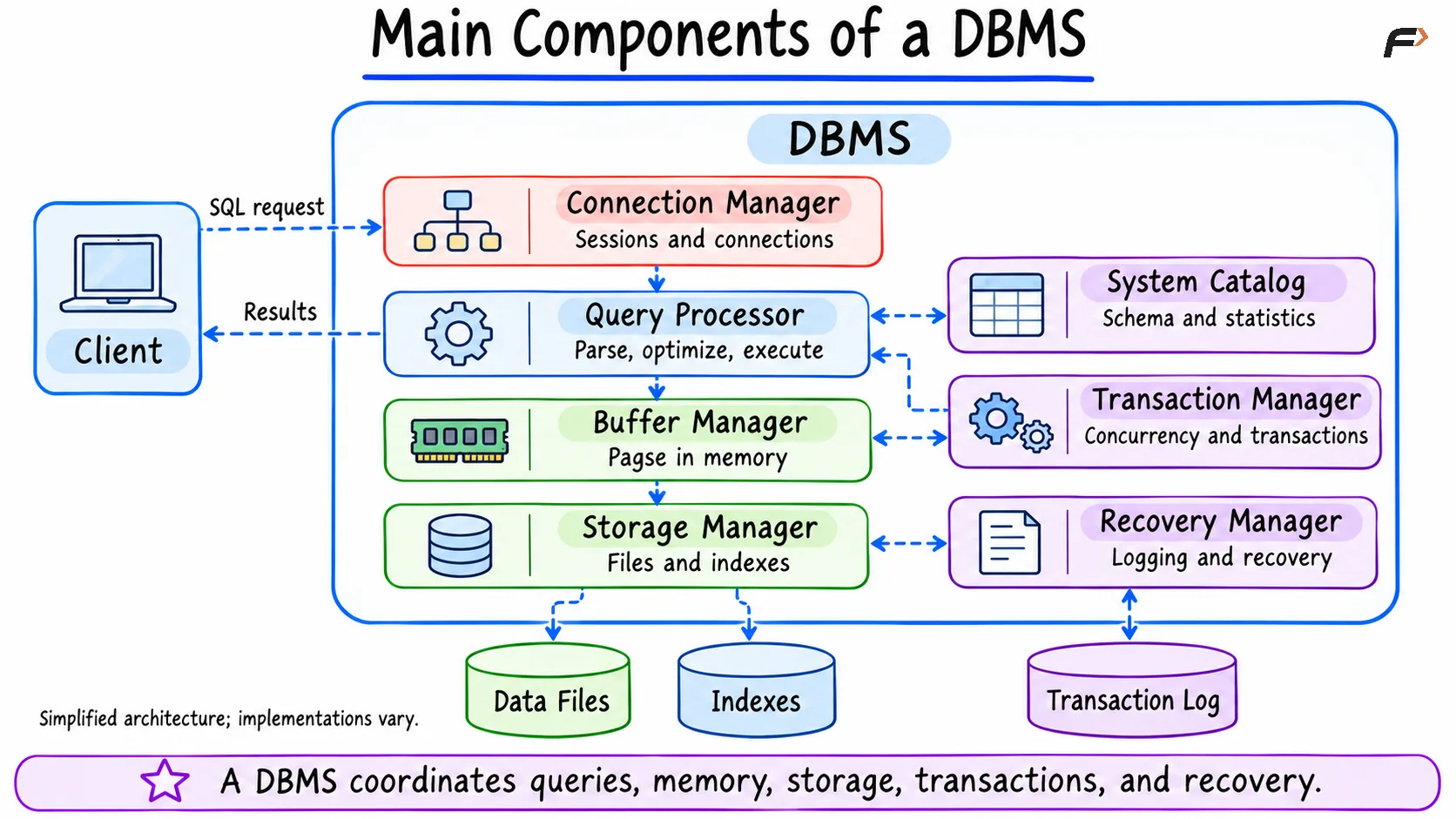
Main Components of a DBMS
Client and Connection Management
A query begins outside the database server. The source of a query may be a command-line client, a graphical database tool, a web or mobile application, a reporting platform, a scheduled data-processing job, or another server. The client uses a database driver and a communication protocol to connect to the DBMS.
Connection Establishment
The connection manager typically handles the network connection, authentication, session creation, connection settings, transaction state, and communication with the client. A session can store information such as the current database, time zone, transaction settings, and session variables. Some applications create a new connection for every request. Production applications commonly use connection pools so that established connections can be reused.
Authentication and Authorization
Authentication establishes the identity associated with the connection. Authorization determines which actions that identity may perform. Permission checks can apply to databases, schemas, tables, views, columns, functions, and administrative operations. A syntactically valid query can still fail when the current identity lacks the required permission.
Query Processor
The query processor converts a high-level SQL statement into operations the DBMS can execute. The major responsibilities of the query processor include parsing, semantic validation, query rewriting, optimization, and execution.
Parser
The parser examines the SQL text and verifies its grammatical structure.
For example, the following statement is missing FROM:
SELECT student_id students;The parser breaks valid SQL into meaningful elements such as keywords, identifiers, operators, expressions, and clauses. It then creates an internal representation, commonly called a parse tree or syntax tree. The parser checks SQL grammar, but grammar alone cannot prove that the referenced database objects exist.
Semantic Analyzer
Semantic analysis checks the meaning of the parsed statement against database metadata and may verify whether tables and columns exist, whether names are unambiguous, whether functions exist, whether data types are compatible, whether aggregate expressions are valid, whether the current identity has permission, and whether constraints and object rules apply.
For example, a query can have valid grammar but refer to a nonexistent column:
SELECT student_numberFROM students;The parser may accept the structure. Semantic analysis fails if student_number is not defined in the students table.
Query Rewriter
Some database systems transform a validated query before optimization. Rewriting may involve expanding a view into its underlying query, simplifying expressions, applying database rules, replacing equivalent expressions, expanding generated structures, and enforcing certain security policies. PostgreSQL explicitly includes a rewrite stage that can transform queries against views into queries against their underlying tables. Rewriting changes the internal representation without changing the requested result.
Query Optimizer
A SQL statement describes the required result. It usually does not prescribe every physical step needed to produce that result. The optimizer considers alternative execution plans. Possible choices for the execution plan include sequential table scan or index scan, join order, join algorithm, sorting strategy, aggregation strategy, parallel or non-parallel execution, and intermediate-result handling. The optimizer estimates the cost of each suitable alternative using information such as table size, index availability, value distribution, and expected row counts.
The selected plan is normally the plan with the lowest estimated cost, not necessarily the plan with the fewest visible steps.
Execution Engine
The execution engine runs the selected plan. Plan operators can include table scan, index scan, filter, sort, aggregate, nested-loop join, hash join, merge join, and limit. Each operator consumes rows from lower operators and produces rows for the operator above it. The execution engine coordinates with the transaction, buffer, and storage components while processing these operators.
System Catalog and Database Statistics
The system catalog can describe databases and schemas, tables and columns, data types, constraints, views, indexes, functions, users and permissions, storage information, and optimizer statistics. The parser and semantic analyzer consult the catalog to resolve object names and validate a query. The optimizer uses statistical information to estimate how many rows may satisfy a condition.
For example, the optimizer may need to estimate the number of students whose program is Computer Science. That estimate helps determine whether an index scan or a broader table scan is likely to be more efficient.
Statistics describe the data rather than storing the actual table rows. Inaccurate or outdated statistics can contribute to inefficient execution plans.
Buffer Manager and Buffer Pool
Persistent database data normally resides on storage, while active processing occurs in memory. The buffer manager coordinates movement between the two. A database file is divided into fixed-size units commonly called pages or blocks. When the execution engine needs a row, the buffer manager checks whether the page containing that row is already in memory.
Buffer Hit
A buffer hit occurs when the required page is already present in the buffer pool. The DBMS can use the in-memory page without reading it again from persistent storage.
Buffer Miss
A buffer miss occurs when the required page is not in the buffer pool. The buffer manager must load the page from storage. If the buffer pool is full, another page may need to be removed according to the DBMS’s replacement strategy.
Modified Pages
An update may change a page in memory before the revised page is written back to the main data file. A modified in-memory page is commonly called a dirty page. The DBMS later writes dirty pages to persistent storage according to its checkpointing and background-writing strategy. The successful completion of a transaction does not necessarily mean every changed data page has already reached its final location in the main database files. Transaction logging helps preserve durability during this interval.
Storage Manager
The storage manager commonly works with table files, index files, data pages, record formats, free-space information, temporary files, storage allocation, and access methods. The execution engine requests logical operations, such as finding rows that match an index condition. The storage layer translates those requests into access to pages, records, and files.
Table Access
A table scan examines table pages to locate matching rows. This can be efficient when a large part of the table is required, the table is small, no useful index exists, or using an index would require too many separate page accesses.
Index Access
An index provides an additional structure for locating rows. It can be useful when a condition selects a small part of the table, indexed values support the required lookup, sorting can use the index order, or a join can use indexed keys. An index does not replace the table. It provides an alternative access path to the table’s data.
Transaction, Concurrency, and Recovery Components
Query execution also depends on components that protect correctness.
Transaction Manager
The transaction manager coordinates groups of operations as transactions.
It tracks transaction states such as:
Active
Committed
Rolled back
Failed
It works with other components to preserve atomicity, consistency, isolation, and durability. A read query still executes within a transaction context, even when no explicit BEGIN statement appears. Many systems automatically start and complete a transaction for an individual statement.
Concurrency-Control Manager
Multiple sessions may access the database simultaneously. The concurrency-control manager coordinates these operations so that one transaction does not observe or produce invalid effects caused by another transaction. Depending on the DBMS, the concurrency-control manager may involve locks, multiversion concurrency control, transaction snapshots, isolation levels, deadlock detection, and serialization checks. The exact mechanism varies between database products.
Log Manager
The log manager records information required for transaction recovery. For a data-changing operation, log records generally preserve enough information for the DBMS to recover after a failure. Many systems follow a write-ahead logging principle. Required log information reaches durable storage before the corresponding changed data page is allowed to be permanently written.
Recovery Manager
The recovery manager uses logs, checkpoints, and other recovery information after a failure. It may need to reapply changes from committed transactions, discard or reverse incomplete work, restore the database to a consistent state, and continue from a checkpoint rather than processing the entire history. The exact recovery process depends on the database engine.
End-to-End Flow of a SELECT Query
Consider a query that retrieves Computer Science students in alphabetical order.
SELECT student_id, full_nameFROM studentsWHERE program = 'Computer Science'ORDER BY full_name;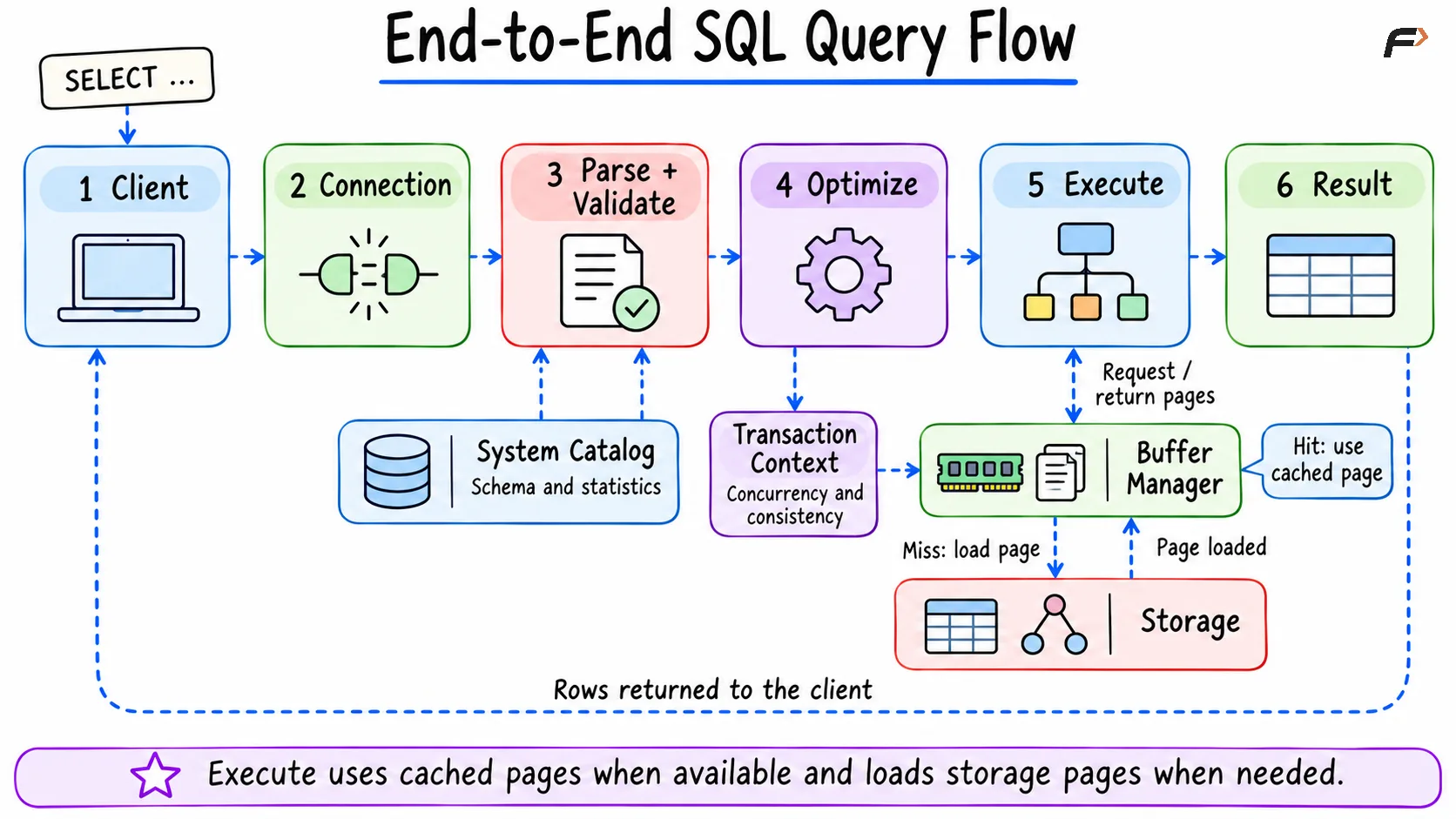
End-to-End SQL Query Flow
Step 1: The Client Sends the Query
The application or SQL tool sends the statement through an established database connection. The DBMS receives the SQL text together with session and protocol information.
Step 2: The DBMS Checks Access
The server identifies the current account and checks whether it can access the required objects. The query fails if the session lacks permission to read the students table or an associated view.
Step 3: The Parser Analyzes the SQL
The parser verifies the statement’s grammar and creates an internal syntax representation. It identifies selected columns, the source table, filter conditions, and sorting requirements. A syntax error stops processing at this stage.
Step 4: Semantic Validation Resolves Objects
The DBMS consults the system catalog.
It confirms that:
The
studentstable existsstudent_id,full_name, andprogramare valid columnsThe comparison uses compatible data types
The requested operations are permitted
A missing table or ambiguous column causes processing to stop.
Step 5: The Query May Be Rewritten
The DBMS may transform the internal query.
If students were a view, its definition might be expanded into operations on underlying tables. Other safe transformations may simplify the query before optimization.
Step 6: The Optimizer Considers Plans
The optimizer considers ways to obtain the required rows.
Possible plans include:
Scanning the whole table, filtering rows, and sorting the result
Using an index on
program, fetching matching rows, and sorting themUsing an index that supports both filtering and ordering
The available indexes, table size, and data distribution affect the estimated cost.
Step 7: The Execution Engine Runs the Plan
The execution engine activates the plan operators. A possible execution plan may perform an index or table scan, followed by a filter on program, retrieval of student_id and full_name, a sort by full_name, and finally the projection of the requested columns. The selected plan may differ between database products or between executions as data and statistics change.
Step 8: The Buffer Manager Locates Pages
The execution engine requests the pages needed by the scan. The buffer manager returns pages already present in memory and requests missing pages from the storage layer.
Step 9: The Storage Manager Reads Data
The storage manager accesses table and index pages from persistent storage when required. It returns the necessary records or page contents to the execution engine through the buffer manager.
Step 10: Rows Move Through the Plan
Rows flow through filter, sort, and projection operators. Rows that do not satisfy the program condition are removed. The remaining rows are ordered by full_name.
Step 11: The DBMS Formats the Result
The DBMS converts internal values into the database protocol’s result format. Column metadata, row values, status information, and possible warnings are prepared for transmission.
Step 12: The Client Receives the Result
The server sends the result to the client. The client driver converts protocol messages into structures that the application can use, such as result sets, arrays, objects, or table displays.
Flow of a Data-Changing Query
A write query uses many of the same stages as a read query, but it also modifies pages and creates recovery information.
Consider an update to one student record.
UPDATE studentsSET program = 'Data Science'WHERE student_id = 103;The query still passes through parsing, validation, optimization, and execution.
Additional write-related work includes locating the matching row, checking transaction visibility, coordinating concurrent access, checking constraints, creating transaction log records, updating a page in memory, updating affected indexes, marking modified pages as dirty, committing or rolling back the transaction, and returning the operation status.
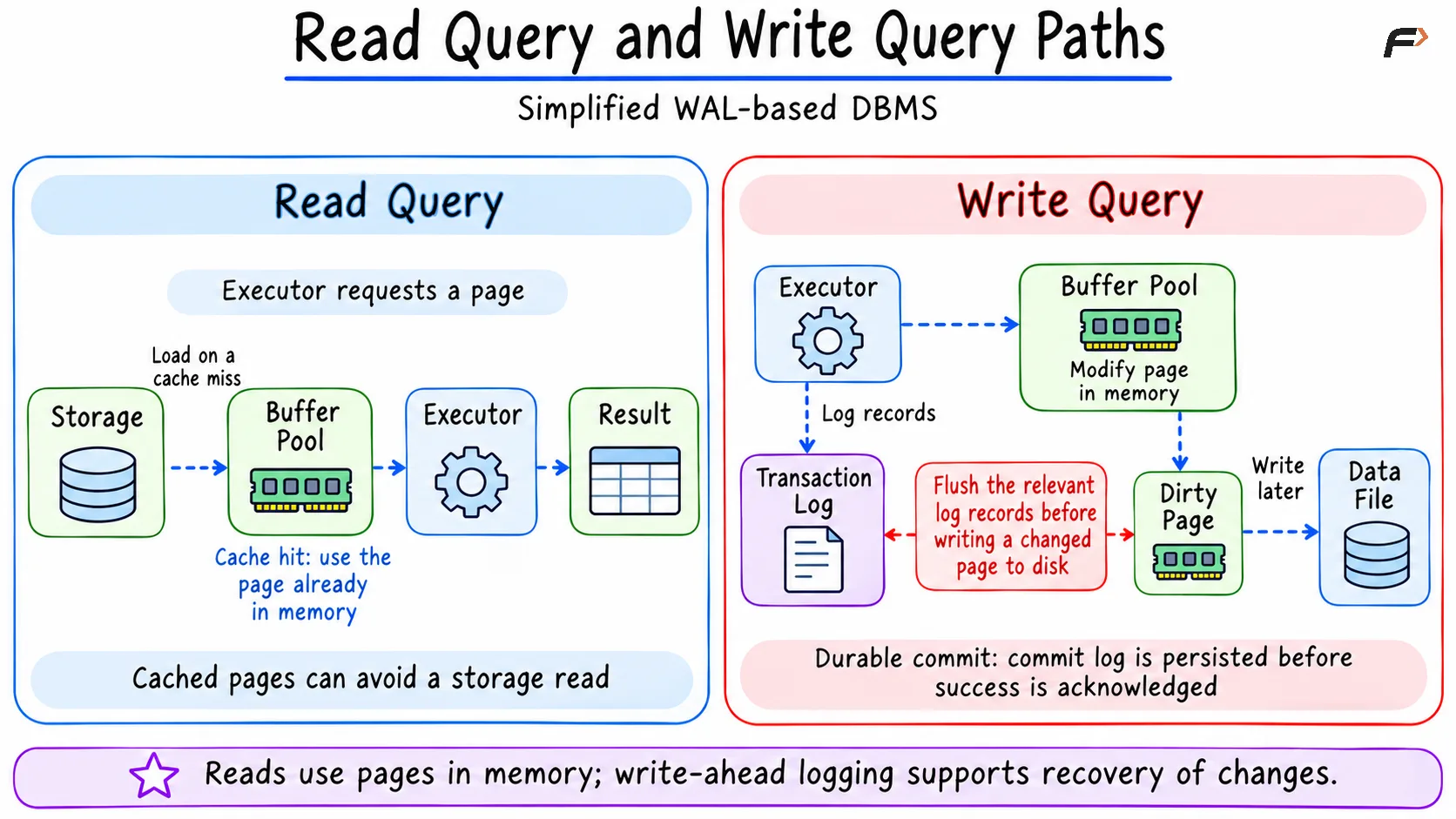
Read Query and Write Query Paths
Commit Processing
A commit confirms successful transaction completion. Before reporting a durable commit, the DBMS must satisfy its logging and durability requirements. The exact sequence depends on the storage engine and configuration. Changed data pages may be written to their main files later. Durable log records allow the recovery process to reconstruct committed changes after a failure.
Rollback Processing
A rollback cancels the transaction’s uncommitted effects. The DBMS uses transaction information, versioning, undo data, or related mechanisms to ensure that incomplete changes do not become part of the committed database state.
Viewing a Query Plan
SQL provides tools for inspecting the plan selected by the optimizer.
EXPLAINSELECT student_id, full_nameFROM studentsWHERE program = 'Computer Science'ORDER BY full_name;EXPLAIN normally displays the planned operations without returning the query’s regular result. Plan output can reveal the scan type, index usage, join order, sort operations, estimated row counts, estimated costs, and filter conditions.
MySQL and PostgreSQL use different plan formats and terminology. Their cost values are internal estimates and are not direct measurements in milliseconds.
Plans with Actual Execution Information
Both systems can execute a query and report actual runtime information.
EXPLAIN ANALYZESELECT student_id, full_nameFROM studentsWHERE program = 'Computer Science'ORDER BY full_name;EXPLAIN ANALYZE executes the statement. It should be used carefully with INSERT, UPDATE, and DELETE because the underlying operation can change data.
Common Confusions
The DBMS is not only a storage engine.
Storage is one responsibility. SQL processing, transaction control, permissions, caching, logging, and recovery are also required.The parser does not choose the execution plan.
The parser checks structure and builds an internal representation. The optimizer chooses a suitable plan.The optimizer usually chooses the lowest estimated-cost plan.
Estimates depend on statistics and a cost model, so the selected plan is not guaranteed to be the fastest possible plan in every execution.EXPLAINandEXPLAIN ANALYZEare not identical.EXPLAINshows a proposed plan.EXPLAIN ANALYZEruns the statement and adds actual execution information.
Summary
A DBMS processes SQL through cooperating components that validate statements, select execution plans, access data, and manage transactions. The optimizer uses metadata and statistics to choose a plan, while the execution engine works with buffer and storage managers to run it. Concurrency control coordinates simultaneous operations, and logging and recovery help protect committed changes. Read and write queries share much of this processing, but writes also involve modifying data and handling commit or rollback.
Be the first to add a comment.