Introduction
A database can contain millions of records spread across files, memory pages, indexes, and storage devices. Most applications do not need to understand those details. A student portal only needs student and course information. A database administrator may need storage and indexing details. A reporting application may require summarized data instead of individual records.
Data abstraction allows each user or application to interact with an appropriate representation of the same database. Schemas define those representations, instances contain the current data, and data independence limits the effect of structural or storage changes.
Data Abstraction in DBMS
Data abstraction is the process of hiding unnecessary database details while presenting the information required for a particular task. It separates a database into layers. Each layer describes the same database from a different perspective.
Perspective | Relevant information | Hidden information |
|---|---|---|
Application user | Forms, reports, and permitted records | Table storage and indexes |
Application developer | Tables, columns, relationships, and views | Disk pages and file organization |
Database administrator | Storage structures, indexes, partitions, and access paths | Hardware implementation details not needed for administration |
Consider a university database. A student portal may display a student’s name, enrolled courses, and grades. It does not need to expose employee salaries, database indexes, or the files that contain the records. Abstraction reduces complexity and helps separate application requirements from database implementation details.
The Three Levels of Data Abstraction
The three-schema architecture describes a database at three abstraction levels:
External level
Conceptual level
Internal level
Each level has a corresponding schema. Mappings between the levels allow the DBMS to translate user requests into storage operations and return the results in the required form.
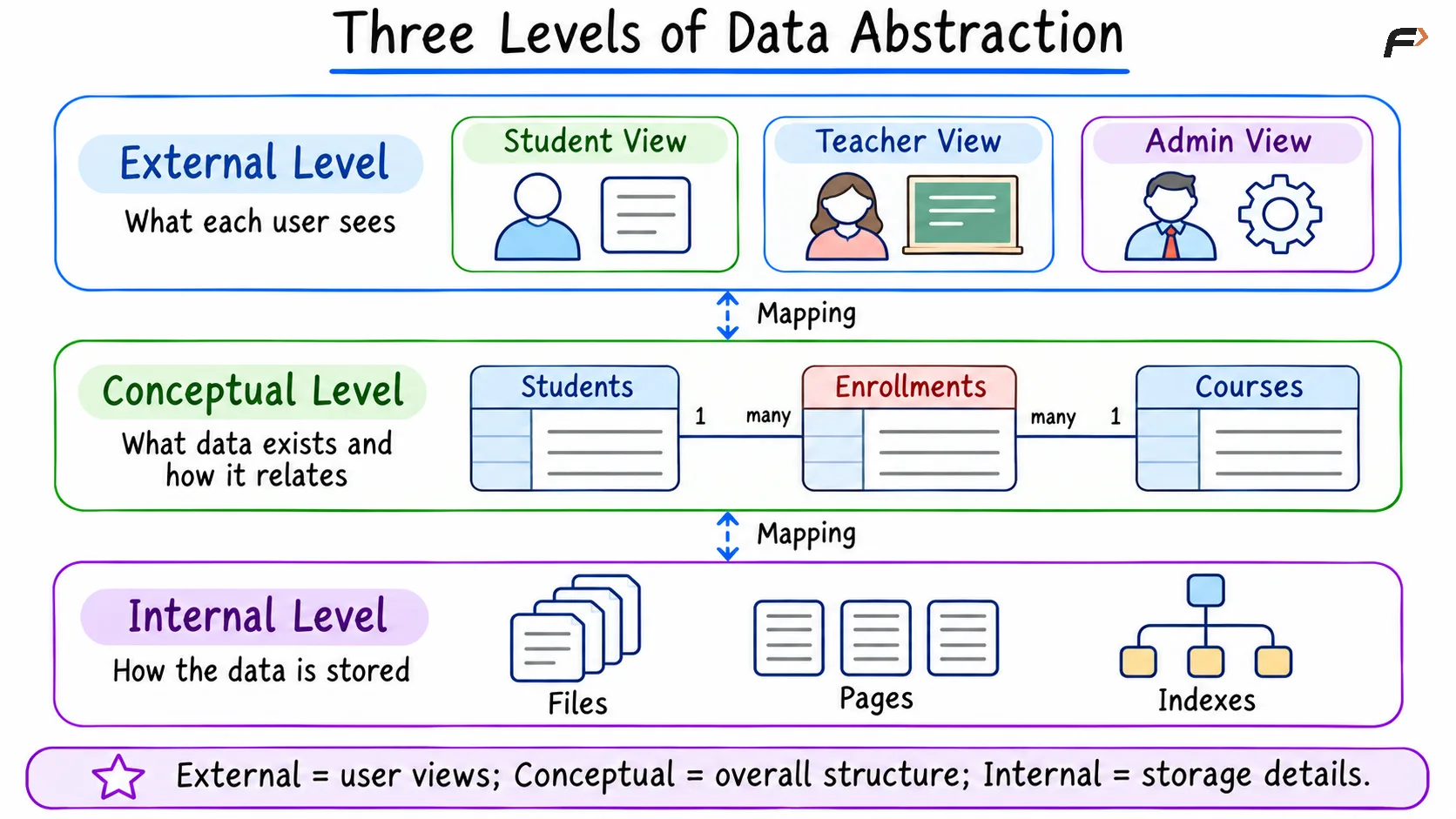
Three Levels of Data Abstraction
External Level
The external level is the highest level of abstraction. It describes how a particular user group or application sees the database. A large database may have several external views, such as a student view containing courses and grades, a teacher view containing class lists and assessments, a finance view containing fees and payments, and an administrator view containing account and enrollment information.
Each external view exposes only the relevant part of the database. Different views may show different columns, rename fields, combine data, or hide sensitive information. An external schema is also called a view schema or subschema. A database can have many external schemas because different users and applications have different data requirements.
Conceptual Level
The conceptual level describes the complete logical structure of the database by defining its entities or tables, attributes or columns, relationships, primary and foreign keys, data types, integrity constraints, and the business rules represented in the database.
For a university database, the conceptual schema may contain students, courses, instructors, and enrollments.
The conceptual schema describes what information the database contains and how that information is related. It does not describe the exact disk locations of records. A database normally has one overall conceptual schema.
Internal Level
The internal level is the lowest level of abstraction. It describes how the DBMS organizes and accesses stored data, which may include data files, pages and blocks, record formats, indexes, partitions, compression methods, access paths, and storage allocation. These details are primarily managed by the DBMS and database administrators. Applications usually interact with tables and views rather than storage pages or physical files.
The internal schema describes storage organization. It is not the stored data itself.
Mapping Between the Abstraction Levels
The DBMS maps requests and results between the three levels.
A request from a student portal may follow this path:
The portal requests data through an external view.
The DBMS maps the external view to the conceptual schema.
The conceptual request is mapped to internal storage operations.
The DBMS reads the required records.
The result moves back through the mappings.
The portal receives data in the format defined by its external view.
This mapping separates user-facing representations from storage details.
A change at one level can sometimes be absorbed by updating the relevant mapping. The higher level can then continue operating without being redesigned.
Schema in DBMS
A schema is a definition or blueprint that describes the structure of a database at a particular abstraction level. A relational database schema commonly defines table names, column names, data types, relationships, constraints, views, and index definitions. The schema describes the form of the data rather than the current values stored in the database.
For example, a students table may be defined with a student ID, name, and program.
CREATE TABLE students ( student_id INT PRIMARY KEY, full_name VARCHAR(100) NOT NULL, program VARCHAR(50) NOT NULL);This definition is part of the database schema. It establishes which columns exist and which rules the stored rows must follow.
Schema as a Namespace
The word “schema” also has a product-specific meaning.
In PostgreSQL, a schema is a named namespace inside a database. It can group tables, views, and other objects.
CREATE SCHEMA university;CREATE TABLE university.students ( student_id INTEGER PRIMARY KEY, full_name VARCHAR(100) NOT NULL);In MySQL, SCHEMA is effectively a synonym for DATABASE.
CREATE SCHEMA university;CREATE TABLE university.students ( student_id INT PRIMARY KEY, full_name VARCHAR(100) NOT NULL);This product-specific usage is related to object organization. The broader DBMS meaning of schema is the structural description of data.
Instance in DBMS
A database instance is the actual data stored in the database at a particular moment.
After the students table has been created, records can be inserted into it.
INSERT INTO students (student_id, full_name, program)VALUES (101, 'Aarav Mehta', 'Computer Science'), (102, 'Sara Khan', 'Information Systems');At this moment, the two stored rows form part of the database instance.
Adding, updating, or deleting a row changes the instance. The table definition can remain unchanged.
Schema Versus Instance
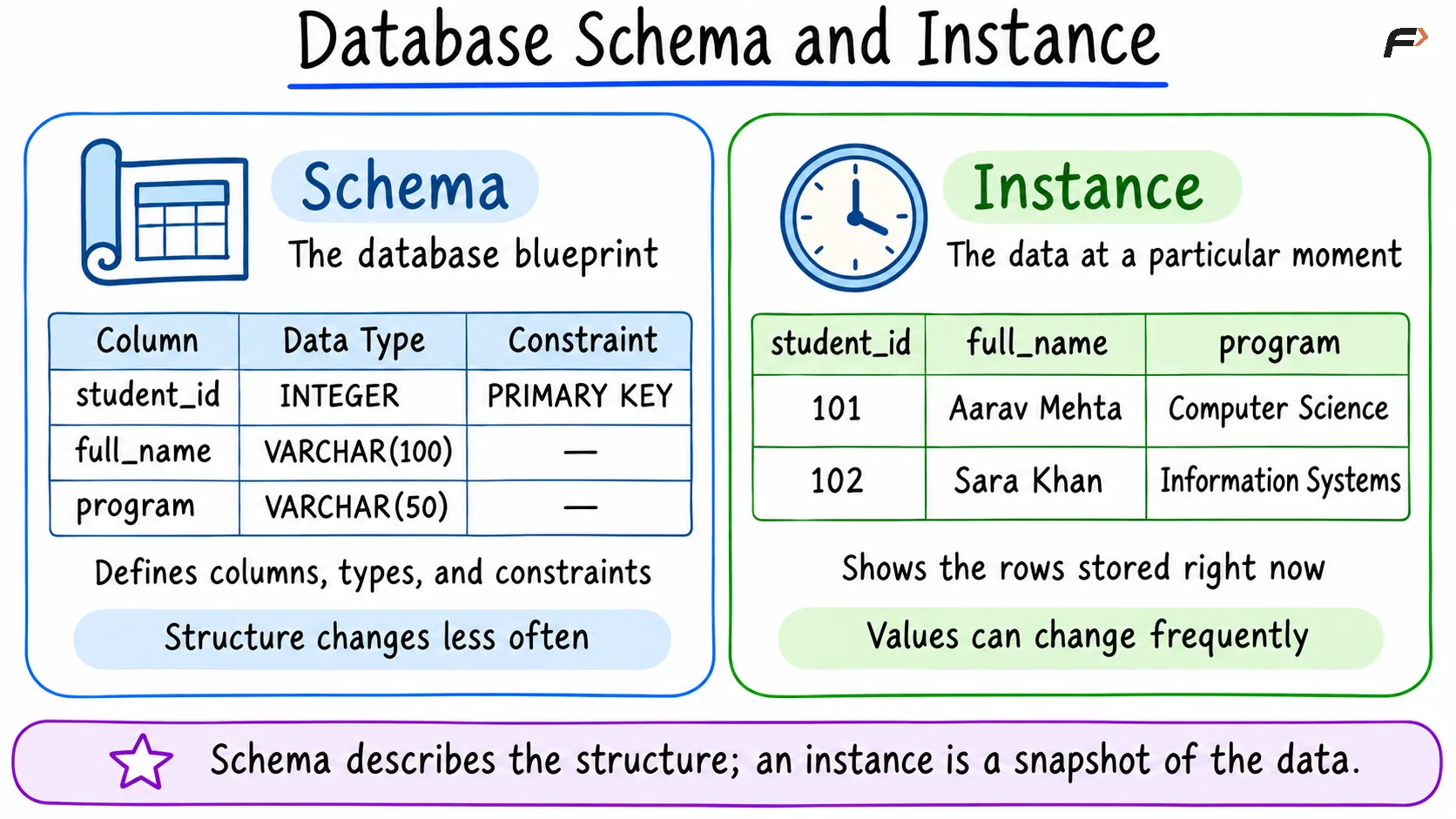
Database Schema and Instance
Schema and instance describe different aspects of a database.
Basis | Schema | Instance |
|---|---|---|
Meaning | Structure or blueprint | Current stored data |
Describes | Tables, columns, relationships, and constraints | Rows and values |
Frequency of change | Usually changes less often | Changes frequently |
Changed by | DDL statements | DML statements |
Example | Definition of the | Student records currently stored |
Also called | Intension | Extension or database state |
The schema determines which instances are valid.
For example, a NOT NULL constraint in the schema prevents an instance from containing a missing value in that column. A primary key constraint prevents two rows from having the same key.
Schema Change
Adding a column changes the schema.
ALTER TABLE studentsADD COLUMN admission_year INT;Instance Change
Adding a row changes the instance.
INSERT INTO students ( student_id, full_name, program, admission_year)VALUES ( 103, 'Neha Sharma', 'Data Science', 2026);The distinction is simple: the schema defines the permitted structure, while the instance contains the values currently following that structure.
Data Independence in DBMS
Data independence is the ability to change a schema at one abstraction level without requiring corresponding changes at the next higher level.
It limits the effect of database changes.
Without data independence, a storage change could require changes to table definitions, application queries, reports, and user interfaces. With appropriate separation and mappings, many changes remain confined to one level.
There are two main types:
Physical data independence
Logical data independence
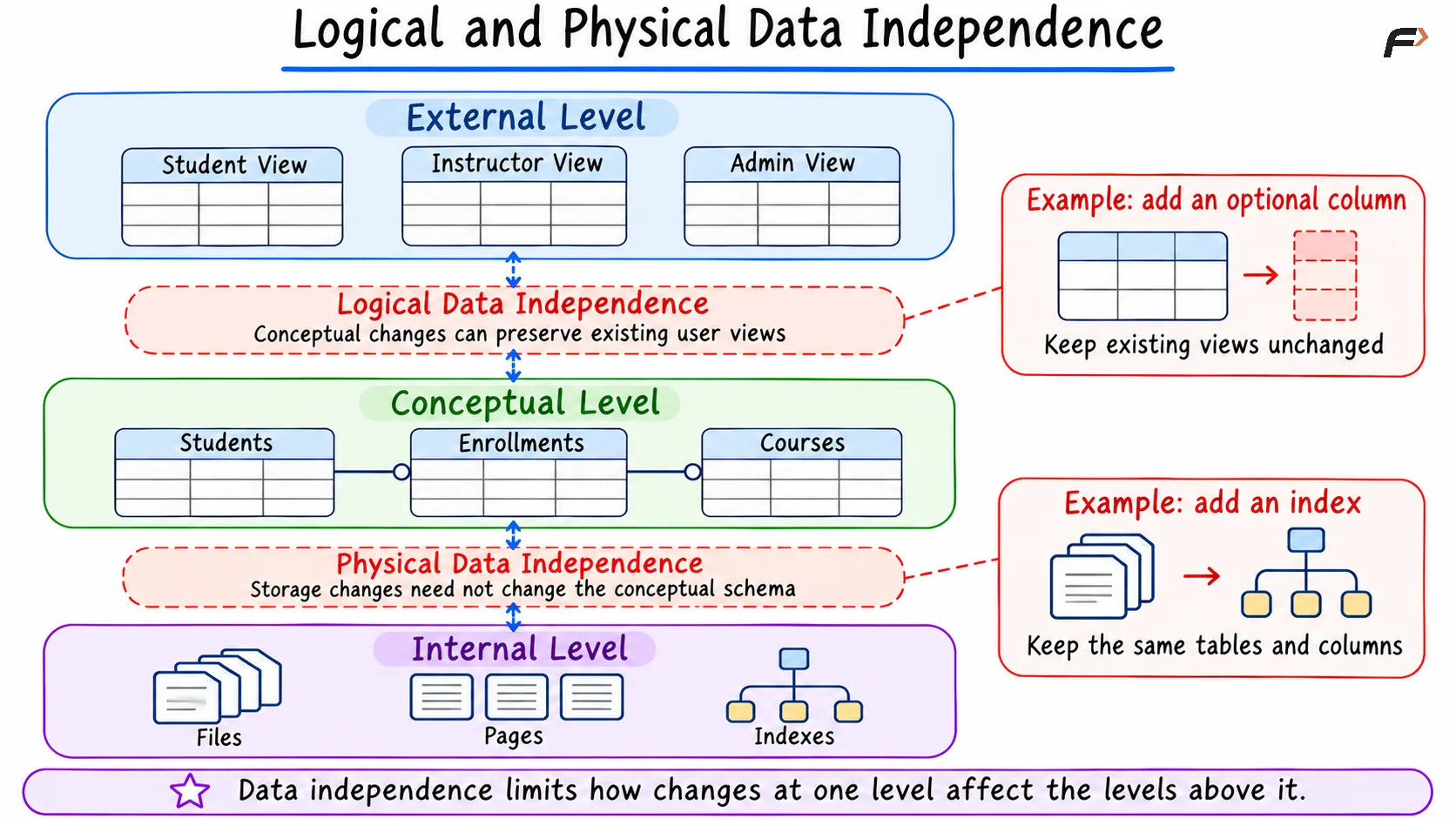
Logical and Physical Data Independence
Physical Data Independence
Physical data independence is the ability to change the internal schema without changing the conceptual schema.
The database can change how data is stored or accessed while preserving its logical structure.
Common physical changes include adding or removing an index, changing file organization, moving data to another storage device, partitioning a large table, changing compression methods, reorganizing data pages, and modifying an access path.
Suppose searches by program become slow. An index can be created without changing the columns or records visible to applications.
CREATE INDEX idx_students_programON students (program);The students table still has the same logical columns. Existing queries can continue using the table in the same way. The DBMS may choose the new index to retrieve matching records more efficiently.
Physical data independence is generally easier to achieve because storage changes usually do not alter the meaning or structure expected by applications.
Logical Data Independence
Logical data independence is the ability to change the conceptual schema without requiring changes to existing external schemas or application programs.
Possible conceptual changes include adding a new table, adding an optional column, dividing one table into related tables, combining related structures, introducing a new relationship, changing a constraint, or renaming and reorganizing logical data.
External views can sometimes preserve the interface expected by an application.
For example, an application may access a view containing only student IDs and names.
CREATE VIEW student_directory ASSELECT student_id, full_nameFROM students;A new column can later be added to the underlying table without changing the columns exposed by this view.
ALTER TABLE studentsADD COLUMN email VARCHAR(255);Queries that use student_directory can continue receiving student_id and full_name.
Logical data independence does not mean every logical change is automatically harmless. Removing a column used by an application or changing its meaning can still require application changes. Views, compatibility layers, mappings, and carefully planned migrations help preserve existing interfaces.
Logical data independence is usually harder to achieve than physical data independence because applications directly depend on logical structures and meanings.
Benefits of Data Abstraction and Data Independence
Data abstraction and data independence improve database systems in several ways.
Benefit | Effect |
|---|---|
Reduced complexity | Users and applications work with relevant data instead of storage details |
Multiple views | Different groups can receive different representations of the same database |
Better security | External views can hide unnecessary or sensitive columns |
Easier maintenance | Many storage changes remain isolated from applications |
Flexible optimization | Indexes and storage strategies can change without redesigning the logical model |
Application stability | Stable external interfaces reduce the effect of internal changes |
Clear responsibilities | Users, developers, designers, and administrators can work at appropriate levels |
These benefits depend on good schema design and stable interfaces. Abstraction hides complexity, but it does not remove the need to manage underlying changes carefully.
Common Confusions
A schema is not the same as the stored data.
A schema defines structure. An instance contains the actual values stored at a particular moment.An internal schema is not the physical data itself.
It describes how the data is organized and accessed. The records remain the actual stored data.A database does not usually have only one external view.
Different applications and user groups can have different external schemas.Logical and conceptual are often used together in introductory DBMS discussions.
The conceptual level represents the overall logical structure. Some design methods distinguish conceptual design from the DBMS-specific logical design more precisely.The word schema has more than one meaning.
It can mean a database structure in general or a named namespace in systems such as PostgreSQL.
Summary
Data abstraction separates a database into external, conceptual, and internal levels, distinguishing user views from logical structure and storage details. A schema defines the structure, while an instance contains the data stored at a particular moment. Physical data independence allows storage changes without altering the conceptual schema. Logical data independence preserves external views and applications through certain conceptual changes, but application updates may still be necessary when expected structures or meanings cannot be preserved.
Be the first to add a comment.