Introduction
The word “thread” is not enough by itself. The more important question is who manages that thread: a user-space library or the operating system kernel.
That management layer changes the behavior of the thread. It affects scheduling, blocking, switching cost, CPU core usage, debugging visibility, and the way runtime tasks relate to OS threads.
Core Difference
A user-level thread is managed by a user-space thread library or runtime. A kernel-level thread is managed directly by the OS kernel.
If the kernel knows about a thread, the OS scheduler can schedule it directly. If the kernel does not know about each runtime thread, then the runtime schedules those logical threads above one or more kernel-visible execution units.
User-Level Threads
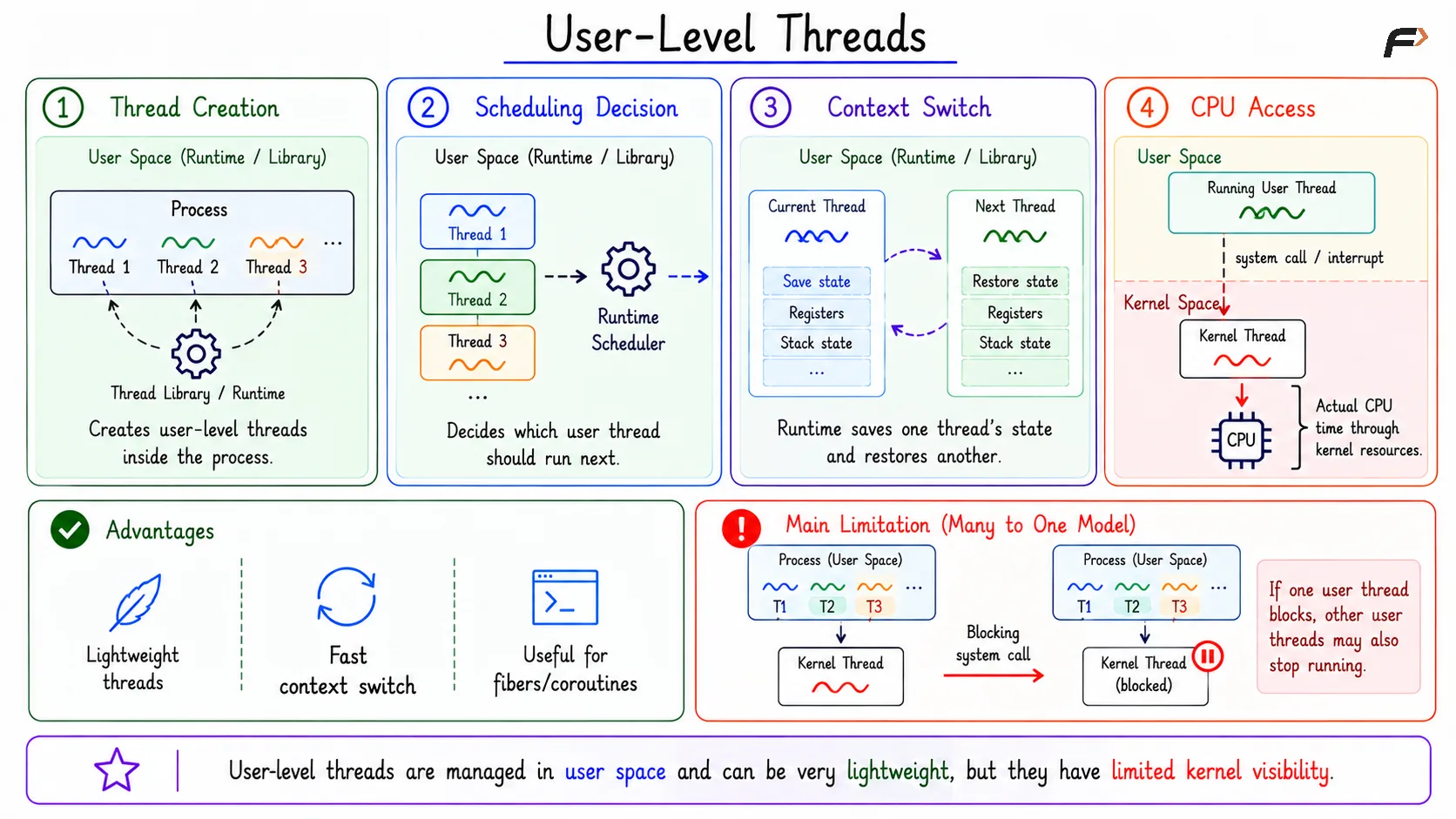
User-level threads are created, scheduled, and switched by a runtime or library in user space. User space means the normal application area, outside the privileged kernel mode of the operating system.
A simple working flow is:
Thread creation: The runtime creates user-level threads inside the process.
Scheduling decision: The runtime decides which user thread should run next.
Context switch: The runtime saves one user thread’s state and restores another.
CPU access: Actual CPU time still comes through kernel-visible execution resources.
Because many operations happen in user space, user-level threads can be lightweight. A switch between user-level threads may avoid a full kernel-level scheduling operation, so runtimes can use them for fibers, coroutines, green threads, or other lightweight tasks.
Their main limitation is kernel visibility. In a simple many-to-one model, many user-level threads are mapped onto one kernel thread. If one user thread makes a blocking system call and the underlying kernel thread blocks, the other user threads mapped above it may also stop running.
User-Level Threads
Kernel-Level Threads
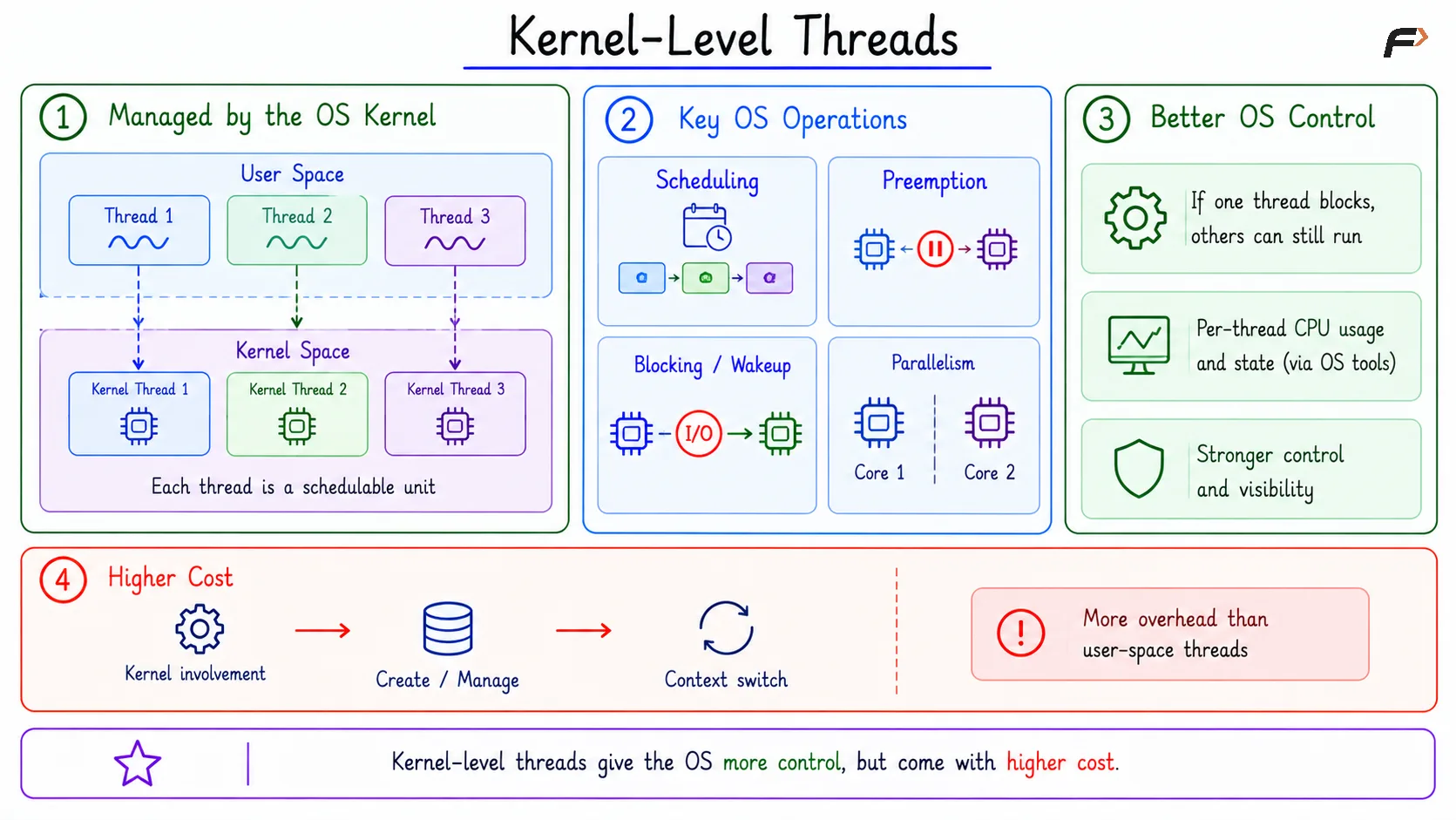
Kernel-level threads are managed by the OS kernel. The kernel knows each of them as a schedulable execution unit, so it can place them in states such as ready, running, and blocked.
The kernel can directly handle important thread operations:
Scheduling: The OS scheduler can choose which kernel-level thread gets CPU time.
Preemption: The kernel can stop one thread and run another.
Blocking and wakeup: A blocked thread can wait for I/O while another thread continues.
Parallelism: Different kernel-level threads can run on different CPU cores.
The strength of kernel-level threads is better OS control. If one kernel-level thread blocks, other kernel-level threads in the same process can still be scheduled. OS tools can also often show per-thread CPU usage and thread state.
The tradeoff is cost. Creating, managing, and switching kernel-level threads usually requires more kernel involvement than purely user-space thread switching.
Kernel-Level Threads
User-Level vs Kernel-Level Threads
Aspect | User-Level Thread | Kernel-Level Thread |
|---|---|---|
Managed by | User-space runtime or thread library | OS kernel |
Kernel visibility | Limited; kernel may not see each user thread | High; kernel sees each thread |
Scheduler | Runtime scheduler | OS scheduler |
Switching cost | Usually lower | Usually higher |
Blocking behavior | Weak in simple many-to-one models | Stronger because other kernel threads can run |
Multicore parallelism | Depends on runtime mapping | Supported directly by OS scheduling |
Control | More runtime control | More OS control |
Debugging visibility | May need runtime-specific tools | OS tools can often inspect threads |
The key difference is not only speed. User-level threads are cheaper and flexible, but kernel-level threads give the OS stronger control over blocking, scheduling, and multicore execution.
Runtime Tasks and OS Threads
Modern systems often combine both ideas. A language runtime may create many logical tasks, fibers, or coroutines and map them onto a smaller number of OS-visible threads.
This layered view is important:
OS thread: Scheduled by the kernel and visible to operating system tools.
Runtime task: Scheduled by the runtime and may not be directly visible to the kernel.
Mapping: One runtime may use one-to-one mapping, while another may schedule many tasks over fewer OS threads.
For example, POSIX threads on modern Linux are kernel-visible threads. At the same time, many modern runtimes also provide lightweight tasks above OS threads for cheaper concurrency.
Summary
User-level threads are managed by a runtime or user-space library. They can be lightweight and fast to switch, but the kernel may not see each individual user thread.
Kernel-level threads are managed by the OS kernel. They usually cost more to manage, but they provide stronger scheduling, better blocking behavior, OS-level visibility, and direct support for multicore parallelism.
Be the first to add a comment.