Introduction
The kernel is the privileged core of an operating system, but its internal structure also matters. Kernel structure decides where trusted operating system services should run.
Some services may run inside kernel space, while others may run outside the kernel in user space. This design affects performance, isolation, reliability, and system complexity.
Why Kernel Structure Matters
Operating system services include CPU scheduling, memory management, file systems, device drivers, networking, interrupts, IPC, and security. Kernel structure decides how these services are arranged.
If services run inside the kernel, they can use direct calls and shared kernel mechanisms. This is usually faster, but a bug in privileged code can affect the whole system. If services run outside the kernel, failures are easier to isolate, but communication through IPC and message passing can add overhead.
Monolithic Kernel
In a monolithic kernel, many operating system services run inside kernel space. The scheduler, memory manager, file systems, drivers, networking, interrupt handling, and security logic may all be part of the kernel.
This structure gives strong performance because kernel components can communicate through direct function calls. It also reduces frequent user-kernel transitions during common operations. Linux is generally considered a monolithic kernel with loadable kernel modules.
Advantages | Disadvantages |
|---|---|
Fast service calls | Large trusted code base |
Fewer context switches | Lower isolation between components |
Efficient kernel-level communication | A faulty driver can crash the system |
High performance for common OS work | Fault recovery can be difficult |
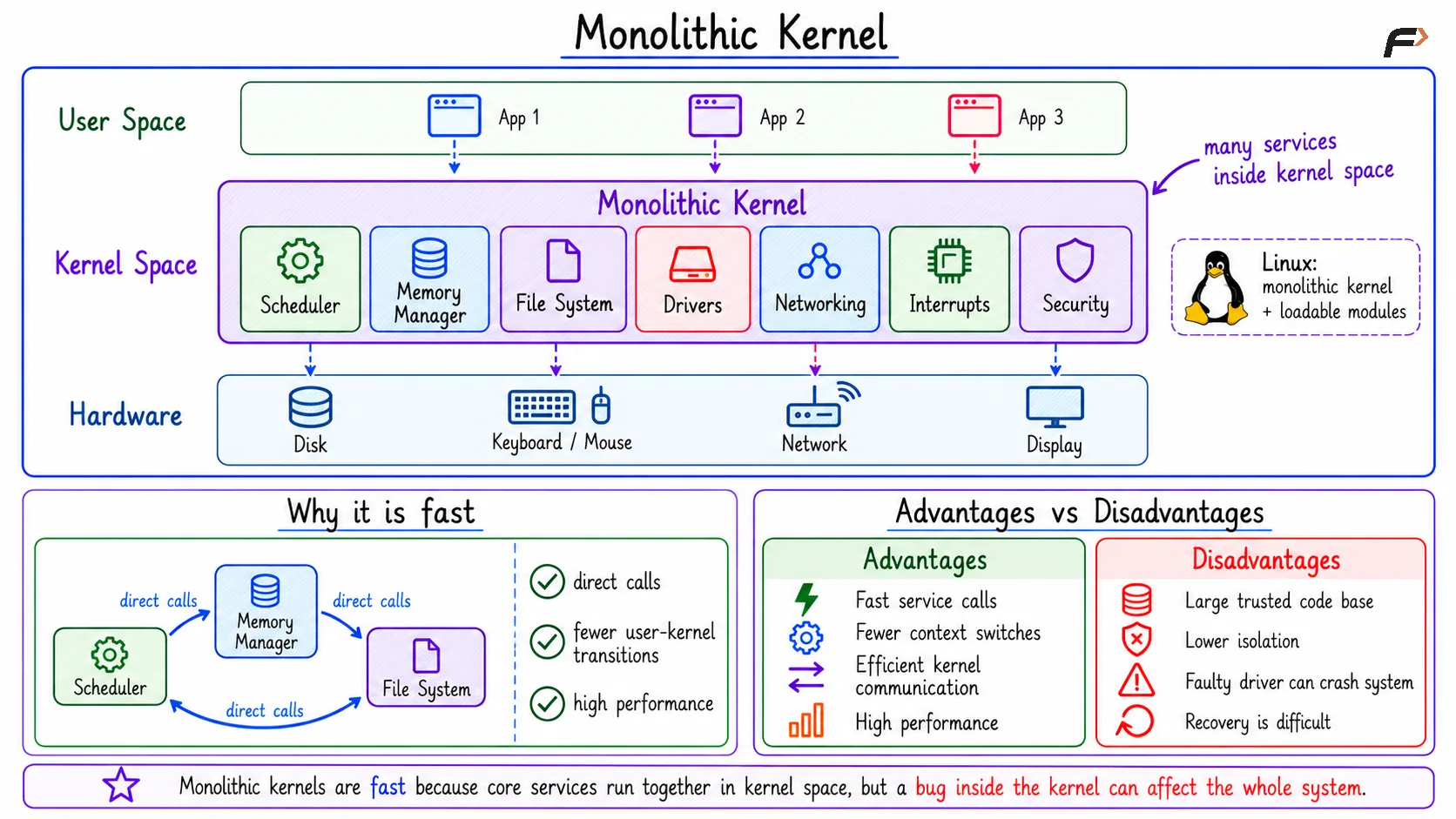
Monolithic Kernel
Microkernel
A microkernel keeps only the most essential services inside kernel space. The kernel usually handles low-level scheduling, address-space management, and inter-process communication.
Other services, such as file systems and device drivers, can run in user space as separate servers. These services communicate using IPC, often through message passing.
Advantages | Disadvantages |
|---|---|
Smaller kernel | More message passing and context switching |
Less privileged code and Strong modularity | Implementation can be complex |
Better isolation | IPC overhead can reduce performance |
Better fault containment | More coordination is needed |
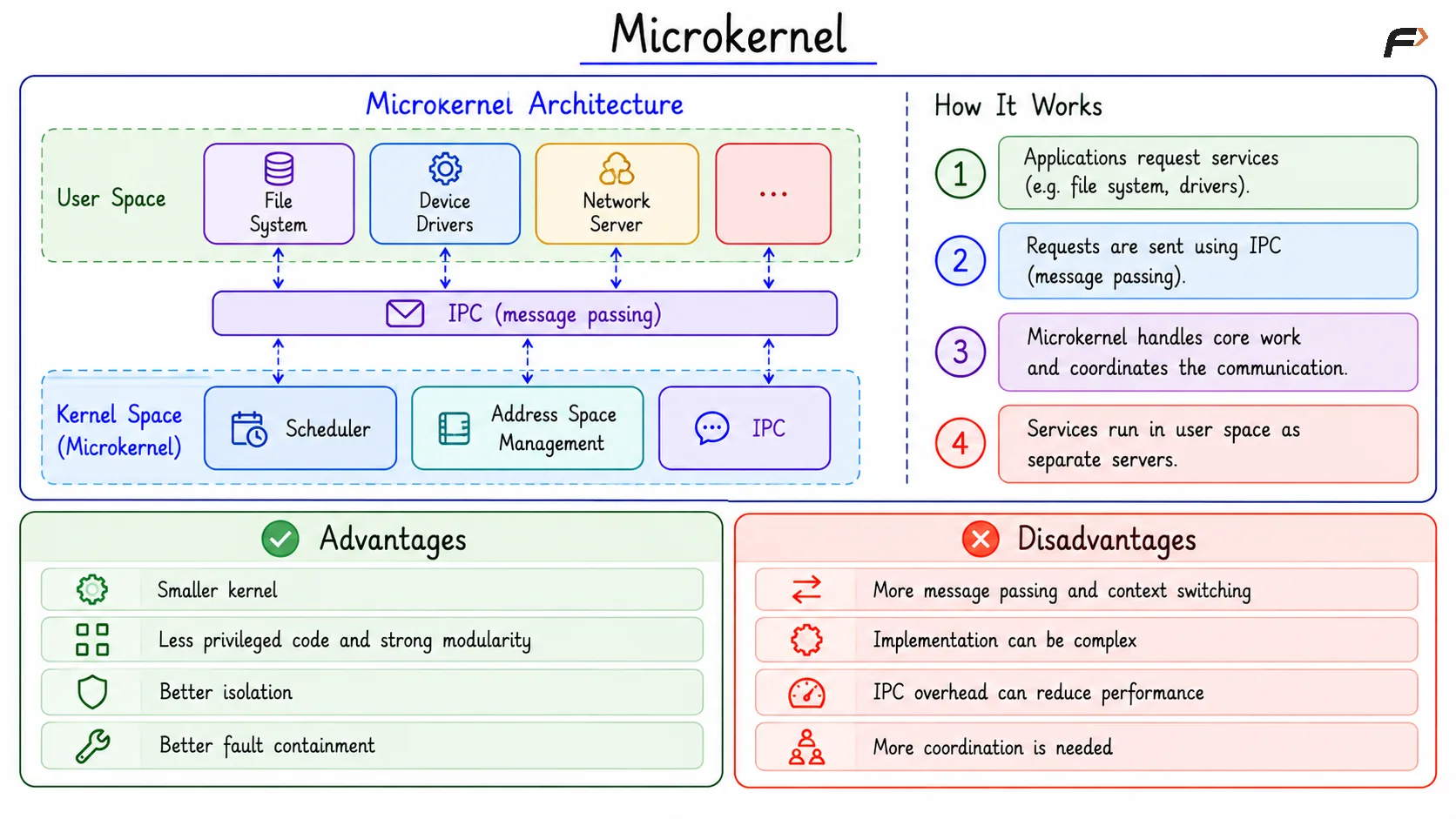
Microkernel
Hybrid Kernel
A hybrid kernel combines monolithic and microkernel ideas. Some services may be organized in a modular or microkernel-like way, while performance-critical services still run in kernel space.
The goal is balance. Designers may keep frequently used or performance-sensitive services inside the kernel, while separating other parts for flexibility and maintainability.
Examples commonly discussed under hybrid kernel design include Windows NT and XNU, the kernel used by macOS.
Loadable Kernel Modules
Loadable kernel modules are pieces of kernel code loaded only when needed. They help keep the base kernel more flexible because every driver or feature does not need to be loaded at boot time.
Common examples include:
Device driver modules: Add support for specific hardware.
File-system modules: Add support for different file systems.
Network modules: Add protocols or networking features.
Modules can also be unloaded later if they are no longer needed. However, they still run with kernel privilege, so a buggy module can still crash or weaken the system.
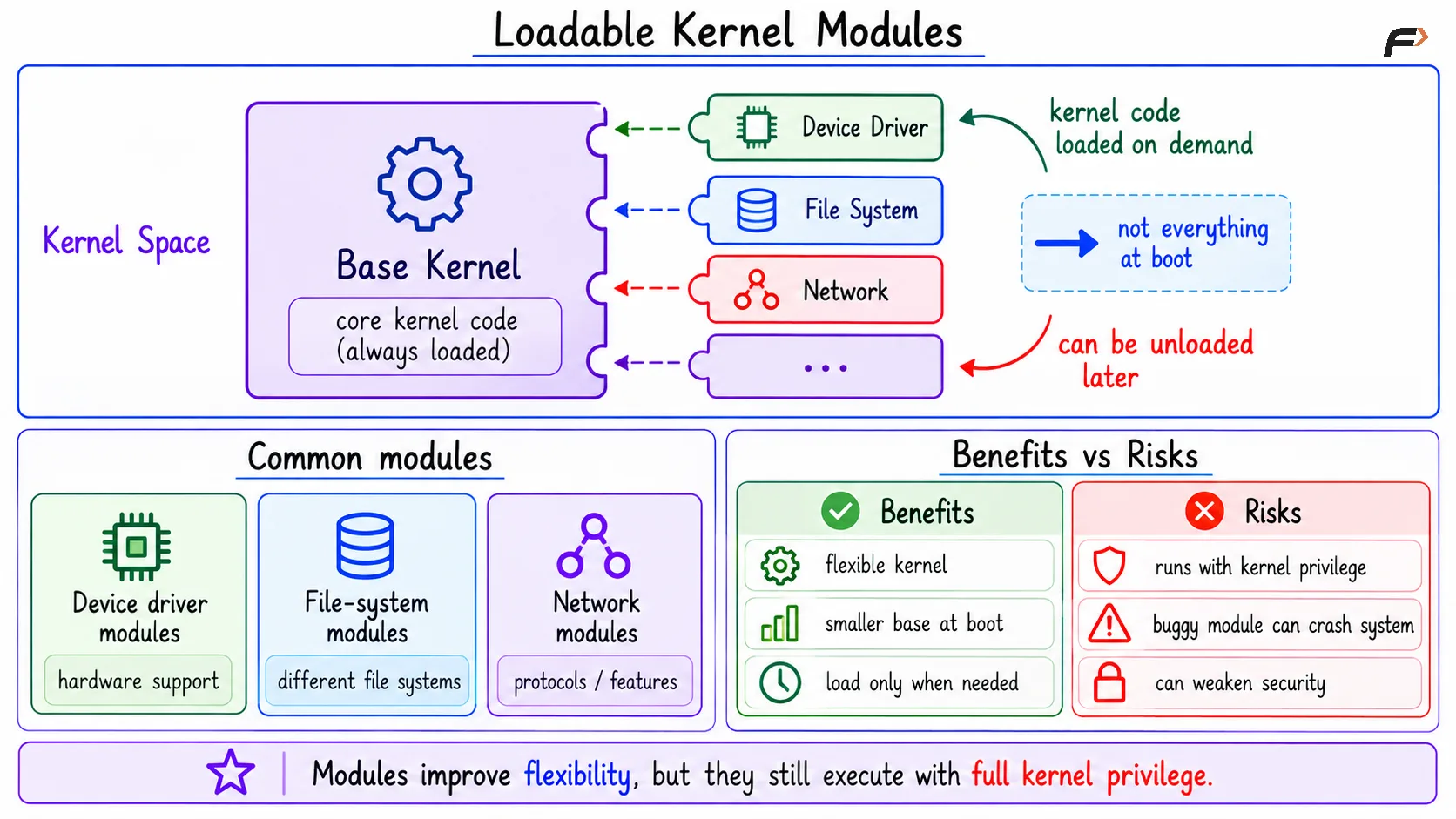
Loadable Kernel Modules
Kernel Structure Comparison
Structure | Main Idea | Strength | Main Risk |
|---|---|---|---|
Monolithic kernel | Many OS services run inside kernel space | High performance | Low isolation |
Microkernel | Minimal kernel, services outside kernel | Strong isolation | IPC and context-switching overhead |
Hybrid kernel | Mixes both approaches | Balance of performance and modularity | Design complexity |
Loadable modules | Kernel code loaded when needed | Flexibility | Modules still run with privilege |
Summary
Kernel structure is an architectural decision about where operating system services should run. Keeping services inside the kernel improves direct access and performance, while moving services outside improves isolation and fault containment.
Monolithic kernels favor speed, microkernels favor modularity and isolation, and hybrid kernels try to balance both. Loadable kernel modules add flexibility, but they still run in kernel space and must be handled carefully.
Be the first to add a comment.