Introduction
Processes and threads are both related to program execution, but they do different jobs. A process is mainly about resource ownership and isolation, while a thread is mainly about execution.
The safest way to remember the difference is simple: a process is the resource container, and a thread is the execution path inside that container.
Core Difference Between Process and Thread
A process answers the question: what resources belong to this running program? A thread answers the question: which path of code is running inside that program?
Concept | Main Role |
|---|---|
Process | Owns resources and provides isolation |
Thread | Executes code inside a process |
Memory and Isolation
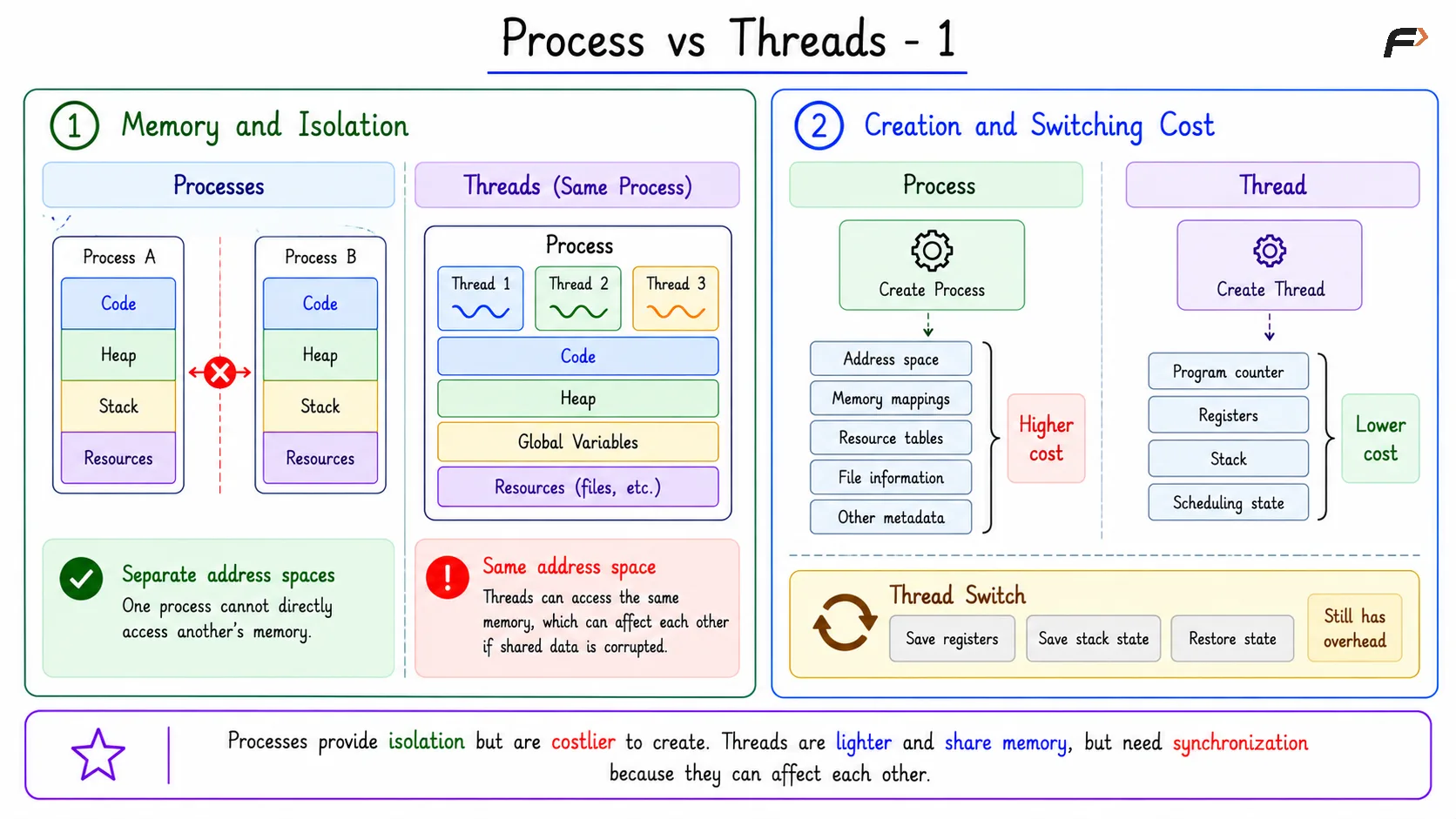
Processes usually have separate virtual address spaces. This means one process normally cannot directly access another process’s memory.
This isolation improves safety. If Process A has a memory bug, Process B is usually protected because it has its own address space and resource boundary.
Threads are different. Threads inside the same process share one address space, so they can access the same code, heap, global variables, open files, and process resources.
Thread sharing makes communication faster and easier, but it also creates risk. If one thread corrupts shared data, other threads in the same process can be affected.
Process vs Threads
Creation and Switching Cost
Creating a process usually costs more because the operating system must create a process context. This includes address space, memory mappings, resource tables, file information, and other metadata.
Creating a thread is usually lighter because the thread reuses the existing process resources. It mainly needs its own execution state, such as a program counter, registers, stack, and scheduling state.
A thread switch still has overhead. The system may still save and restore registers, stack state, and other execution details. Threads reduce overhead by sharing resources; they do not remove overhead completely.
Communication and Correctness
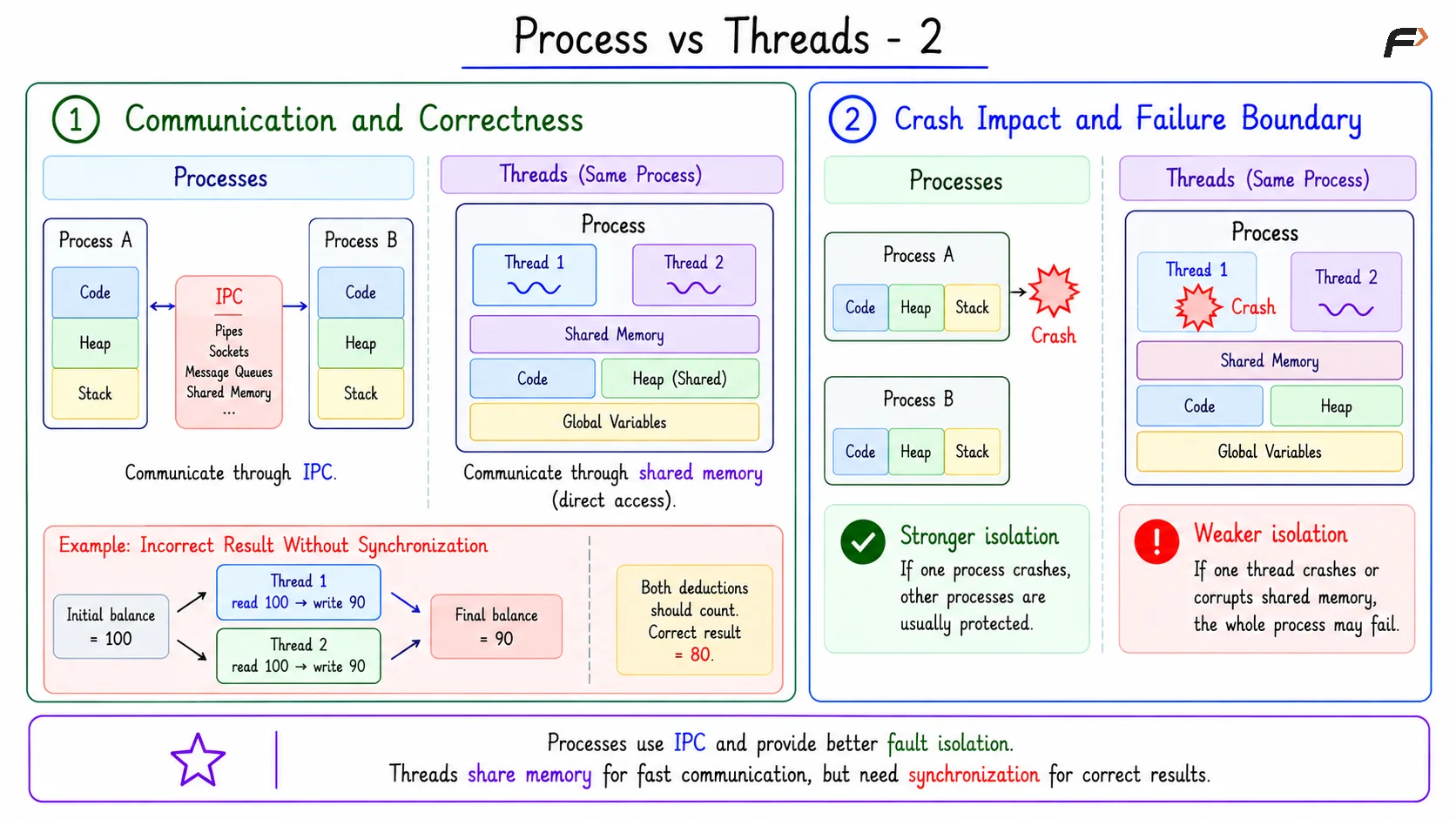
Processes normally communicate through IPC, or Inter-Process Communication. Common IPC methods include pipes, sockets, message queues, and shared memory.
Threads inside the same process usually communicate through shared memory. They can directly access the same objects, heap data, and global variables.
This convenience does not automatically mean correctness. If two threads update shared data at the wrong time, the result can become incorrect.
For example, if a shared balance is 100, and two threads both read 100 before writing back 90, the final value may become 90. If both deductions should count, the correct final value should be 80.
Process vs Threads
Crash Impact and Failure Boundary
Processes usually provide a stronger failure boundary. If one process crashes, other processes are normally protected by memory isolation.
Threads have a weaker failure boundary because they live inside the same process. If one thread corrupts shared memory or causes a fatal process-level error, the whole process may fail.
This is why systems often use processes when fault isolation matters, and threads when efficient cooperation matters.
How Real Systems Use Both
Real systems often combine processes and threads instead of choosing only one forever.
A browser may use separate processes for isolation between tabs, sites, or sensitive components. Inside each process, threads may handle UI work, networking, rendering, and background tasks.
A backend server may use worker processes for stronger isolation and worker threads inside those processes for efficient request handling. The design depends on the balance between safety, performance, sharing, and fault tolerance.
Summary
A process is a running program that owns resources and provides isolation. A thread is an execution path inside that process, with its own stack and execution state but shared process memory and resources.
Processes are better when protection, fault boundaries, and security matter. Threads are better when shared execution, responsiveness, and lower overhead matter. The strongest comparison is not simply “process is heavy and thread is light”; it is that processes isolate, while threads share.
Be the first to add a comment.