Introduction
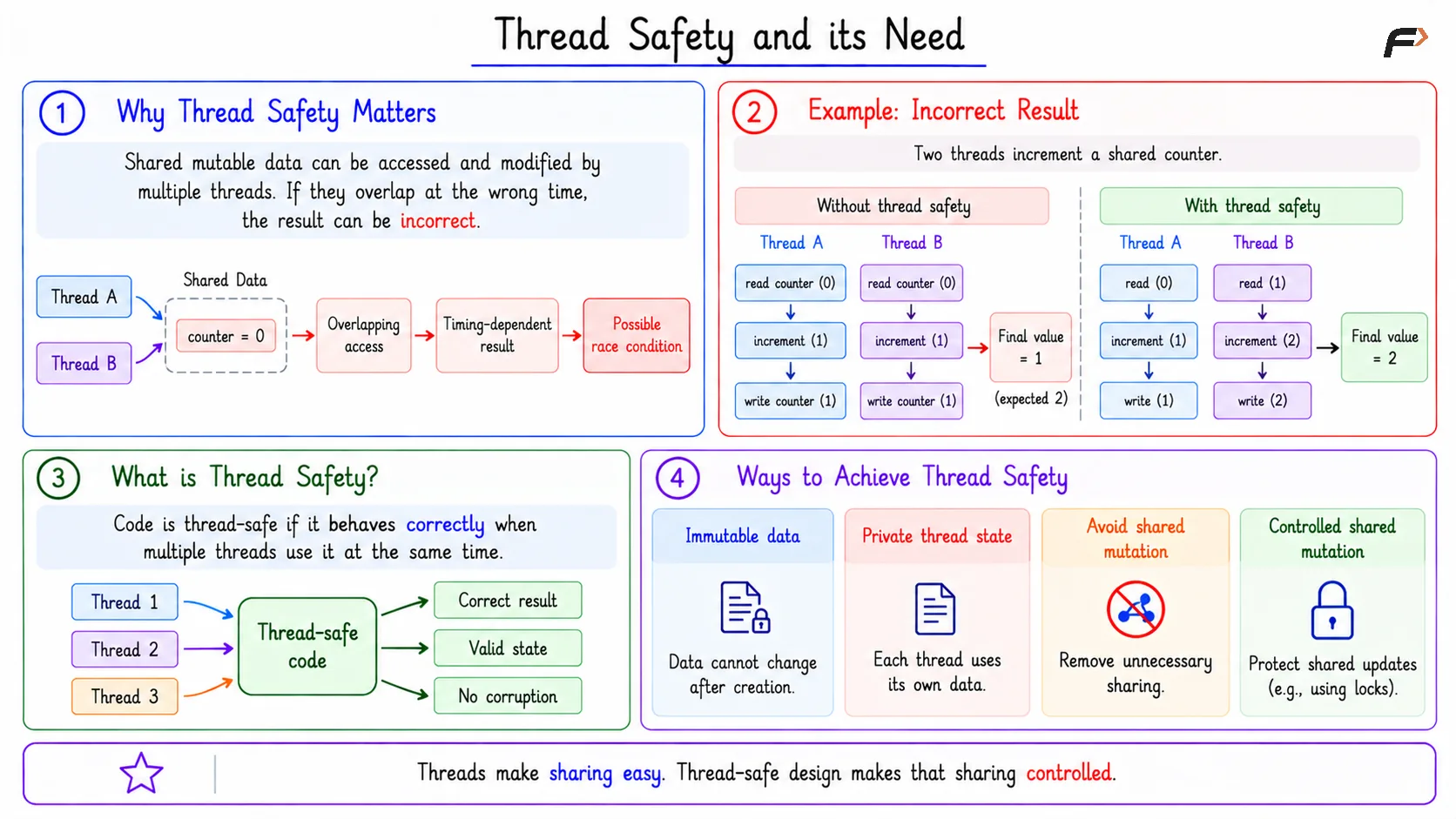
Threads are useful because they can share memory inside the same process. That sharing makes communication fast, but it also creates correctness risks when multiple threads access the same mutable data.
Thread safety, reentrancy, and race conditions are three related ideas used to reason about this risk. They are connected, but they do not mean the same thing.
Why Thread Safety Matters
The main problem is shared mutable data. This means data that more than one thread can access, and at least one thread can modify.
If two threads touch shared mutable data at the wrong time, the program may still compile and run, but the result may become incorrect. The bug may appear only under certain timings, machine loads, or scheduler decisions.
Thread Safety
Code is thread-safe if it behaves correctly when multiple threads call or use it at the same time. The word “correctly” is important because thread-safe code must preserve valid state, not merely avoid crashing.
Common ways to support thread safety include:
Immutable data: Data that cannot change after creation cannot be corrupted by competing writes.
Private thread state: Each thread uses its own data, so there is no shared update.
Avoided shared mutation: The design removes unnecessary sharing before synchronization is needed.
Controlled shared mutation: Shared updates are protected using a disciplined method.
Thread safety does not mean the code is always faster. It also does not mean the function creates threads internally. A normal function can be thread-safe if concurrent calls cannot corrupt its state.
Thread Safety and its Need
Reentrancy
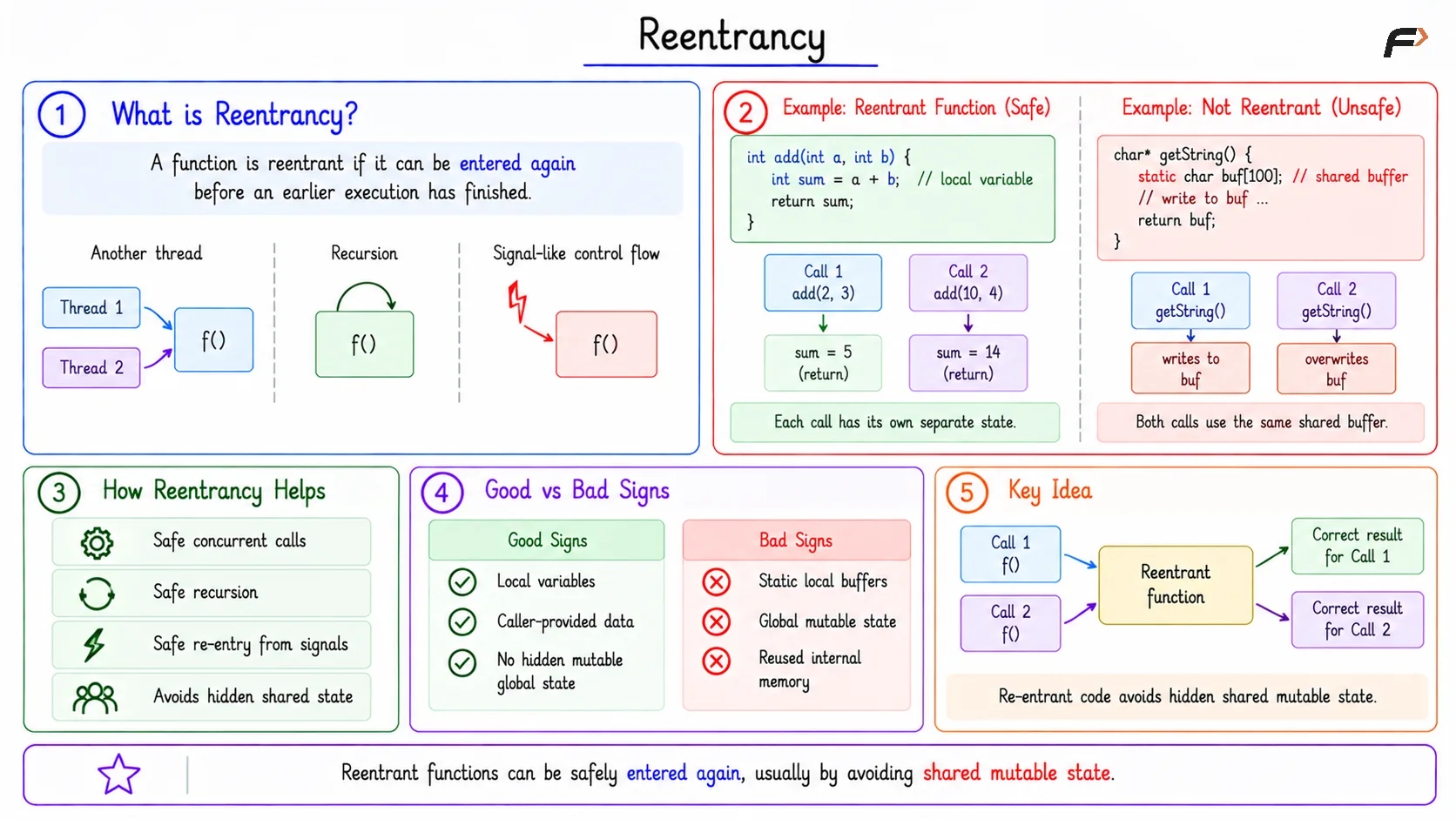
A function is reentrant if it can be safely entered again before an earlier execution of the same function has finished. This can happen through another thread, recursion, or signal-like control flow.
Reentrant code usually avoids hidden shared mutable state. It commonly works with local variables, caller-provided storage, or data that belongs only to the current call.
Good signs of reentrant code include:
Local variables: Each call gets its own separate state.
Caller-provided data: The function does not depend on one shared internal buffer.
No hidden mutable global state: Re-entry cannot overwrite data used by an earlier call.
Bad signs include shared static buffers, global mutable storage, and reused internal memory returned to the caller.
Reentrancy
Thread-Safe vs Reentrant
Thread-safe and reentrant code can overlap, but they protect against different situations.
Aspect | Thread-Safe | Reentrant |
|---|---|---|
Main condition | Safe when multiple threads use the code together | Safe when the same function is entered again before an earlier call finishes |
Main concern | Concurrent access by threads | Overlapping entry into the same function |
State strategy | Shared mutable state must be controlled | Hidden shared mutable state is usually avoided |
Synchronization | May use locks or other protection | Must be careful because re-entry can interact badly with internal state |
Common trap | Assuming thread-safe means fast | Assuming normal thread safety always means reentrant |
A function can be thread-safe without being cleanly reentrant if it relies on internal state or locking behavior that does not handle re-entry well.
Race Condition
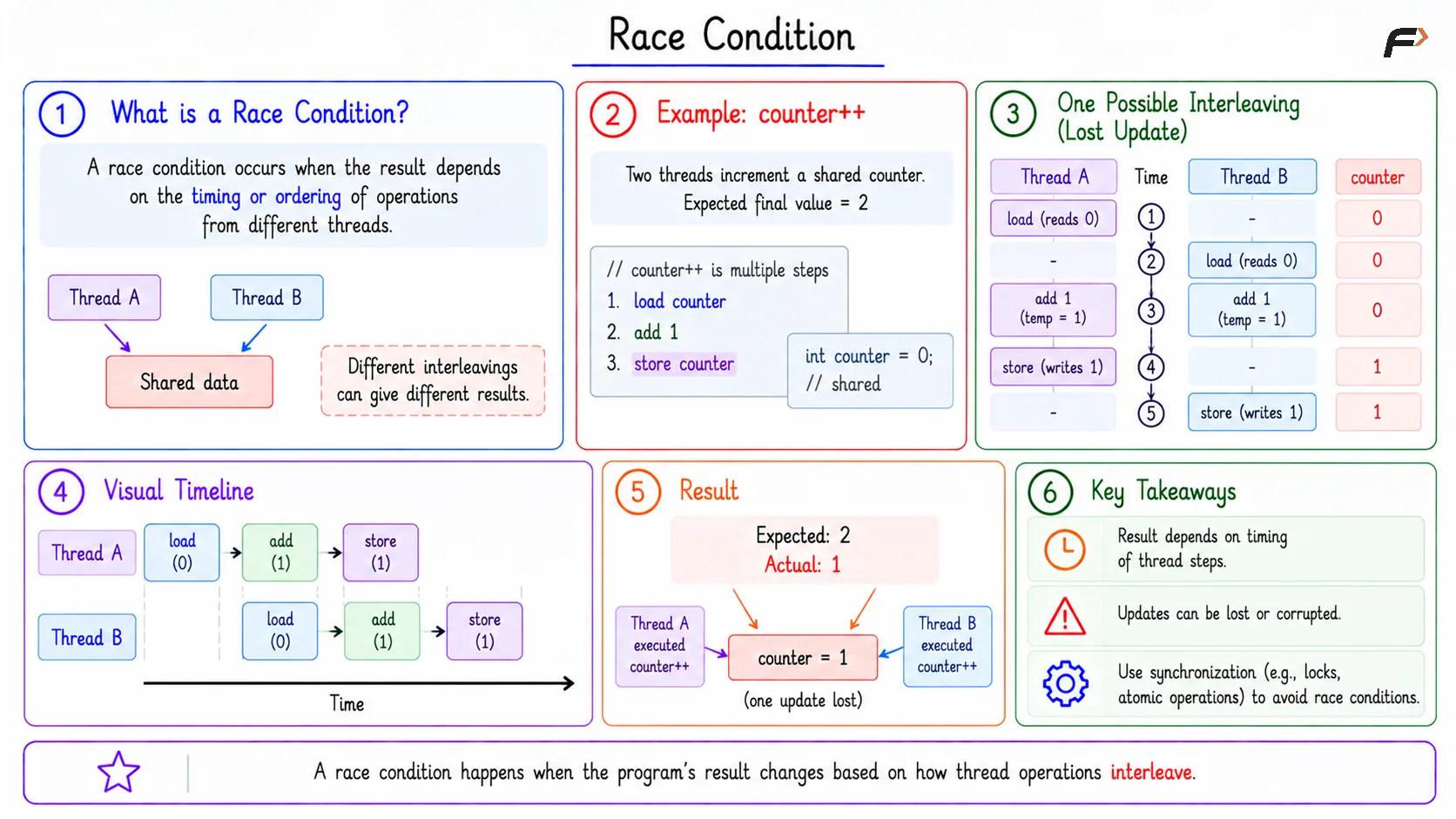
A race condition occurs when the correctness of a program depends on the timing or ordering of operations from different threads. The program’s result changes depending on how thread steps interleave.
Consider a shared variable counter that starts at 0. If Thread A and Thread B both run counter++, the expected final value is 2.
The problem is that counter++ may behave like multiple smaller steps:
load counter
add 1
store counter
If both threads load the old value before either stores the new value, one update can be lost.
Step | Thread A | Thread B | Counter |
|---|---|---|---|
1 | Reads 0 | - | 0 |
2 | Pauses | Reads 0 | 0 |
3 | Adds 1 | Adds 1 | 0 |
4 | Stores 1 | - | 1 |
5 | - | Stores 1 | 1 |
Both threads executed the increment, but the final value became 1 instead of 2. The result depended on timing, so this is a race condition.
Race Condition
Why Race Conditions Are Tricky
Race conditions are hard to find because they may not fail every time. A program can pass tests many times and still fail later under a different schedule.
They are also sensitive to observation. Adding print statements, logging, or debugging steps can change timing enough to hide the bug temporarily.
The key warning is simple: correctness should not depend on lucky scheduling. If a program works only when thread operations happen in a certain order, the design is fragile.
Thinking Before Fixing
Before choosing a synchronization tool, first identify the shared behavior that must be made correct.
Useful questions include:
Is the data shared? If not, there may be no thread-safety issue.
Is the data mutable? Immutable data removes many race risks.
Can two threads touch it together? Overlap creates the danger.
Must multiple steps behave like one operation? Then the operation needs protection or redesign.
Locks, semaphores, monitors, critical sections, and atomic operations are important tools, but they should support a clear design. Less sharing is often easier to reason about than heavily protected sharing.
Summary
Thread safety means code remains correct when multiple threads use it at the same time. Reentrancy means a function can be safely entered again before an earlier execution finishes.
A race condition happens when shared-data correctness depends on timing. The clean rule to remember is: threads make sharing easy, but disciplined design and synchronization make shared behavior safe.
Be the first to add a comment.