Introduction
A thread pool is a managed group of reusable worker threads. Instead of creating a new thread for every task, the system keeps workers ready and gives them tasks from a queue.
The main idea is simple: tasks finish, but workers stay alive. This reduces repeated thread creation cost and keeps concurrency under control when many requests arrive together.
Why Thread Pools Exist
Creating a thread is cheaper than creating a process, but it still has cost. Each thread needs stack memory, metadata, and scheduler tracking, so creating unlimited threads can hurt the system under load.
A one-thread-per-request design may work for small traffic. But when requests increase suddenly, it can cause high memory use, excessive context switching, contention, and unstable latency. A thread pool avoids this by reusing a limited number of workers.
What Is a Thread Pool?
A thread pool contains worker threads, a task queue, and limits that control how much work can run or wait.
Task: A unit of work, such as handling one request or running one background job.
Task queue: The waiting area where submitted work stays until a worker is free.
Worker threads: Reusable threads that pick tasks, execute them, and return to the pool.
Pool limits: Rules that decide how many workers can run and how much work may wait.
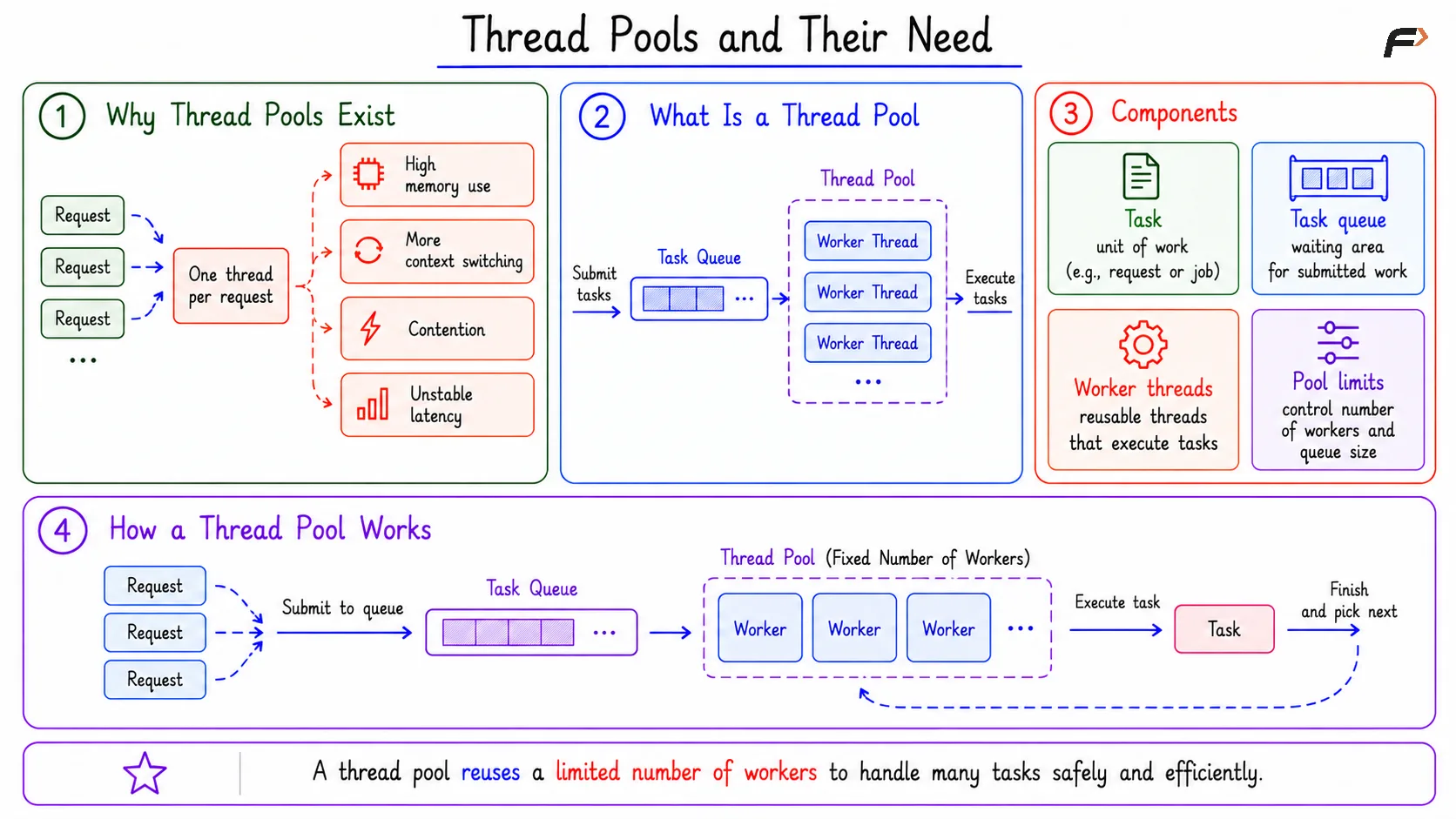
Thread Pools and its Need
How a Thread Pool Works
The basic flow is:
Workers are created: The application starts a fixed or managed number of worker threads.
Workers wait: Idle workers stay ready for incoming tasks.
Tasks enter the queue: New work is submitted and stored until a worker is available.
A worker picks a task: An idle worker removes one task from the queue.
The task runs: The worker executes the task like a normal thread.
The worker returns: After finishing, the worker becomes available for another task.
The important point is reuse. The task ends, but the worker thread does not die after every task.
How Thread Pools Help Servers
Thread pools are useful in server-style systems because they turn uncontrolled concurrency into managed concurrency.
Suppose 500 requests arrive suddenly. Without a thread pool, the server might try to create 500 threads. With a pool of 32 workers, only 32 tasks run at once, while the remaining tasks wait, time out, or get rejected depending on the policy.
This gives several benefits:
Controlled worker count: Prevents sudden thread explosions.
Predictable memory use: Limits stack and thread-related memory.
Lower creation overhead: Reuses existing workers instead of repeatedly creating threads.
Reduced scheduler pressure: Avoids too many runnable threads competing at once.
Burst handling: Allows short traffic bursts to wait in a queue.
Explicit overload behavior: Lets the system define waiting, timeout, or rejection rules.
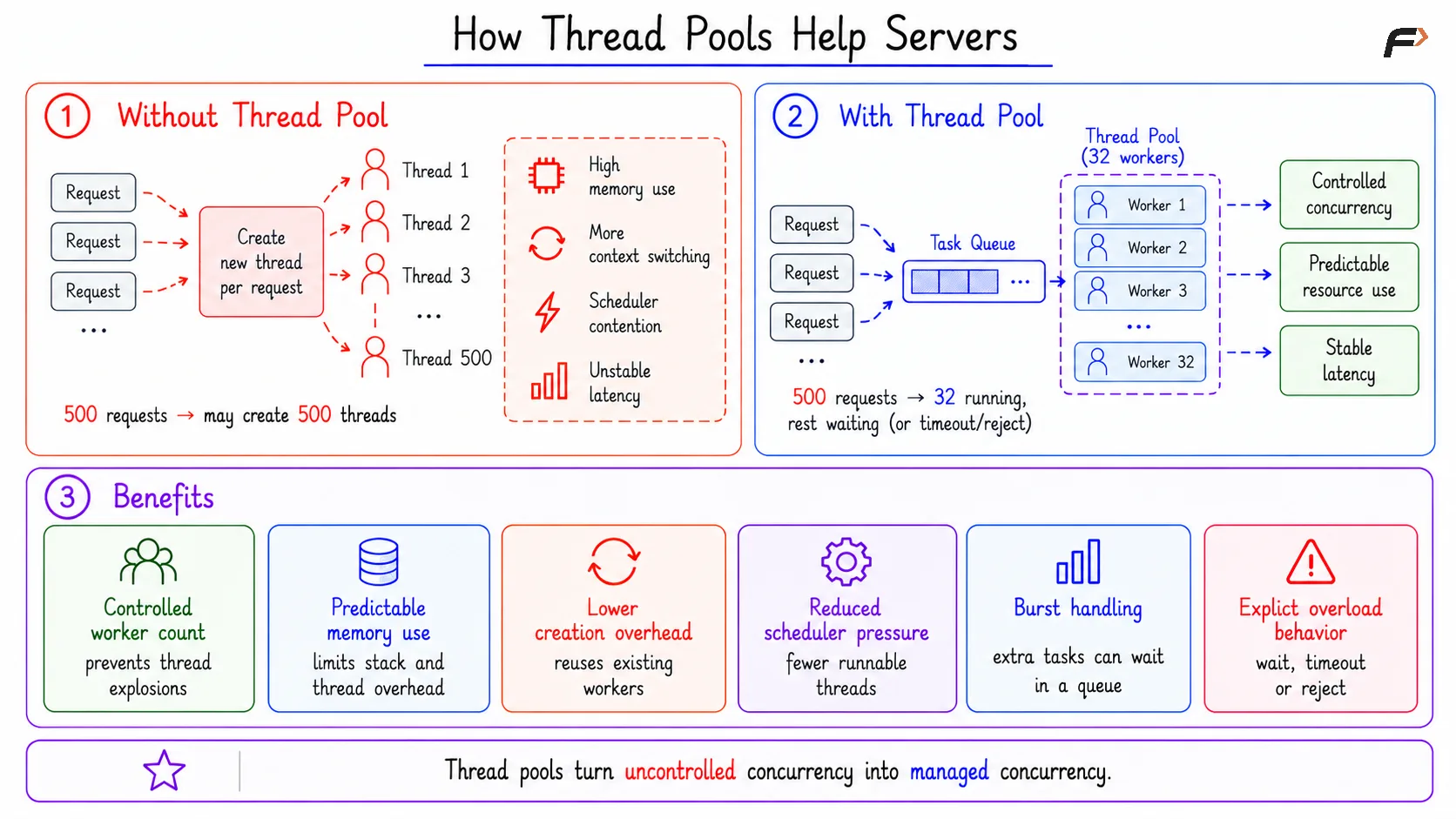
How Thread Pools Help Servers
Important Thread Pool Settings
Thread pools need limits. Without limits, a pool can hide overload instead of controlling it.
Setting | Meaning |
|---|---|
Pool size | Number of worker threads allowed to run |
Queue limit | Number of tasks allowed to wait |
Core size | Minimum number of ready workers |
Maximum size | Upper limit on workers |
Keep-alive time | How long extra idle workers stay alive |
Rejection policy | What happens when the pool and queue are full |
Shutdown behavior | How running and waiting tasks are handled during shutdown |
These settings decide whether the system stays stable when traffic increases.
Pool Sizing Tradeoffs
There is no universal best pool size. The right size depends on workload type, CPU capacity, blocking time, memory, downstream services, and latency goals.
If the pool is too small, work may wait even when the machine could handle more. This can increase queueing delay and reduce throughput. If the pool is too large, the system may waste memory, increase context switching, and create more contention on shared queues, locks, databases, or files.
For CPU-bound work, a pool near the available CPU core count is often a useful starting point. For I/O-bound work, more threads may be useful because many workers spend time waiting, but the pool still needs a clear upper bound.
Queueing and Backpressure
Pool size controls how much work runs at the same time. Queue size controls how much work is allowed to wait.
An unbounded queue can become dangerous. Waiting tasks may grow continuously, memory usage may rise, and old requests may wait so long that the service appears alive but stops being useful.
Backpressure means the system pushes back during overload. Common controls include:
Bounded queues: Limit how many tasks can wait.
Timeouts: Prevent work from waiting forever.
Rejection: Refuse new work when limits are reached.
Rate limiting: Reduce how quickly work enters the system.
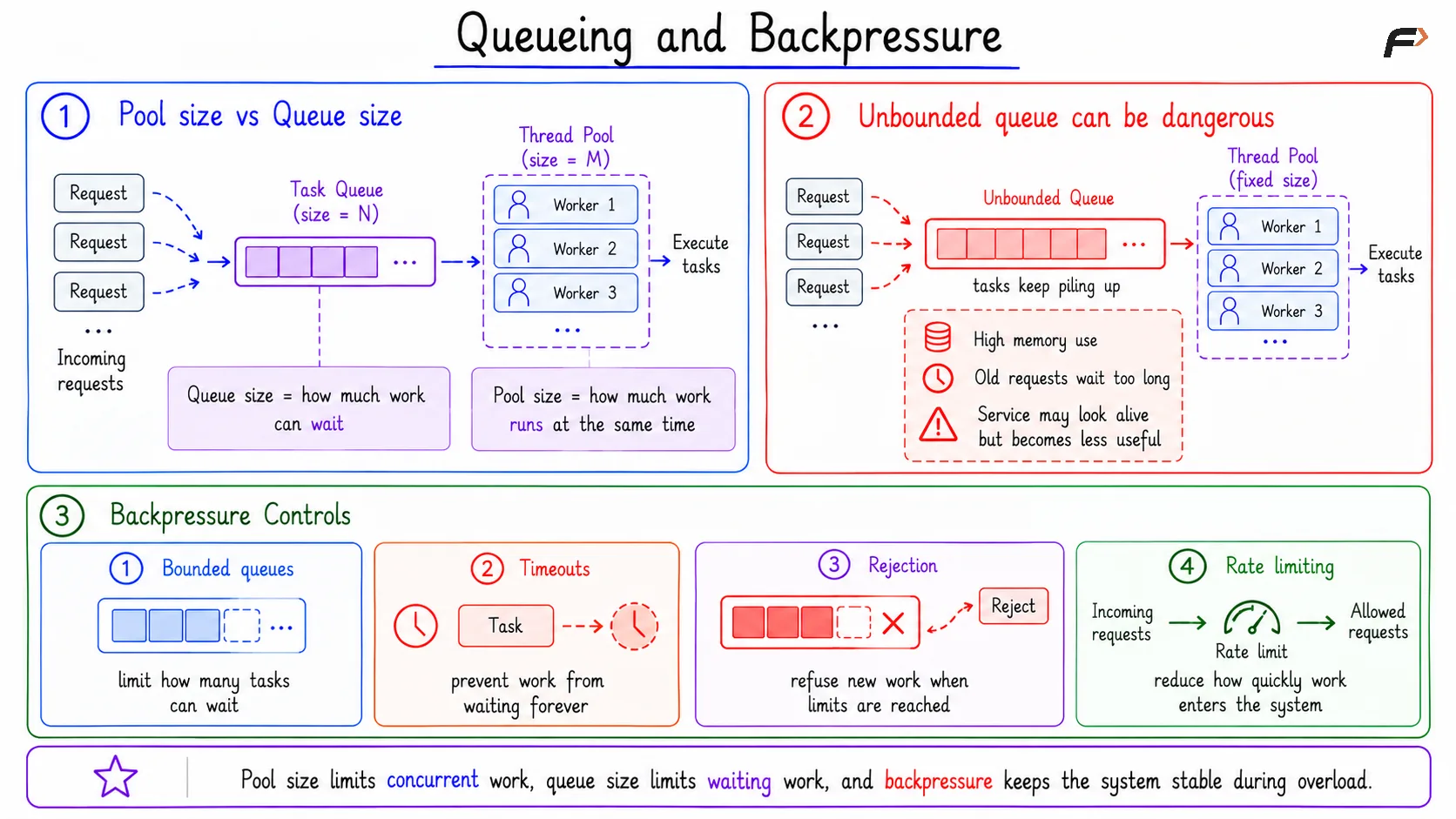
Queueing and Backpressure
Where Thread Pools Are Used
Thread pools are common in practical systems because they make concurrency more predictable.
Web servers: Handle incoming requests with worker pools.
Background jobs: Run asynchronous work outside the main request path.
Logging systems: Process log work without blocking important execution.
Databases: Use workers for queries, maintenance, and internal tasks.
A thread pool is not only a performance tool. It is also a control mechanism for keeping systems stable under load.
Observing a Thread Pool
A thread pool should be monitored in real systems. It is not enough to know that the program is running; the worker count, queue behavior, and latency also matter.
Important signals include:
Active workers: How many workers are busy.
Queue depth: How much work is waiting.
Latency: How long tasks or requests take.
Throughput: How much work finishes per unit time.
Rejection count: How often the pool refuses work due to limits.
Useful observation tools may include OS thread views such as top -H or ps -L, runtime thread dumps, and service metrics from monitoring dashboards.
Summary
A thread pool reuses a controlled set of worker threads instead of creating a new thread for every task. Incoming work enters a queue, available workers execute tasks, and workers return to the pool after finishing.
The main benefit is managed concurrency: lower creation overhead, more predictable resource use, and better overload behavior. The key rule is: pool size controls how much work runs, queue size controls how much work waits, and synchronization controls shared-data correctness.
Be the first to add a comment.