Introduction
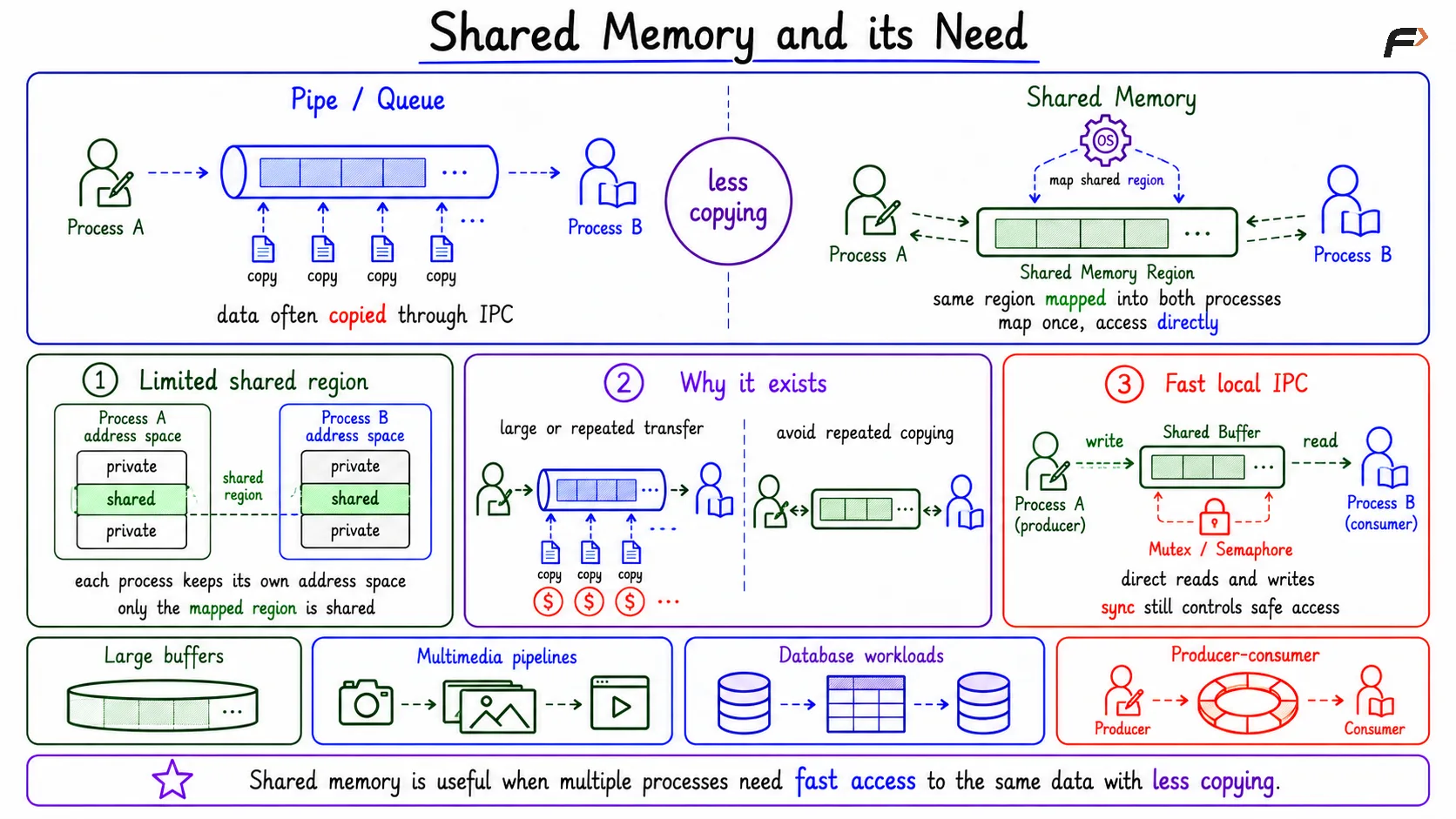
Shared memory is an Inter-Process Communication mechanism used when processes need fast access to common data. It is especially useful when copying large data through pipes or message queues would be too expensive.
The main idea is speed. After the shared region is set up, one process can write into it and another process can read from the same underlying memory.
What Shared Memory Means
Shared memory is an IPC mechanism where the operating system maps the same memory region into the address spaces of multiple processes.
Each process still has its own virtual address space. Only the region intentionally mapped by the OS is shared.
This does not mean that one process can freely access all memory of another process. The sharing is limited to the specific region created and mapped for IPC.
Why Shared Memory Exists
Pipes and message queues are useful, but they usually involve copying data through an intermediate IPC mechanism. That is fine for small messages or simple streams, but it can become costly for large or repeated data transfer.
Shared memory reduces repeated copying after setup. The OS arranges the mapping once, and then processes can access the shared region using ordinary memory reads and writes.
It is useful for:
Large buffers: Avoid repeatedly copying large data between processes.
Multimedia pipelines: Share chunks of audio, video, or image data efficiently.
High-performance local IPC: Use direct memory access instead of message copying.
Producer-consumer buffers: Store data in a shared region while synchronization controls access.
Shared Memory and its Need
How Shared Memory Works
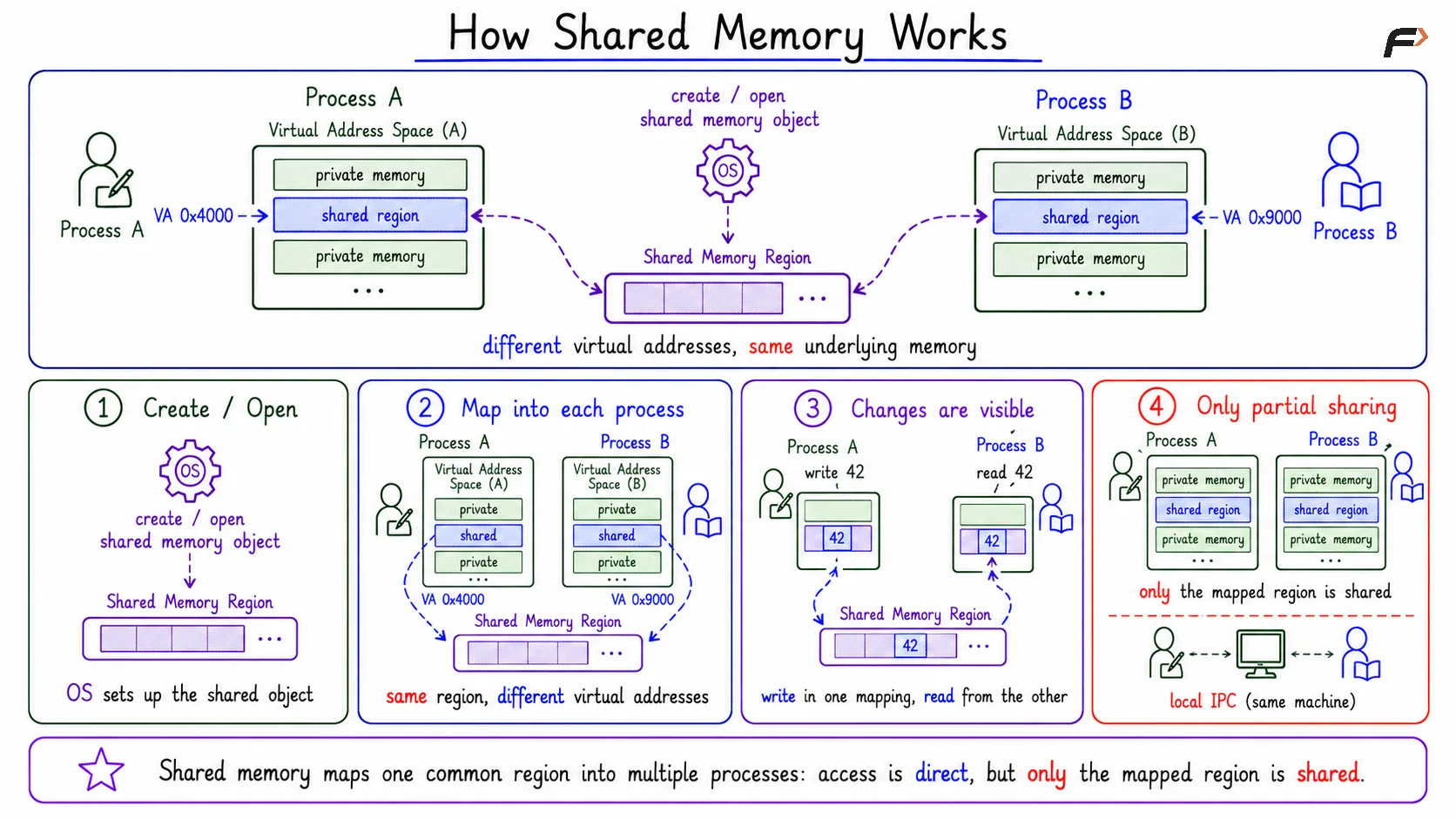
The OS creates or opens a shared memory object and maps it into each participating process. The virtual addresses may differ from process to process, but they refer to the same underlying memory.
For example, Process A may see the shared region at one virtual address, while Process B sees it at another. Under the hood, both mappings refer to the same shared memory region.
Key points are:
Different virtual addresses: Each process may map the region at a different address.
Same underlying memory: Changes made through one mapping are visible through the other.
Partial sharing: Only the mapped region is shared, not the whole process memory.
Local IPC: Shared memory is mainly for processes on the same machine.
How Shared Memory Works
Why Shared Memory Is Fast
Shared memory is fast because data does not need to be sent as a stream or queued message each time. Once the mapping exists, processes access the same memory region directly.
With a pipe or message queue, the data usually moves through kernel-managed buffers. With shared memory, the shared region itself is the data area.
This makes shared memory a strong choice when the data is large, frequently accessed, or reused by multiple processes. The speed comes from reducing repeated copying, not from removing all OS involvement entirely.
The Synchronization Problem
Shared memory gives shared data, but it does not automatically make access safe. If two processes read and write the same mutable data without coordination, race conditions can occur.
For example, one process may read a value while another process is halfway through updating it. The result can be corrupted data or inconsistent state.
Shared memory therefore needs a separate synchronization rule. The memory region provides the data path, but synchronization controls who may access it and when.
Common Synchronization Tools
Shared memory is commonly paired with synchronization mechanisms. The exact tool depends on the design, but the goal is always controlled access.
Common tools include:
Mutex: Allows only one process or thread into a critical section at a time.
Semaphore: Controls access counts or coordinates producer-consumer behavior.
Condition variable: Lets a process wait until a shared-state condition becomes true.
Without synchronization, shared memory can become faster but unsafe. The program must define how readers and writers coordinate.
Shared Memory vs Other IPC
Shared memory is usually chosen for speed, while pipes and message queues are often chosen for simplicity or structure.
IPC Mechanism | Best Fit | Main Tradeoff |
|---|---|---|
Pipe | Simple byte stream | No natural message boundaries |
Message queue | Separate structured messages | Queue and message-size limits |
Shared memory | Fast large-data sharing | Requires explicit synchronization |
If the communication is simple and small, a pipe or message queue may be easier. If the communication involves large local data and performance matters, shared memory can be a better fit.
Summary
Shared memory maps the same memory region into multiple process address spaces. It is useful for fast local IPC, large buffers, multimedia pipelines, database-style workloads, and producer-consumer designs.
Its main strength is reduced copying after setup. Its main risk is unsafe access to shared mutable data, so shared memory must be paired with synchronization such as mutexes, semaphores, condition variables, atomics, or a carefully designed protocol.
Be the first to add a comment.