Introduction
Priority scheduling is a CPU scheduling approach where the scheduler gives preference to the highest-priority ready process. A process with higher priority can get the CPU before other waiting processes.
This is useful because all processes are not equally important. Some system, urgent, interactive, or real-time tasks may need CPU attention before normal batch work.
Why Priority Scheduling Is Needed
Priority scheduling is used when the operating system needs to treat some work as more important than other work. Instead of selecting only by arrival time or burst time, the scheduler uses a priority value.
Common examples include:
System task before user task: Kernel or system work may need faster service.
Real-time task before regular task: Deadline-based work may need higher priority.
Core Rule of Priority Scheduling
The scheduler chooses the highest-priority process from the ready queue. In this editorial, a smaller priority number means higher priority.
If two processes have the same priority, arrival time can be used as a tie-breaker. The worked example uses non-preemptive priority scheduling, so a selected process runs until it completes.
Priority Scheduling Example
Consider five processes:
Process | Arrival Time | Burst Time | Priority |
|---|---|---|---|
P1 | 0 | 8 | 3 |
P2 | 1 | 4 | 1 |
P3 | 2 | 9 | 4 |
P4 | 3 | 5 | 2 |
P5 | 7 | 2 | 1 |
Smaller priority number means higher priority. The scheduling is non-preemptive.
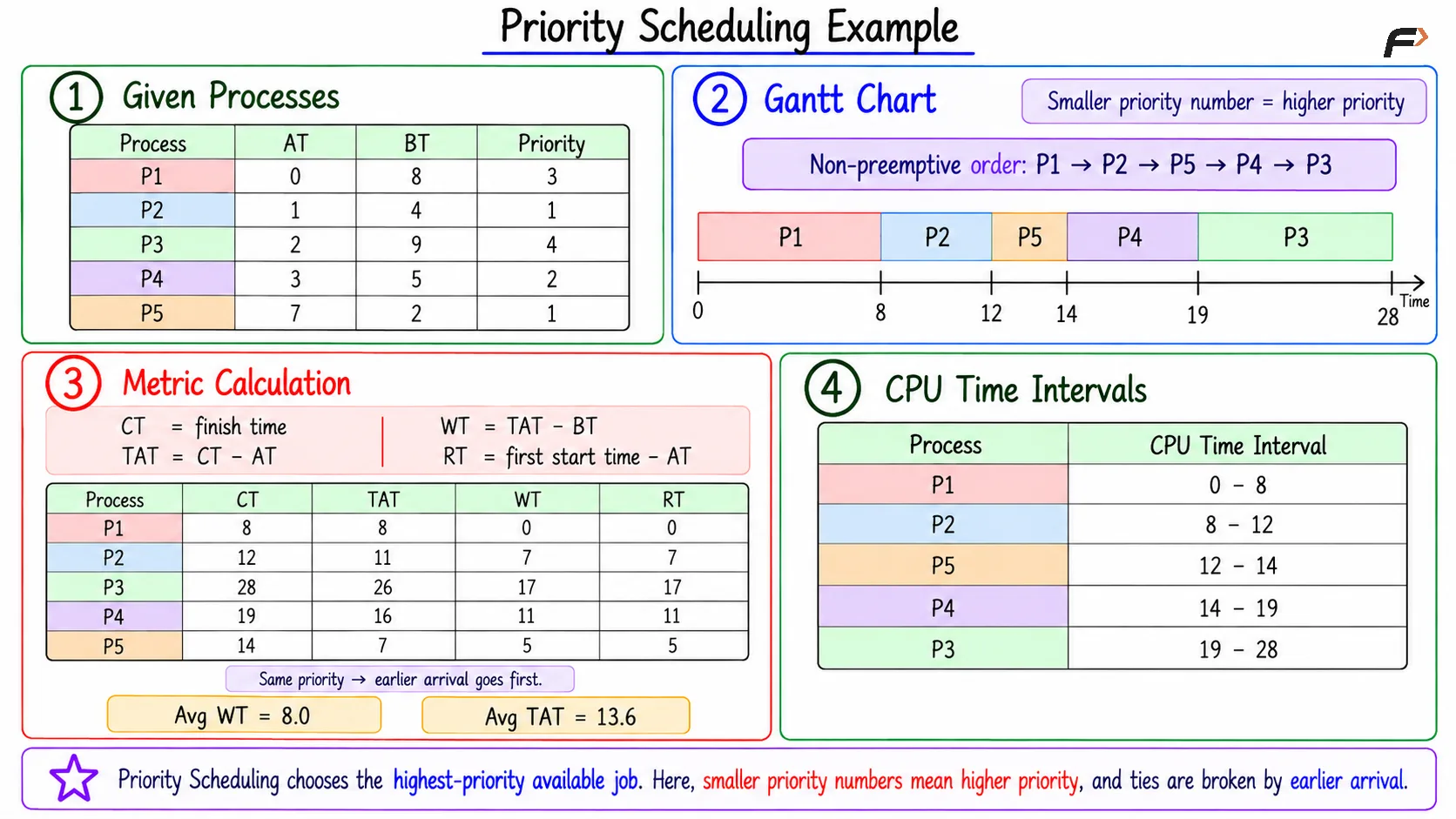
Priority Scheduling Example
The compact scheduling flow is:
At time
0, onlyP1has arrived, soP1runs from0 to 8.At time
8,P2,P3,P4, andP5are available.P2andP5both have priority1, so earlier arrival selectsP2.After
P2,P5runs, thenP4, and finallyP3.
Process | CPU Time Interval |
|---|---|
P1 | 0 to 8 |
P2 | 8 to 12 |
P5 | 12 to 14 |
P4 | 14 to 19 |
P3 | 19 to 28 |
Metric Calculation
The main formulas are:
CT: finish time of the process
TAT:
CT - ATWT:
TAT - BTRT:
first start time - AT
Process | CT | TAT | WT | RT |
|---|---|---|---|---|
P1 | 8 | 8 | 0 | 0 |
P2 | 12 | 11 | 7 | 7 |
P3 | 28 | 26 | 17 | 17 |
P4 | 19 | 16 | 11 | 11 |
P5 | 14 | 7 | 5 | 5 |
Average TAT = 13.6, average WT = 8.0, and average RT = 8.0.
Aging and Starvation
The main risk in priority scheduling is starvation. A low-priority process may wait for a very long time if higher-priority processes keep arriving.
Aging helps reduce this problem. In aging, the priority of a waiting process is gradually improved as its waiting time increases. This ensures that long-waiting processes eventually get a fair chance to run.
Strengths and Weaknesses of Priority Scheduling
Strengths | Weaknesses |
|---|---|
Handles important work first | Low-priority processes may starve |
Useful for system and real-time tasks | Priority assignment can be difficult |
Can use aging to reduce starvation | Priority inversion can occur with shared resources |
Summary
Priority scheduling selects the highest-priority ready process. In the example used here, smaller priority numbers mean higher priority, and ties are handled using earlier arrival time.
It is useful when some work is more important than other work, especially in system, urgent, interactive, or real-time cases. Its main risks are starvation, unfairness, and priority inversion, so aging and careful priority design are important.
Be the first to add a comment.