Introduction
Priority inversion happens when priority scheduling and synchronization interact badly. A high-priority task should normally run first, but a lock can force it to wait for a lower-priority task.
The problem becomes more serious when medium-priority tasks keep running before the low-priority lock holder. Then the high-priority task is indirectly delayed by work that should not have been more important than it.
What Priority Inversion Means
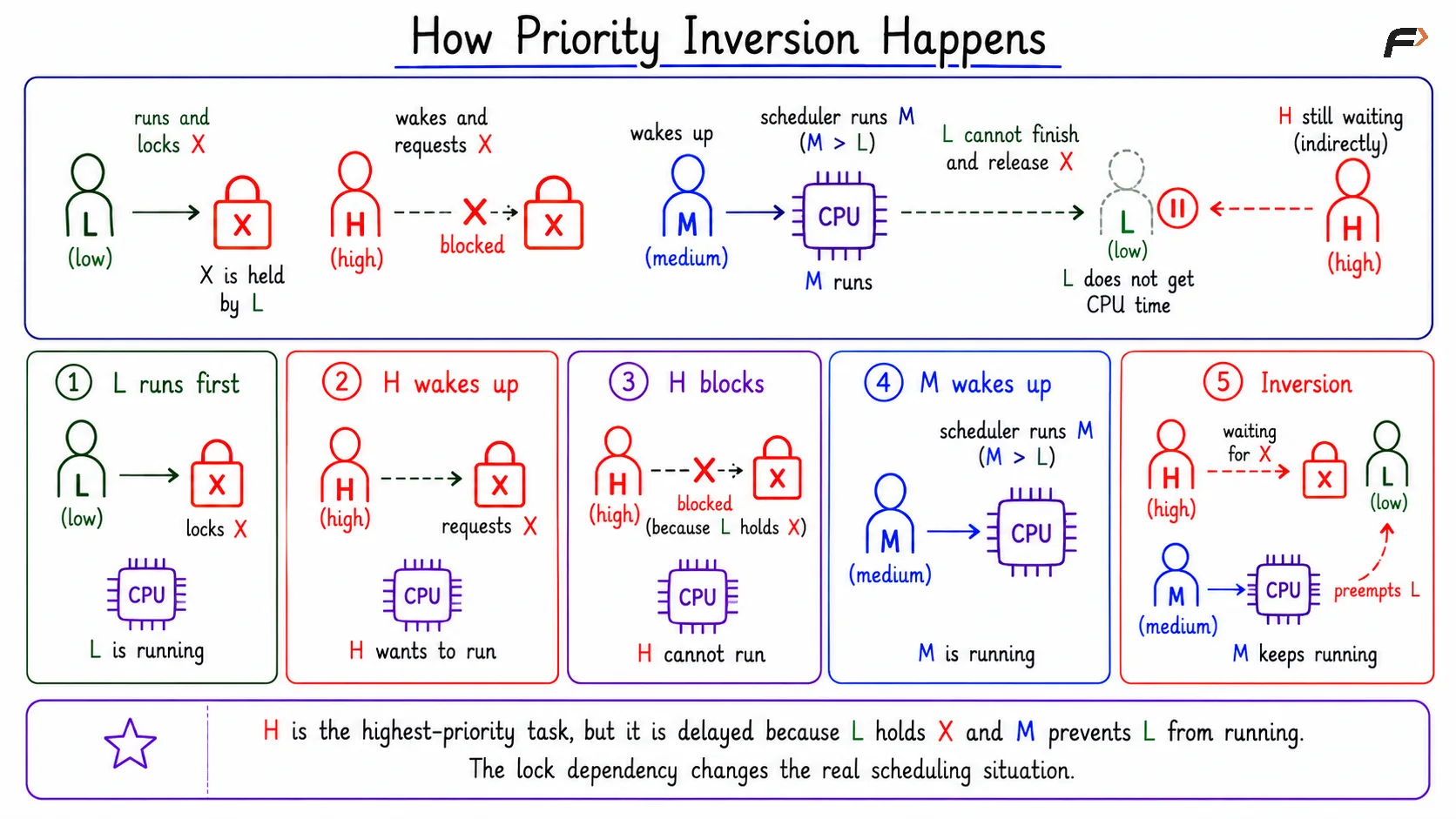
Priority inversion occurs when a high-priority task is blocked because a low-priority task holds the resource it needs, while medium-priority tasks prevent the low-priority task from running.
The classic setup uses three tasks:
H: High-priority task that needs a locked resource.
M: Medium-priority task that does not need that resource.
L: Low-priority task that currently holds the lock needed by H.
The surprising part is that M can delay H, even though H has higher priority than M. This happens because H is blocked on L, and L cannot release the lock until it gets CPU time.
How Priority Inversion Happens
Assume there is a shared lock X. The basic flow is:
L runs first: It locks
X.H wakes up: It requests
X.H blocks: It cannot continue because
Xis held byL.M wakes up: Since
Mhas higher priority thanL, the scheduler runsM.L waits for CPU: It cannot finish its critical section.
H keeps waiting: The highest-priority task is delayed indirectly.
The scheduler is following priority rules, but the lock dependency changes the real situation. The high-priority task is not waiting for CPU directly; it is waiting for the low-priority task to release a resource.
How Priority Inversion Happens
Why Priority Scheduling Alone Fails
Priority scheduling normally chooses the highest-priority ready task. But when a high-priority task blocks on a lock, it is no longer ready to run.
At that point, the lock owner becomes important. If the owner is a low-priority task, medium-priority tasks may keep preempting it, even though finishing the low-priority task is the fastest way to unblock the high-priority task.
This is why priority inversion is a synchronization problem as much as a scheduling problem. Priority alone cannot solve it unless the lock mechanism is also priority-aware.
Priority Inheritance
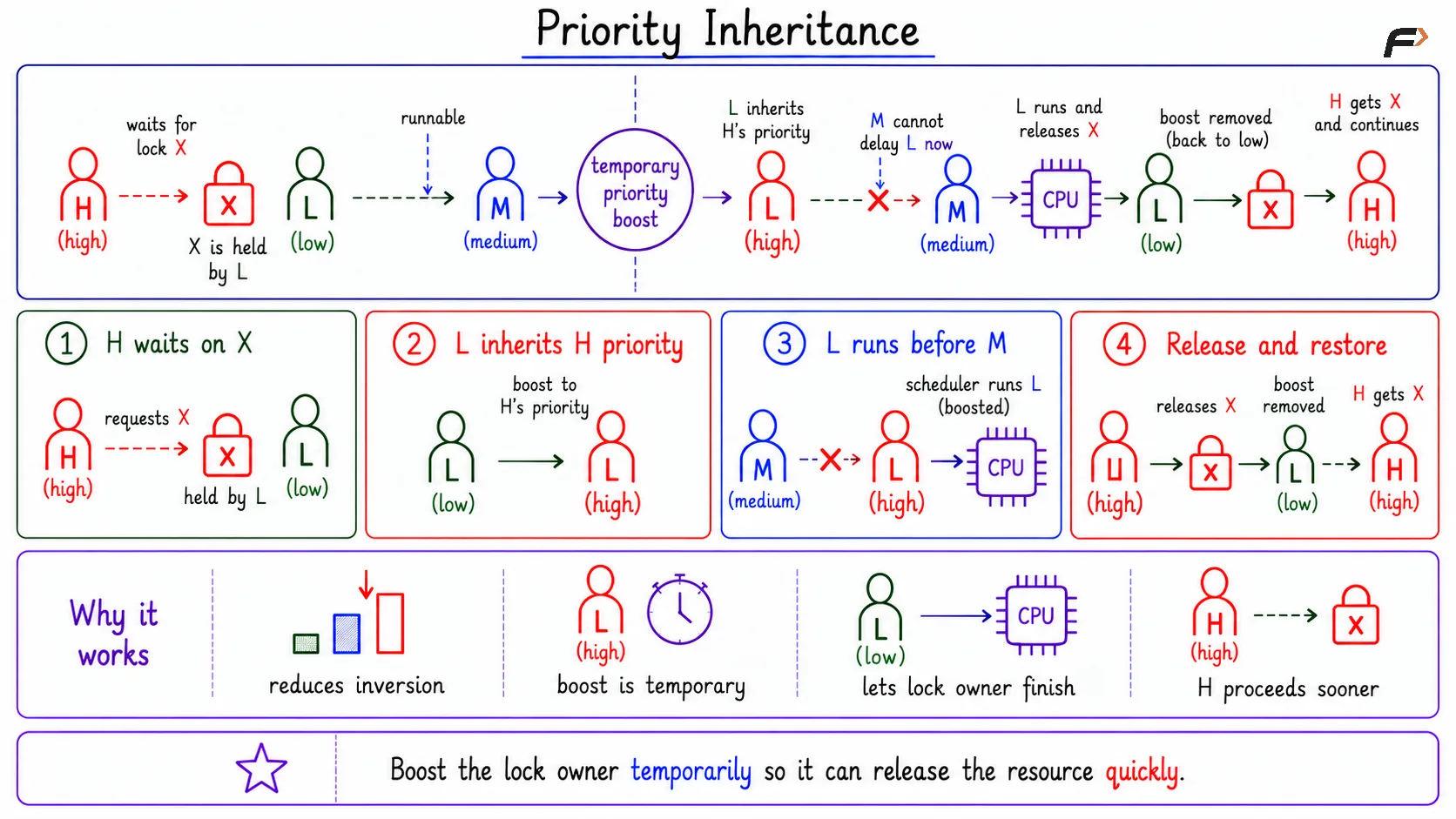
Priority inheritance is the main solution for priority inversion. If a high-priority task waits for a lock held by a low-priority task, the low-priority task temporarily inherits the high priority.
The basic flow is:
H waits on a lock: The lock is owned by L.
L is boosted: L temporarily receives H's priority.
L runs before M: Medium-priority work cannot keep delaying it.
L releases the lock: The shared resource becomes available.
L returns to normal priority: The boost is removed.
H continues: H gets the lock and proceeds.
The practical idea is simple: boost the lock owner so it can release the resource quickly. The boost is temporary, not a permanent priority change.
Priority Inheritance
Priority Ceiling
Priority ceiling is another solution used in real-time systems. Each shared resource is assigned a priority ceiling, usually based on the highest-priority task that may use that resource.
Before a task locks a resource, the system checks priority rules related to currently locked resources. This helps control blocking and can prevent some priority inversion situations before they occur.
Priority ceiling is more static than priority inheritance. It requires advance knowledge about which tasks may use which resources, but it can provide stronger control in systems with strict timing requirements.
Real-Time and Backend Impact
Priority inversion is especially important in real-time systems because a delayed high-priority task may miss a deadline. In such systems, a delay is not only a performance issue; it can break correctness.
In backend services, the same pattern may appear as a latency spike. An important request may wait behind a lock held by a lower-priority worker, while unrelated work keeps using CPU.
Common practical controls include:
Keep critical sections short: The lock holder should release shared resources quickly.
Use priority inheritance where needed: Especially for mutexes shared across priority levels.
Measure blocking time: CPU usage alone may hide priority inversion because the high-priority task is blocked, not running.
Summary
Priority inversion occurs when a high-priority task is delayed because a low-priority task holds a resource it needs, while medium-priority tasks prevent the low-priority task from running. The problem appears because locks create dependencies that priority scheduling alone cannot see.
Priority inheritance fixes the issue by temporarily boosting the lock holder so it can release the resource. Priority ceiling is a more static policy used in real-time systems to control access to shared resources and reduce priority-related blocking.
Be the first to add a comment.