Introduction
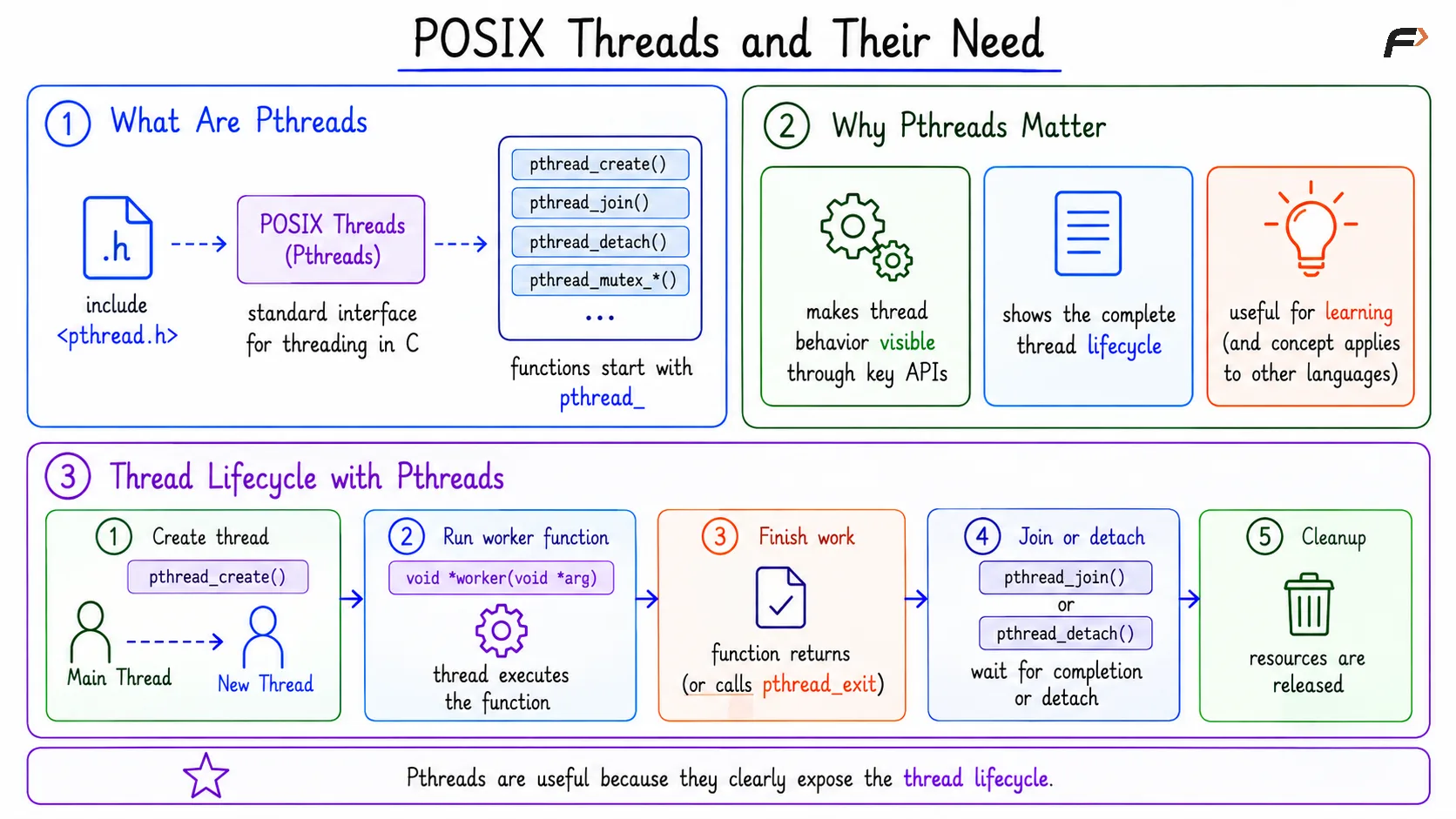
POSIX Threads, commonly called Pthreads, provide a standard C interface for working with threads on POSIX systems. They connect operating system thread theory with real function calls used in programs.
The main idea is to understand the thread lifecycle. A thread is created, runs a function, finishes its work, and then its resources are handled through either join or detach.
Why POSIX Threads Matter
Pthreads make thread behavior visible through a small set of important API calls. Instead of only saying that a thread runs concurrently, we can see how it is created, waited for, detached, or terminated.
The basic flow is: Create thread => Run worker function => Finish work => Join or detach => Cleanup
This lifecycle pattern appears in many programming environments. Other languages may use different names, but they still deal with the same questions: who starts the thread, who waits for it, how results are collected, and how resources are cleaned up.
What Pthreads Are
Pthreads are POSIX threads, a standard interface for threaded programming in C on POSIX-compatible systems. A program usually includes <pthread.h> and uses functions whose names begin with pthread_.
Pthreads are useful for learning because they expose the thread lifecycle clearly. They show that creating a thread is only one part of the story; the program must also decide how the thread finishes and how shared data is handled.
POSIX Threads and their Need
Core Pthread Functions
The main Pthread functions match the basic lifecycle of a thread.
Function | Purpose |
|---|---|
| Creates a new thread and starts it from a given function |
| Waits for a joinable thread to finish and can collect its return value |
| Marks a thread so its resources can be released automatically after it exits |
| Returns the ID of the calling thread |
| Terminates the calling thread |
Basic Pthread Lifecycle
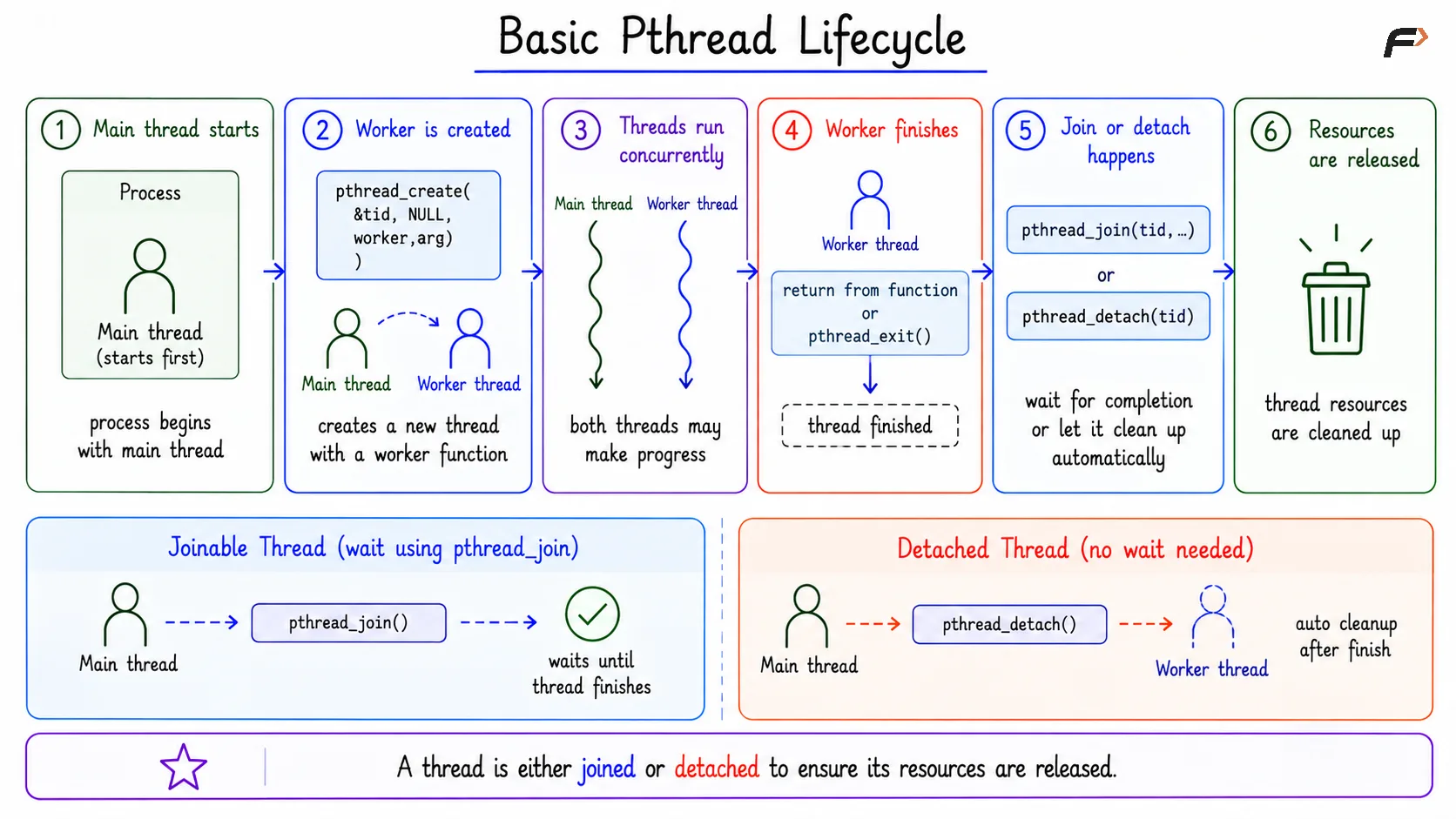
A process begins with a main thread. When the main thread wants another task to run separately, it can create a worker thread using pthread_create.
The lifecycle is usually:
Main thread starts: The process begins execution with the main thread.
Worker is created:
pthread_createstarts a new thread with a worker function.Threads run concurrently: The main thread and worker thread may both make progress.
Worker finishes: The worker returns from its function or calls
pthread_exit.Join or detach happens: The program either waits for the thread or lets it clean up automatically.
Resources are released: The thread’s resources are handled according to its completion path.
If the thread is joinable, another thread should call pthread_join to wait for it. If no thread will wait for it, the thread should be detached.
Basic Pthread Lifecycle
Minimal Code Shape
A basic Pthread program needs a thread ID, a worker function, a create call, and usually a join call.
#include <pthread.h>void *worker(void *arg){ // do work return NULL;}int main(void){ pthread_t tid; pthread_create(&tid, NULL, worker, NULL); pthread_join(tid, NULL); return 0;}In this example, pthread_t tid stores the thread identifier. The worker function takes one void * argument and returns one void * value, which allows pointer-based argument passing and return values.
A common Linux compile command is: cc -pthread app.c -o app
Real programs should check the return values of Pthread calls so errors are not silently ignored.
Arguments and Return Values
A Pthread worker function receives one pointer-sized argument. If the thread needs multiple values, the usual method is to pass a pointer to a structure containing those values.
The important rule is lifetime. The data passed to the thread must remain valid until the thread actually reads it. Passing the address of a short-lived stack variable can be unsafe if that variable goes out of scope too early.
Return values follow the same idea. A thread can return a pointer and another thread can collect it through pthread_join, but the returned pointer must refer to valid memory. Returning the address of a local stack variable is unsafe because the stack frame disappears after the function ends.
Joinable and Detached Threads
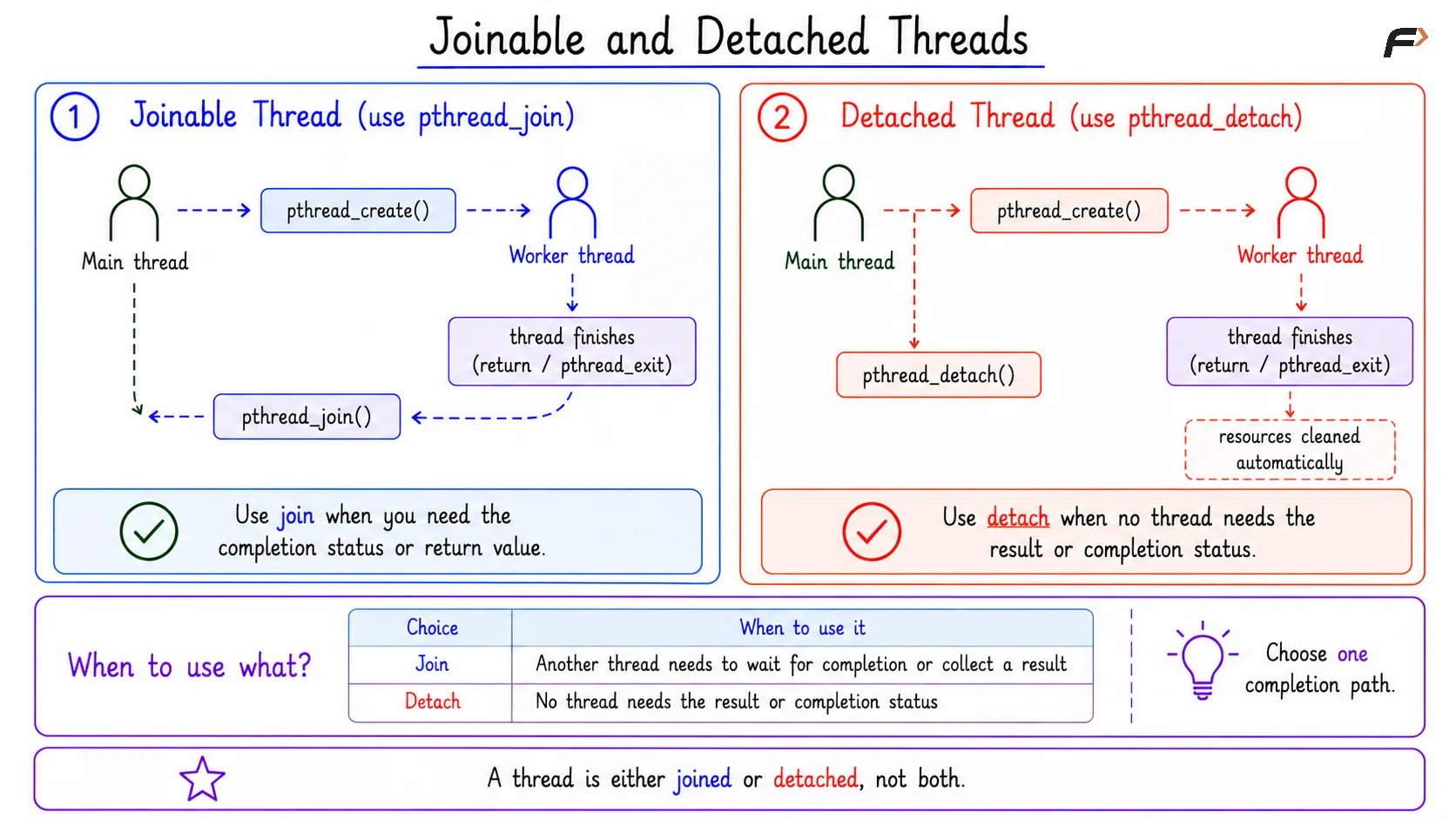
A joinable thread is a thread that another thread can wait for using pthread_join. Join is useful when the program needs the worker’s completion status or return value.
A detached thread is used when no one will wait for it later. After a detached thread finishes, its resources can be cleaned automatically, but it cannot be joined afterward.
Choice | When to use it |
|---|---|
Join | Another thread needs to wait for completion or collect a result |
Detach | No thread needs the result or completion status |
The practical rule is simple: choose one completion path. Join the thread if someone must wait; detach it if no one will wait.
Joinable and Detached Threads
Shared Data Warning
Pthreads make sharing easy because threads in the same process can access shared memory such as globals, heap objects, files, and memory mappings. Passing pointers also makes it easy for one thread to reach data used by another thread.
Easy sharing does not automatically mean safe sharing. If one thread writes shared data while another reads or writes it at the same time, the result can depend on timing. Creating threads and synchronizing shared data are separate responsibilities.
Summary
POSIX Threads are a standard C API for creating and managing threads on POSIX systems. They make the thread lifecycle practical through calls such as pthread_create, pthread_join, pthread_detach, pthread_self, and pthread_exit.
The core lifecycle is create, run, finish, join or detach, and cleanup. Arguments and return values use void *, so memory lifetime matters, and shared data needs proper synchronization to behave correctly.
Be the first to add a comment.