Introduction
Multithreading models explain how user-level threads are connected to kernel-level threads. A user-level thread is managed by a runtime, while a kernel-level thread is visible to the operating system scheduler.
The main question is not only how many threads exist. The more important question is how user threads are mapped to kernel threads, because that mapping decides performance, blocking behavior, and parallel execution.
Why Thread Mapping Matters
User-level threads do not directly receive CPU time from the hardware. The runtime manages user-level work, but the operating system schedules kernel-level threads on the CPU.
This mapping affects several important things:
Blocking behavior: Whether one blocked thread stops only itself or delays other threads.
Multicore parallelism: Whether work can run on multiple CPU cores at the same time.
Overhead: How much cost is involved in creating, switching, and managing threads.
Debugging: Whether OS tools can clearly show the running threads.
Scheduling: Whether the runtime or the operating system has stronger control.
Even after user-level work is mapped to a kernel-level thread, CPU time is still decided by the operating system scheduler.
Types of Multithreading Models
The standard multithreading models are many-to-one, one-to-one, many-to-many, and two-level. Each model describes a different relationship between user-level threads and kernel-level threads.
Many-to-One Model
In the many-to-one model, many user-level threads are mapped to a single kernel-level thread. The runtime chooses which user thread should run, but the kernel sees only one schedulable thread.
This model has low overhead because thread management mainly happens in user space. Switching between user threads can be fast because the kernel is not involved in every user-level scheduling decision.
Its main weakness is blocking. If the single kernel thread blocks during a system call, all user-level threads mapped above it may stop. It also cannot use multiple CPU cores at the same time because only one kernel thread is available.
One-to-One Model
In the one-to-one model, each user-level thread maps to one kernel-level thread. If a process has four user-level threads, it also has four kernel-level threads.
This gives stronger blocking behavior and parallelism. If one thread blocks, other kernel-level threads can continue running, and the operating system can schedule different threads on different CPU cores.
The tradeoff is overhead. Every user thread requires kernel support, so creating too many threads can increase memory use, scheduling cost, and OS management work. Modern POSIX threads on Linux follow this model at the OS thread level.
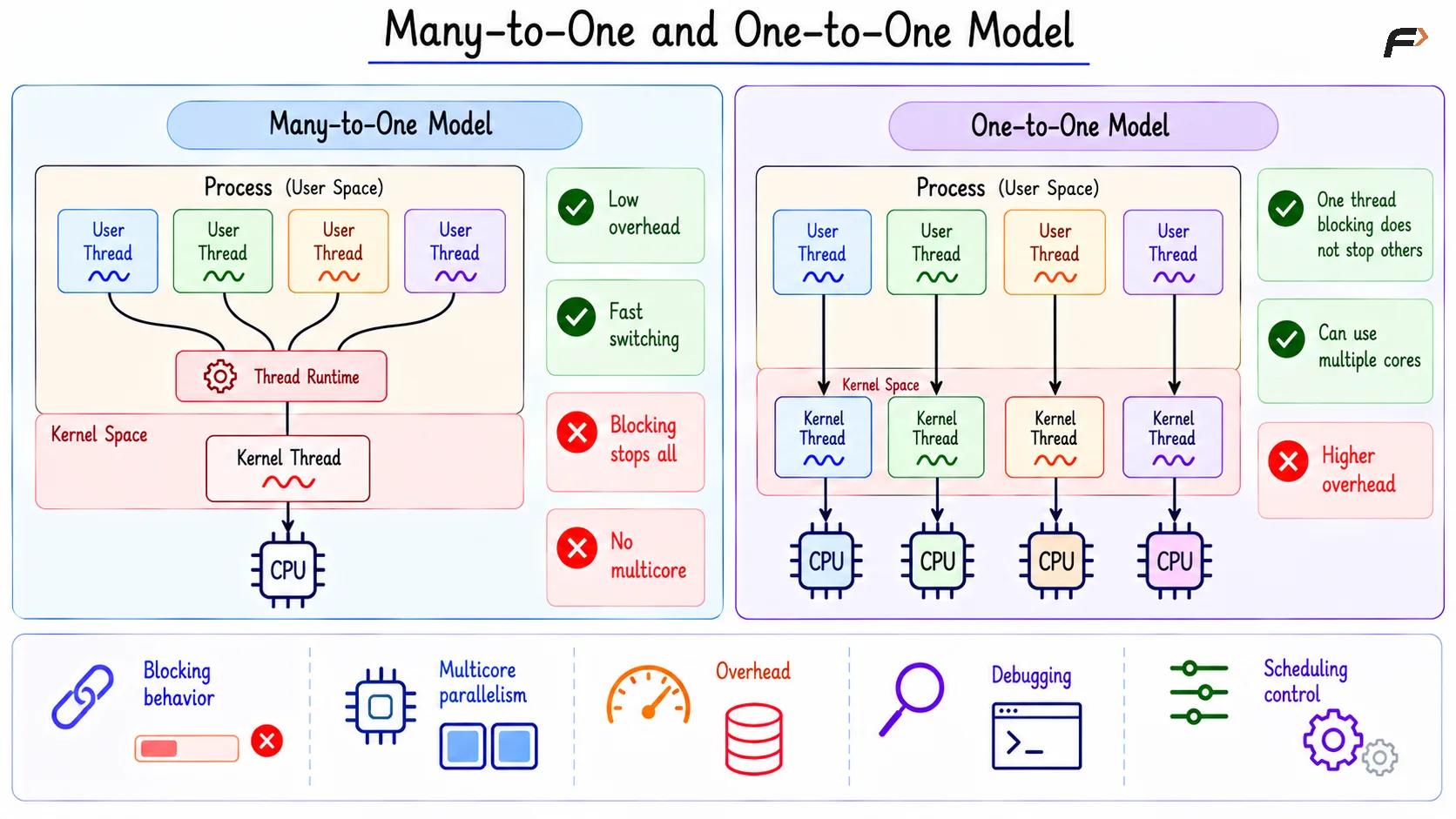
Many-to-One and One-to-One Model
Many-to-Many Model
In the many-to-many model, many user-level threads are mapped onto many kernel-level threads. A runtime may create many logical threads but run them over a smaller or equal number of kernel threads.
This model tries to balance both sides. It allows many lightweight user-level tasks while still giving the operating system multiple kernel threads to schedule across CPU cores.
The cost is complexity. The runtime and operating system need better coordination, and debugging may require runtime-specific tools because not every logical task is directly visible as a separate OS thread.
Two-Level Model
The two-level model is an extension of many-to-many. It allows many user-level threads to run over many kernel-level threads, but it also allows selected user threads to be bound to specific kernel threads.
Binding means a particular user thread is tied to a particular kernel thread when it needs more predictable kernel backing. Other user threads can still be scheduled flexibly by the runtime.
This model gives flexibility with selected control, but it is more complex than basic many-to-many mapping.
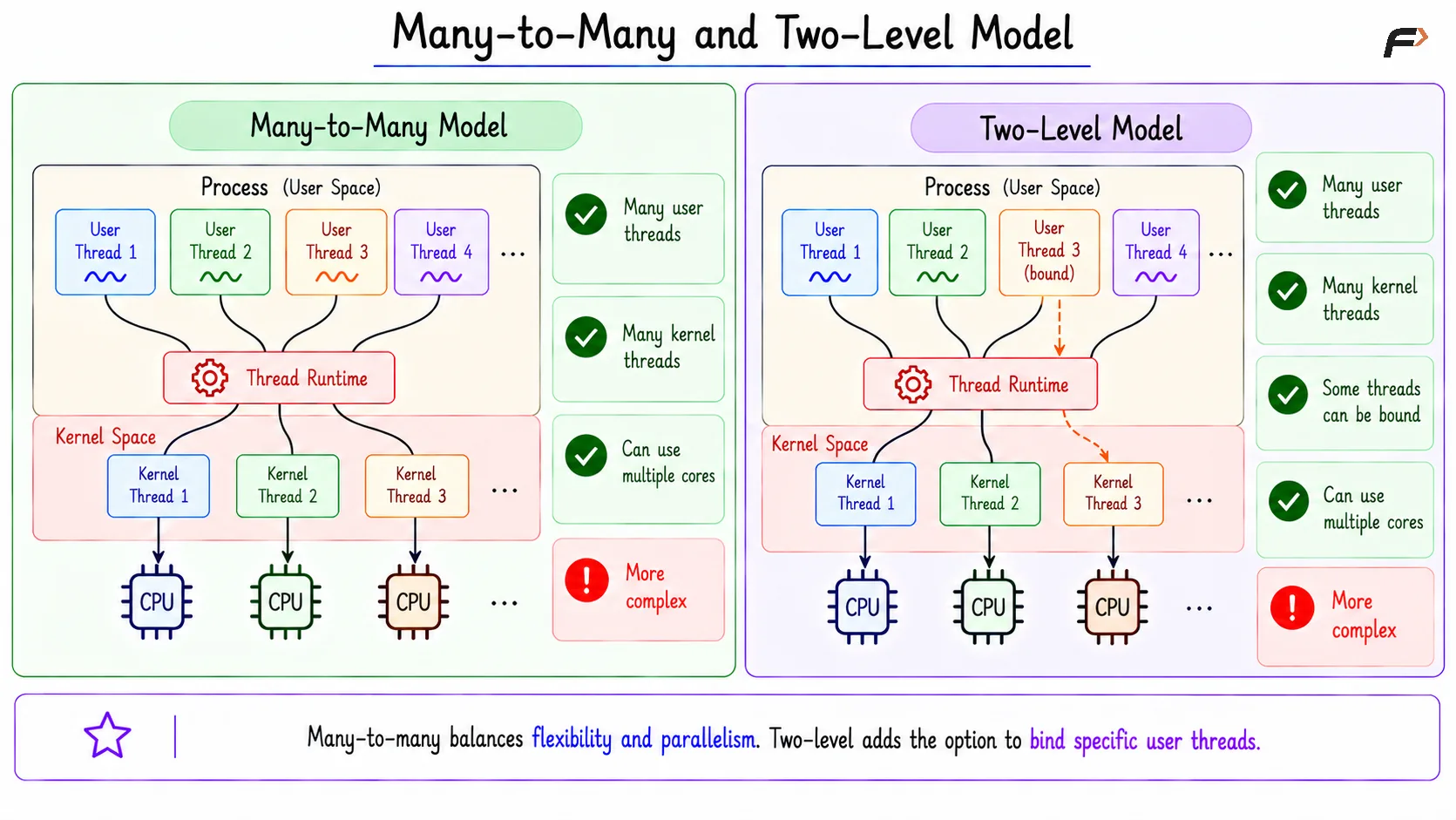
Many-to-Many and Two-Level Model
Comparison of Multithreading Models
Dimension | Many-to-One | One-to-One | Many-to-Many | Two-Level |
|---|---|---|---|---|
Mapping | Many user threads share one kernel thread | Each user thread gets one kernel thread | Many user threads run over many kernel threads | Many-to-many with optional binding |
Blocking behavior | One blocked kernel thread may stop all user threads | Other threads can continue | Blocking is handled better than many-to-one | Similar to many-to-many, with selected binding |
Overhead | Low | Higher | Moderate | Moderate to higher |
Main strength | Fast user-space management | Strong scheduling and blocking support | Balance between lightweight tasks and cores | Flexibility with selected guarantees |
Main weakness | Blocking and no parallelism | Too many kernel threads can be costly | More complex mapping | Extra binding complexity |
Summary
A multithreading model describes how user-level threads map to kernel-level threads. This mapping decides how runtime-managed work reaches the operating system scheduler and finally runs on the CPU.
Many-to-one is lightweight but weak in blocking and parallelism. One-to-one gives strong OS visibility and multicore support with higher overhead. Many-to-many balances many logical tasks with several kernel threads, while two-level adds optional binding for selected control.
Be the first to add a comment.