Introduction
Multiprogramming, multitasking, multiprocessing, and multithreading sound similar, but they are not synonyms. Each term answers a different operating system question.
The clean way to separate them is to ask what problem each idea solves. One focuses on CPU utilization, one on responsiveness, one on hardware parallelism, and one on multiple execution paths inside a process.
Multiprogramming
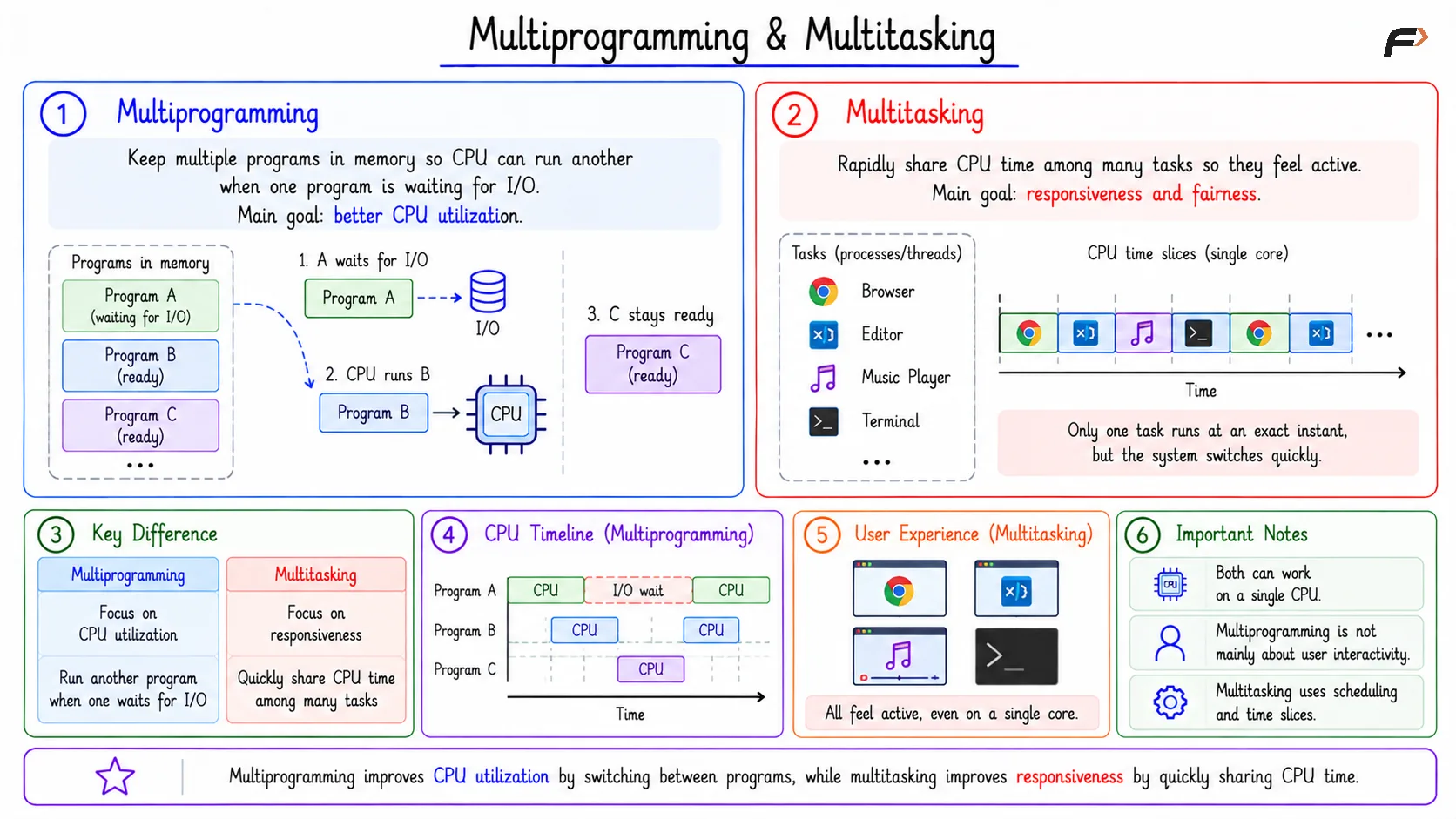
Multiprogramming keeps multiple programs in memory so the CPU can run another program when one program is waiting for I/O. Its main goal is better CPU utilization.
The basic idea is: Program A waits for I/O => CPU runs Program B => Program C stays ready
This can work even on a single CPU. It is not mainly about user interactivity or true parallel execution. The focus is simple: when one job cannot use the CPU, another ready job should get a chance.
Multitasking
Multitasking makes many tasks feel active by rapidly sharing CPU time among them. It is closely related to time-sharing and scheduling.
On a single-core CPU, only one task runs at an exact instant. Still, the operating system can switch quickly between tasks, so a browser, editor, music player, and terminal all appear to make progress.
The goal of multitasking is responsiveness and fairness. Processes or threads may be given small time slices so that no active task appears completely stuck.
Multiprogramming & Multitasking
Multiprocessing
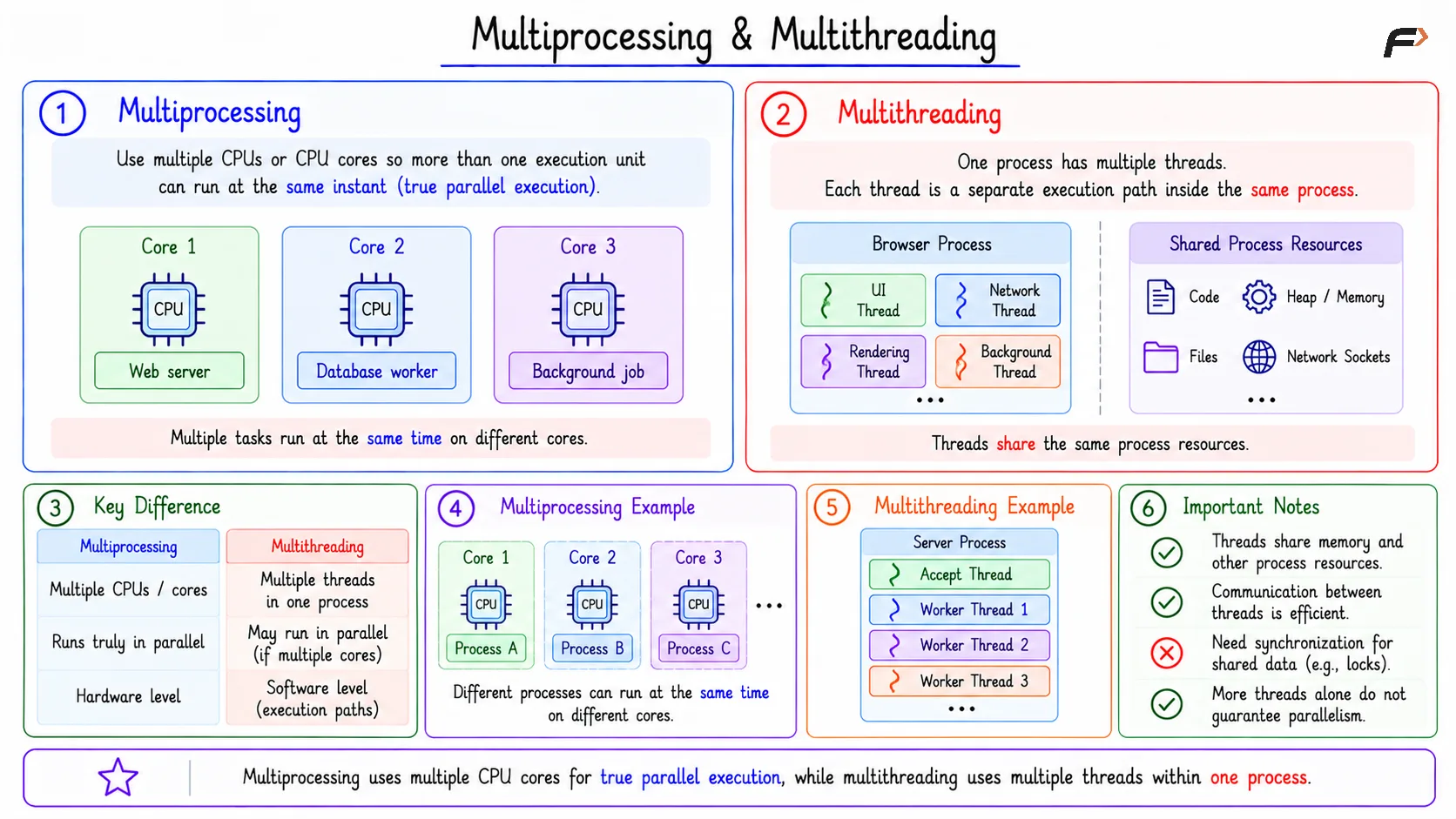
Multiprocessing means using multiple CPUs or CPU cores so more than one execution unit can run at the same instant. This is true parallel execution.
For example, Core 1 may run a server thread while Core 2 runs a database worker and Core 3 runs a background job. Work is not only taking turns; it is actually executing at the same time.
Multiprocessing is mainly about hardware support. It does not simply mean “many processes”; it means multiple processing units are available for simultaneous execution.
Multithreading
Multithreading means one process has multiple threads. Each thread is a separate execution path inside the same process.
A browser process may have threads for UI, networking, rendering, and background work. A server process may have worker threads that handle multiple client requests.
Threads inside the same process share process resources such as memory, heap, code, files, and sockets. This sharing makes communication efficient, but it also means synchronization is needed when shared data is modified.
Multiprocessing & Multithreading
Comparison Table
Aspect | Multiprogramming | Multitasking | Multiprocessing | Multithreading |
|---|---|---|---|---|
Meaning | Multiple programs stay in memory | Multiple tasks share CPU time | Multiple CPUs or cores run work | Multiple threads exist inside one process |
Main goal | Improve CPU utilization | Improve responsiveness | Improve parallel throughput | Support concurrent work inside an application |
Works on one core | Yes | Yes | No, true multiprocessing needs multiple CPUs or cores | Yes, but parallel thread execution needs multiple cores |
Main OS role | Switch when a program waits | Schedule time slices | Schedule work across cores | Manage or schedule threads |
Common example | Run another job during disk wait | Many apps feel active together | Different cores run different work | One app has UI, network, and worker threads |
Common Confusions
Multiprogramming vs multitasking: Multiprogramming focuses on CPU use during I/O waits, while multitasking focuses on making many tasks responsive over time.
Multitasking vs multiprocessing: Multitasking can happen on one core through time-sharing, while multiprocessing needs multiple CPUs or cores for true parallelism.
Multiprocessing vs multithreading: Multiprocessing is about hardware execution units, while multithreading is about multiple threads inside one process.
Connection With Concurrency and Parallelism
These four concepts also connect to concurrency and parallelism. Concurrency means multiple tasks make progress over the same time period.
Parallelism means multiple tasks execute at the exact same instant. Multitasking and multithreading can create concurrency, while multiprocessing provides the hardware support needed for true parallel execution.
Summary
Multiprogramming keeps the CPU busy by running another program when one waits for I/O. Multitasking uses fast scheduling and time slices so many tasks feel active over time.
Multiprocessing uses multiple CPUs or cores for simultaneous execution. Multithreading gives one process multiple execution paths, but shared resources still need synchronization for correctness.
Be the first to add a comment.