Introduction
Message queues are an Inter-Process Communication mechanism used when processes need to exchange separate units of information. They are useful when communication is made of jobs, commands, events, or notifications rather than one continuous byte stream.
A pipe sends bytes in order, but it does not naturally preserve where one message ends and the next begins. A message queue keeps each message as a separate unit.
What Is a Message Queue?
A message queue is an IPC mechanism where processes send and receive discrete messages through a queue managed by the operating system or runtime.
The key word is discrete. Each message enters the queue as one unit, waits there if needed, and is later removed by a receiver as one unit.
The queue is not only a channel. It is also temporary storage that can hold messages until a receiver is ready to process them.
Why Message Queues Are Needed
Pipes are stream-oriented. If one process writes hello and then world, the receiver reads a stream of bytes and needs some convention to separate the two pieces.
That convention may be a newline, fixed length, delimiter, or custom protocol. The pipe itself does not understand message boundaries.
Message queues are useful when the communication already has natural units:
Jobs: A worker receives one task at a time.
Commands: A process handles one command independently.
Events: A component reports that a specific event occurred.
Notifications: A receiver processes each notice separately.
In these cases, preserving message boundaries makes the design simpler and clearer.
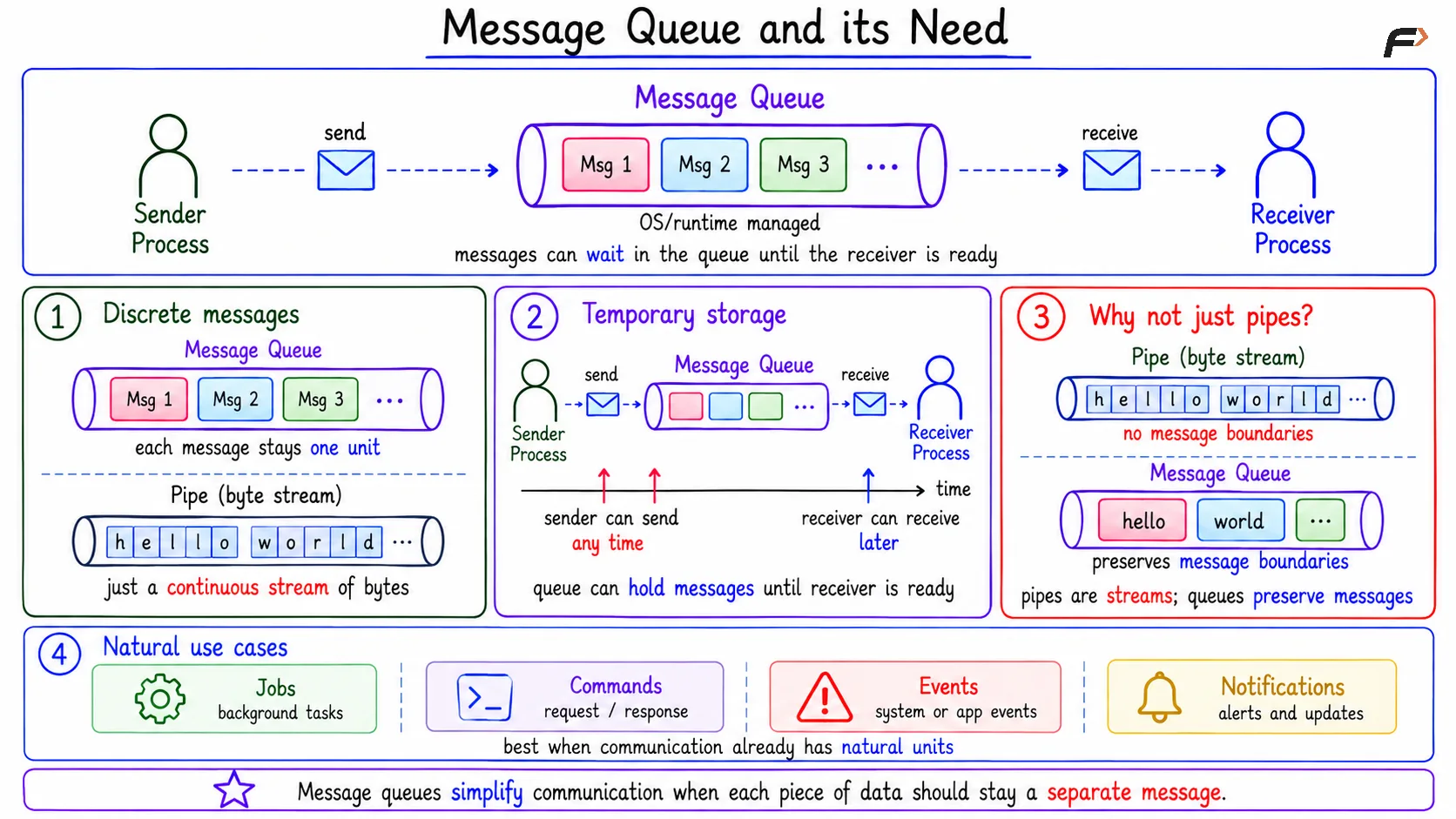
Message Queue and its Need
How a Message Queue Works
A process first creates or opens a message queue. After that, one process can send a complete message into the queue, and another process can receive a complete message from it.
The basic flow is:
Create or open the queue: A process gets access to the queue.
Send a message: The sender places a complete message into the queue.
Store the message: The OS or runtime keeps the message until it is received.
Receive a message: The receiver removes one message and processes it.
Block if needed: A sender may wait if the queue is full, and a receiver may wait if the queue is empty.
Some message queue interfaces also allow non-blocking behavior, where the process returns immediately if sending or receiving cannot happen right now.
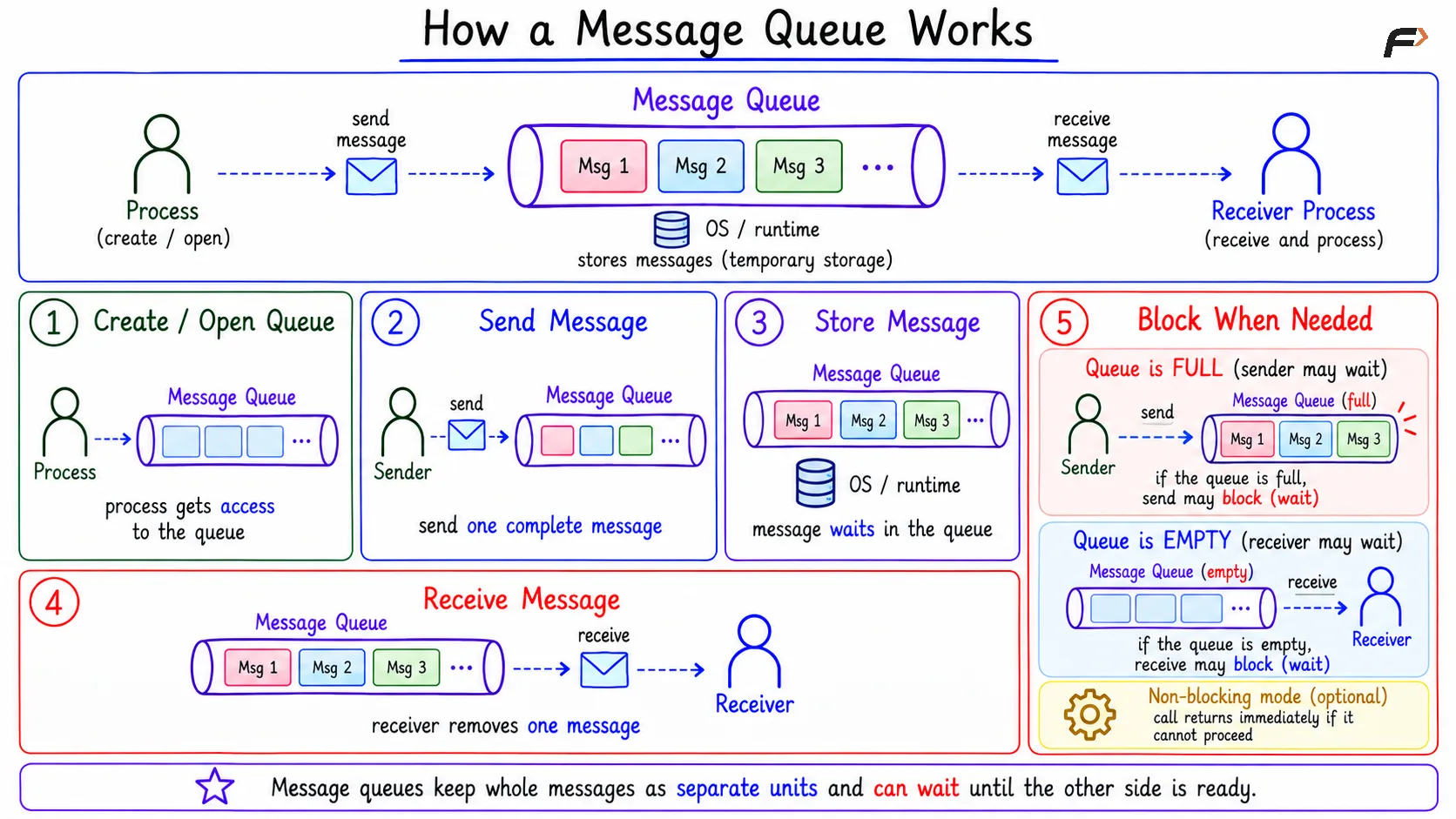
How a Message Queue Works
Common Features
Message queue features depend on the operating system or runtime, but the common idea is that the queue works with whole messages, not just raw bytes.
Useful features may include:
Message boundaries: Each message stays separate from the next.
Message priority: Higher-priority messages may be received before lower-priority ones.
Message type: Messages may carry a type so receivers can select or identify categories.
Bounded capacity: The queue may limit the number of messages or total queued data.
These features make message queues a good fit for structured IPC.
Pipe vs Message Queue
The central difference is that pipes are stream-oriented, while message queues are message-oriented.
Point | Pipe | Message Queue |
|---|---|---|
Data style | Continuous byte stream | Separate message units |
Boundary handling | Application must define boundaries | Queue preserves boundaries |
Best fit | Shell pipelines, stream data | Jobs, commands, events, notifications |
Temporary storage | Kernel pipe buffer | Managed message queue |
A pipe is simpler when ordered bytes are enough. A message queue is better when each unit of communication has independent meaning.
Decoupling Sender and Receiver
Message queues can also decouple the sender and receiver. The sender can place a message into the queue, and the receiver can remove it later.
This does not mean every message queue is persistent forever. It means the queue can hold messages temporarily, so sender and receiver do not always need to act at the exact same moment.
That is why message queues naturally fit worker systems. One process can submit work, and another process can pick up one message at a time.
Advantages and Tradeoffs
Message queues add useful structure, but that structure has costs. They are best used when message boundaries matter more than raw bulk throughput.
Advantages include:
Structured communication: Messages are naturally separated.
Cleaner receiver logic: The receiver handles one complete unit at a time.
Better decoupling: Sender and receiver can coordinate through the queue.
Tradeoffs include:
Queue limits: A full queue may block senders or require error handling.
Copying overhead: Messages may be copied through the queue.
Not ideal for huge data: Shared memory or file-based methods may be better for large bulk transfer.
Summary
A message queue is an IPC mechanism for sending separate messages between processes through an OS-managed or runtime-managed queue. It preserves message boundaries, unlike a pipe, which provides a raw byte stream.
Message queues fit commands, events, jobs, and notifications where each unit has meaning. Their main costs are queue limits, message size limits, copying overhead, and weaker suitability for very large data movement.
Be the first to add a comment.