Introduction
Inter-process communication becomes easier when it is treated as a design choice, not a list of names to memorize. Pipes, message queues, shared memory, signals, mmap, and sockets all exist because processes communicate in different ways.
The useful question is not “which IPC mechanisms do I remember?” The better question is “what kind of communication problem am I solving?” Once the shape is clear, the IPC choice becomes easier to justify.
IPC Is a Design Choice
IPC selection depends on the structure of communication. A system may need a byte stream, separate message units, large shared data, file-backed memory access, small control notifications, or client-server communication.
This keeps the decision practical. The fastest mechanism is not always best, and the simplest mechanism is not always enough.
Core Decision Questions
Before choosing an IPC mechanism, ask what the processes actually need to do.
Important questions include:
Data shape: Is the communication a raw byte stream, separate messages, shared data, file-backed memory, or a control notification?
Data size: Is the data small, medium, or large enough that repeated copying becomes costly?
Communication scope: Are the processes on the same machine, or do they need to communicate over a network?
Participant pattern: Is this one producer and one consumer, or many clients talking to one service?
Message boundaries: Does each job, command, or event need to remain separate?
Synchronization need: Will multiple processes read and write shared mutable state?
Persistence need: Should the object or data remain available beyond one immediate exchange?
These questions matter more than the popularity of any single IPC mechanism.
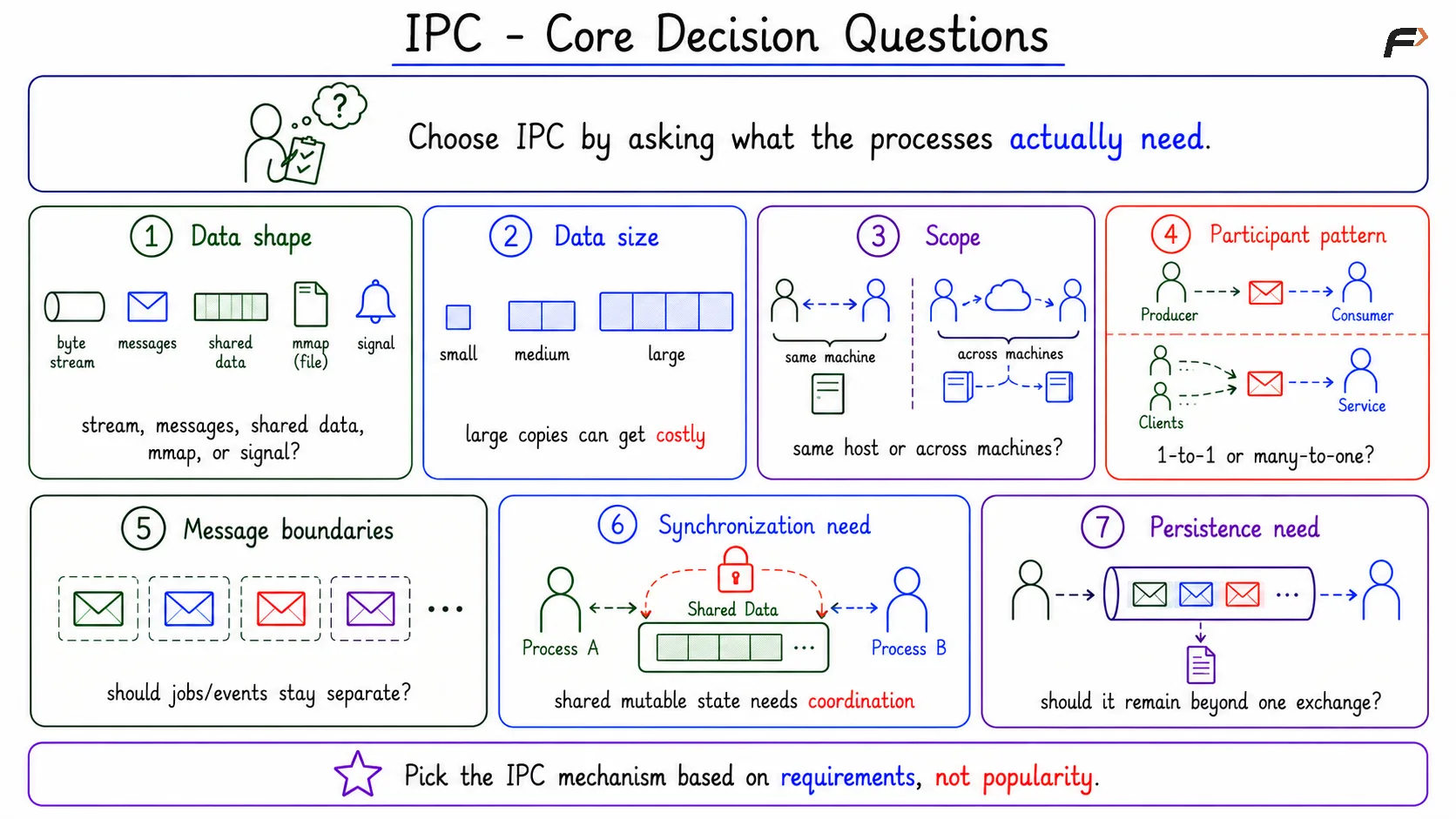
IPC - Core Decision Questions
Mechanism Selection Guide
The major IPC mechanisms fit different communication shapes.
IPC Mechanism | Best Fit | Main Tradeoff |
|---|---|---|
Pipe | Simple local byte stream | No natural message boundaries |
Named pipe | Local stream between unrelated processes | Still stream-oriented |
Message queue | Separate jobs, commands, events, or notifications | Queue limits and overhead |
Shared memory | Fast local sharing of large data | Needs synchronization |
mmap | File-backed memory access or shared mapping | Shared writes need coordination |
Signal | Small control notification | Not for data transfer |
Socket | Local or network endpoint communication | Requires protocol/framing design |
Scenario-Based Choices
Here are common IPC choices by situation:
Shell pipeline: Use a pipe because the communication is an ordered local byte stream.
Unrelated local processes using a stream: Use a named pipe.
Worker receives jobs: Use a message queue because each job is a separate unit.
Large image or video buffer: Use shared memory because repeated copying is expensive.
Map a large file: Use
mmapbecause the file can be accessed through memory.Tell a daemon to reload: Use a signal or service-manager mechanism.
Two local services communicating: Use a Unix domain socket.
Client talks to remote server: Use a TCP socket.
The right answer is the one that matches the communication shape and accepts the tradeoff openly.
Common Mistakes
One common mistake is using signals for data transfer. Signals are small notifications, not rich communication channels.
Another mistake is using shared memory only because it is fast. Shared memory also brings synchronization, cleanup, lifecycle, and correctness responsibilities.
It is also easy to assume TCP preserves message boundaries. TCP preserves byte order, but applications must still define where one message ends and the next begins.
A final mistake is ignoring cleanup. Named IPC objects, queues, shared memory regions, sockets, and mapped regions may need ownership and lifecycle rules.
Summary
IPC selection is about communication shape. Use pipes for simple local streams, named pipes for stream communication between unrelated local processes, message queues for separate work units, shared memory for fast local bulk sharing, mmap for file-backed memory access, signals for control notifications, and sockets for endpoint-based local or network communication.
A strong IPC choice explains both fit and tradeoff. Choose by scenario, data shape, size, scope, participants, synchronization needs, and debugging simplicity rather than by memorizing mechanism names.
Be the first to add a comment.