Introduction
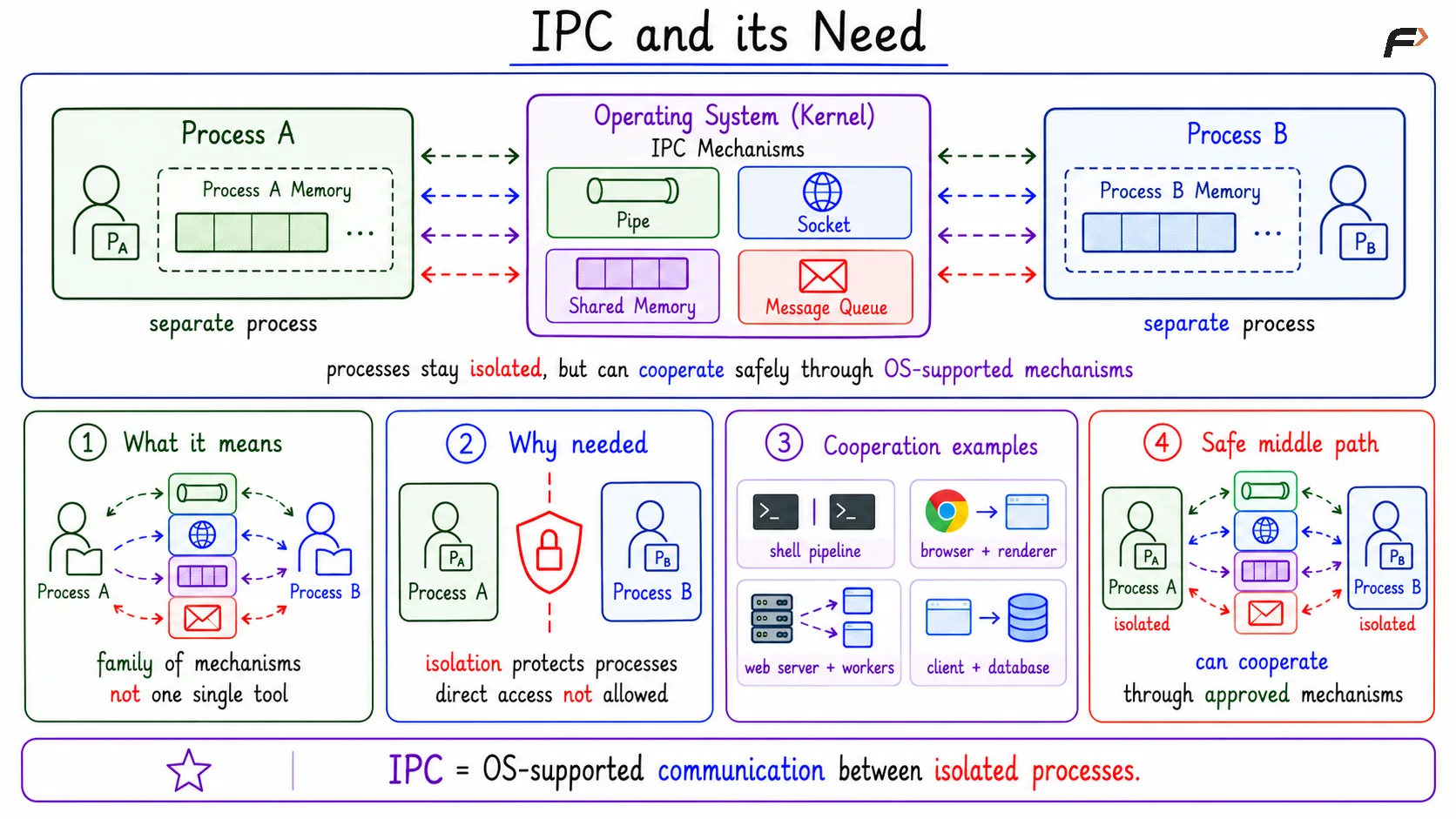
Inter-Process Communication, or IPC, exists because processes are isolated for safety. One process has its own virtual memory, and another process cannot freely read or write that memory.
This isolation protects programs from damaging each other, but real systems still need cooperation. IPC gives processes controlled ways to exchange data, send notifications, and coordinate work.
What IPC Means
IPC is a set of OS-supported mechanisms that allow separate processes to communicate. It is not one single tool; it is a family of communication methods provided by the operating system.
IPC keeps process isolation intact. Processes do not get unrestricted access to each other's memory; they communicate through approved mechanisms such as pipes, sockets, shared memory, or message queues.
Why IPC Is Needed
Separate processes are protected from each other by design. This prevents one faulty process from corrupting another process's memory or directly interfering with kernel-managed resources.
But many useful workflows need cooperation:
Shell pipeline: One command produces output, and another command filters it.
Browser architecture: A browser process may communicate with renderer or helper processes.
Backend service: A web server may pass work to worker processes.
Database system: A client process may communicate with a database server.
IPC provides the safe middle path: processes remain isolated, but they are not unable to cooperate.
IPC and its Need
IPC Is a Design Choice
IPC is chosen based on how processes need to communicate. The choice depends on:
Data: Stream or structured messages, small or large.
Direction: One-way or two-way communication.
Location: Same machine or across a network.
Performance: Speed, synchronization, and safety requirements.
Different communication needs require different IPC mechanisms.
Common IPC Mechanisms
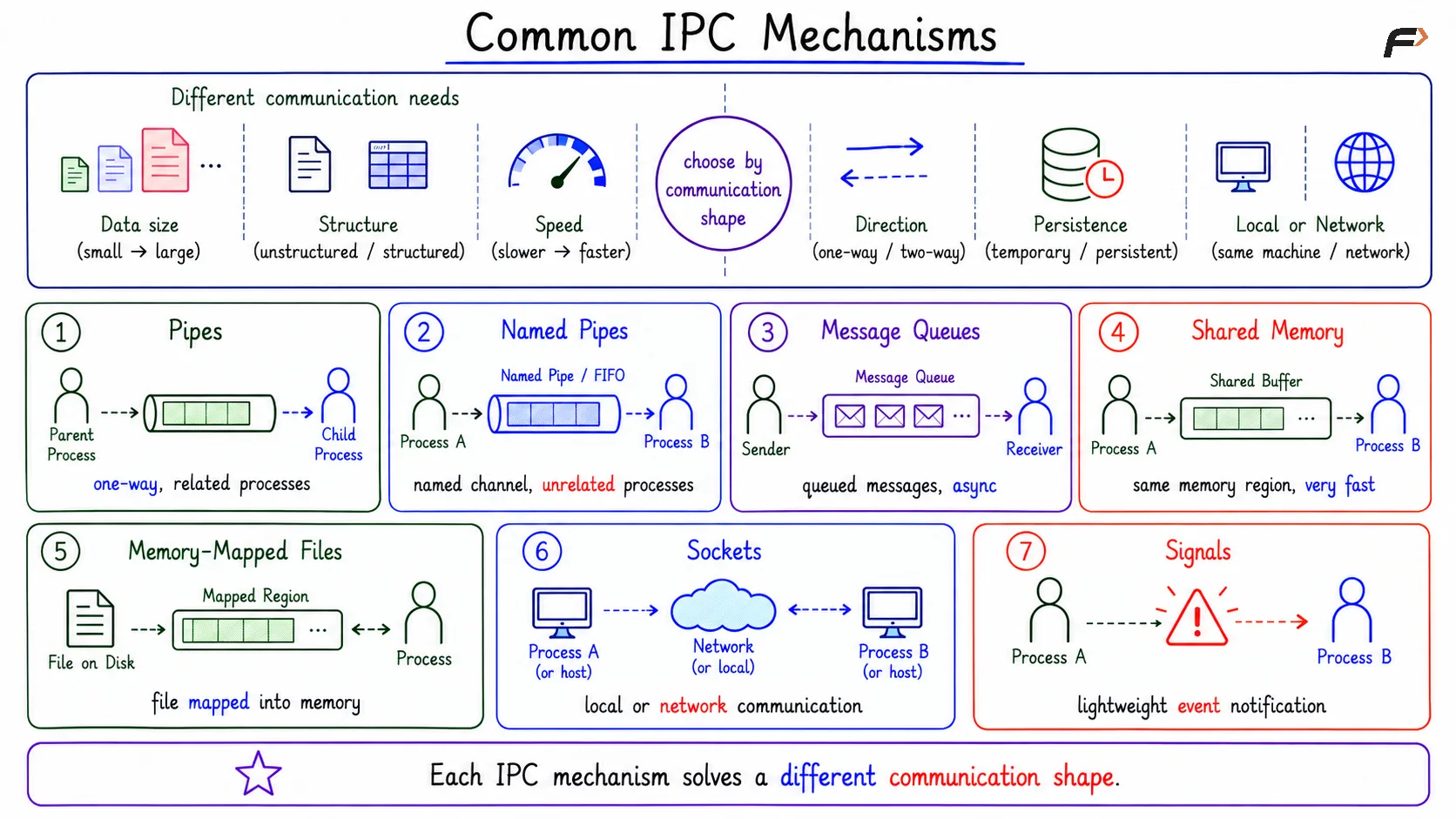
Different IPC mechanisms fit different communication needs. The choice depends on data size, structure, speed, direction, persistence, and whether communication is local or network-based.
Pipes: Simple one-way communication between related processes, commonly used between a parent and child process.
Named pipes: Pipes with a name that allow unrelated processes to communicate.
Message queues: Store messages in a queue so processes can send and receive data asynchronously.
Shared memory: Allows multiple processes to access the same memory region for fast data exchange.
Memory-mapped files: Maps a file into memory so processes can access file data through memory operations.
Sockets: Enable communication between processes, either on the same machine or across a network.
Signals: Lightweight notifications sent to processes to indicate events such as termination or interruption.
These mechanisms are not interchangeable names for the same thing. Each one solves a different communication shape.
Common IPC Mechanisms
Choosing the Right IPC Mechanism
IPC choice depends on the communication requirement. The best mechanism is the one that matches the shape of the data and coordination.
Use these practical directions:
Simple local byte stream: Pipe.
Pipe-like communication through a name: Named pipe.
Structured messages: Message queue.
Fast large-data sharing: Shared memory, with synchronization.
File-backed sharing: Memory-mapped file.
Local or network service communication: Socket.
Small event notification: Signal.
The main question is not “which IPC is best?” The better question is “what kind of communication does this system need?”
Summary
IPC allows isolated processes to exchange data, signals, and coordination information through operating-system-supported mechanisms. It preserves process safety while still allowing real programs to cooperate.
Common IPC mechanisms include pipes, named pipes, message queues, shared memory, memory-mapped files, sockets, and signals. IPC is a design choice based on communication shape, data size, structure, synchronization needs, and whether the communication is local or network-based.
Be the first to add a comment.