Introduction
Software-only algorithms explain mutual exclusion clearly, but real machines are more complicated than the simple teaching model. Multiple cores, CPU caches, compiler optimizations, and memory reordering can make plain shared-variable reasoning unsafe.
Hardware synchronization solves this by providing atomic operations. These operations give the operating system a small indivisible step that can be used to build locks and higher-level synchronization primitives.
Why Hardware Synchronization Exists
A normal shared-variable check may look simple in code, but it can break when multiple threads or processes run on real hardware. One thread may be preempted, another core may update cached data, or operations may become visible in a different order.
The missing requirement is atomicity. Synchronization often needs a check and an update to happen as one indivisible action.
Hardware gives the reliable low-level step. The operating system and libraries use that step to build tools that application code can use more safely.
Meaning of Atomic Operation
Atomic means indivisible. Other threads cannot observe the operation halfway done.
A read-modify-write operation performs three logical actions:
Read: It reads the current memory value.
Modify: It computes or changes the value.
Write: It writes the updated value back.
Atomic behavior: The whole sequence appears as one unbroken operation.
This matters because lock acquisition often needs to check whether a lock is free and mark it as busy in the same step.
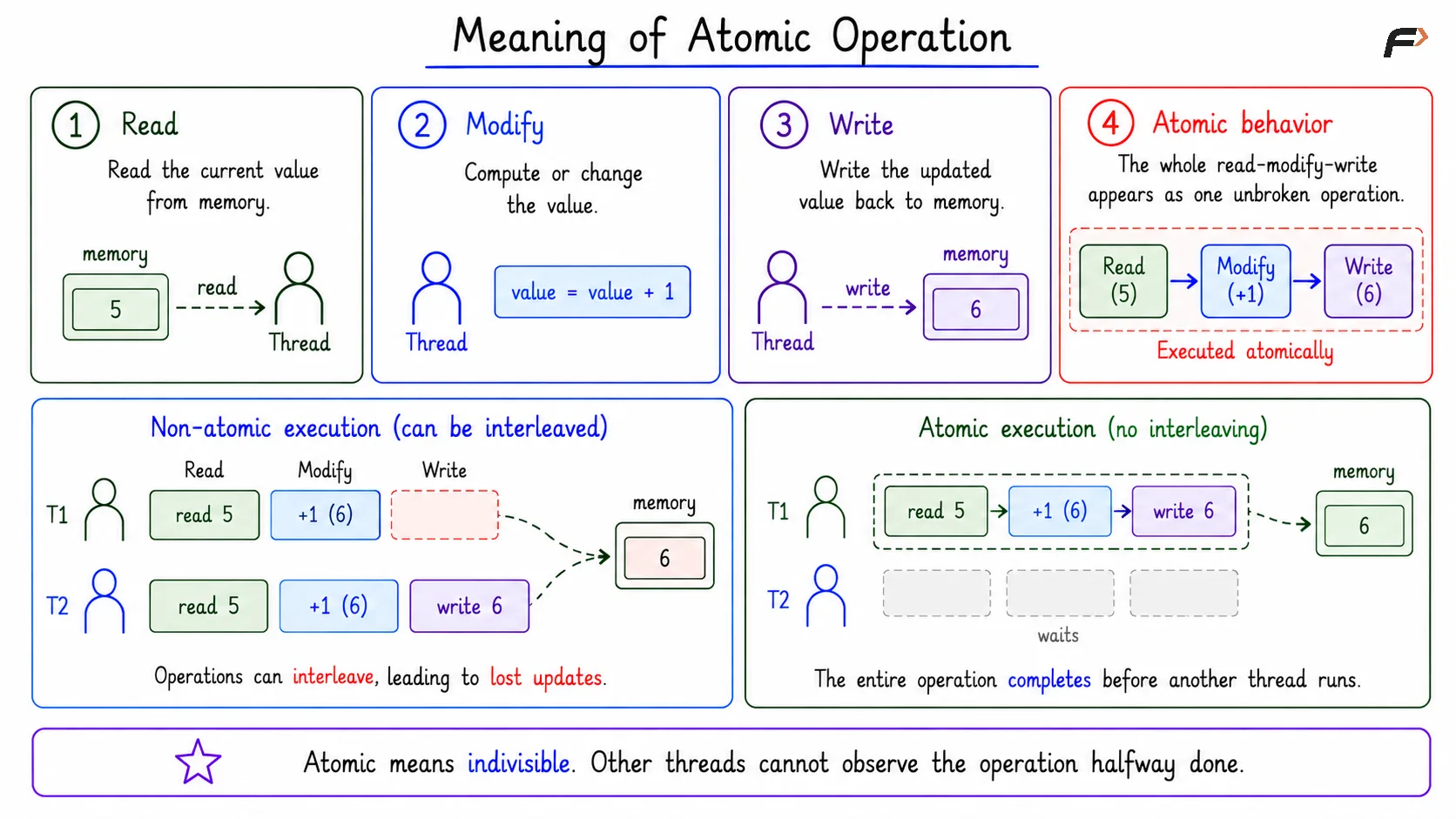
Meaning of Atomic Operation
Why Normal Check-Then-Set Fails
Suppose 0 means unlocked and 1 means locked. A simple but unsafe lock attempt might do this:
if lock == 0:
    lock = 1
    enter critical section
The problem is that the check and the update are separate. Two threads can both read lock == 0 before either write becomes visible, and both may enter the critical section.
Atomic hardware avoids this timing gap by combining the check and update into one indivisible operation.
Common Hardware Primitives
Operating systems commonly rely on hardware-supported atomic primitives.
Primitive | Basic idea |
|---|---|
Test-and-set | Reads the old value and sets a new value as one atomic action |
Compare-and-swap | Updates a value only if it still matches an expected value |
Atomic exchange | Swaps values atomically |
Fetch-and-add | Reads a value, adds to it, and stores the result atomically |
These primitives do not replace synchronization design. They provide the low-level operation from which synchronization tools can be built.
From Hardware to OS Synchronization Tools
Raw atomic instructions are usually too low-level for normal application code. Operating systems, runtimes, and libraries build higher-level synchronization tools on top of them.
Common examples include:
Spinlocks: Waiting threads repeatedly check until the lock becomes free.
Mutexes: Only one thread can hold the lock; others must wait.
Semaphores: Counters used to control access to limited resources.
Condition variables: Tools for waiting until a condition becomes true.
Read-write locks: Allow multiple readers or one writer.
The clean distinction is: hardware provides atomicity, while OS and library primitives provide usable synchronization behavior.
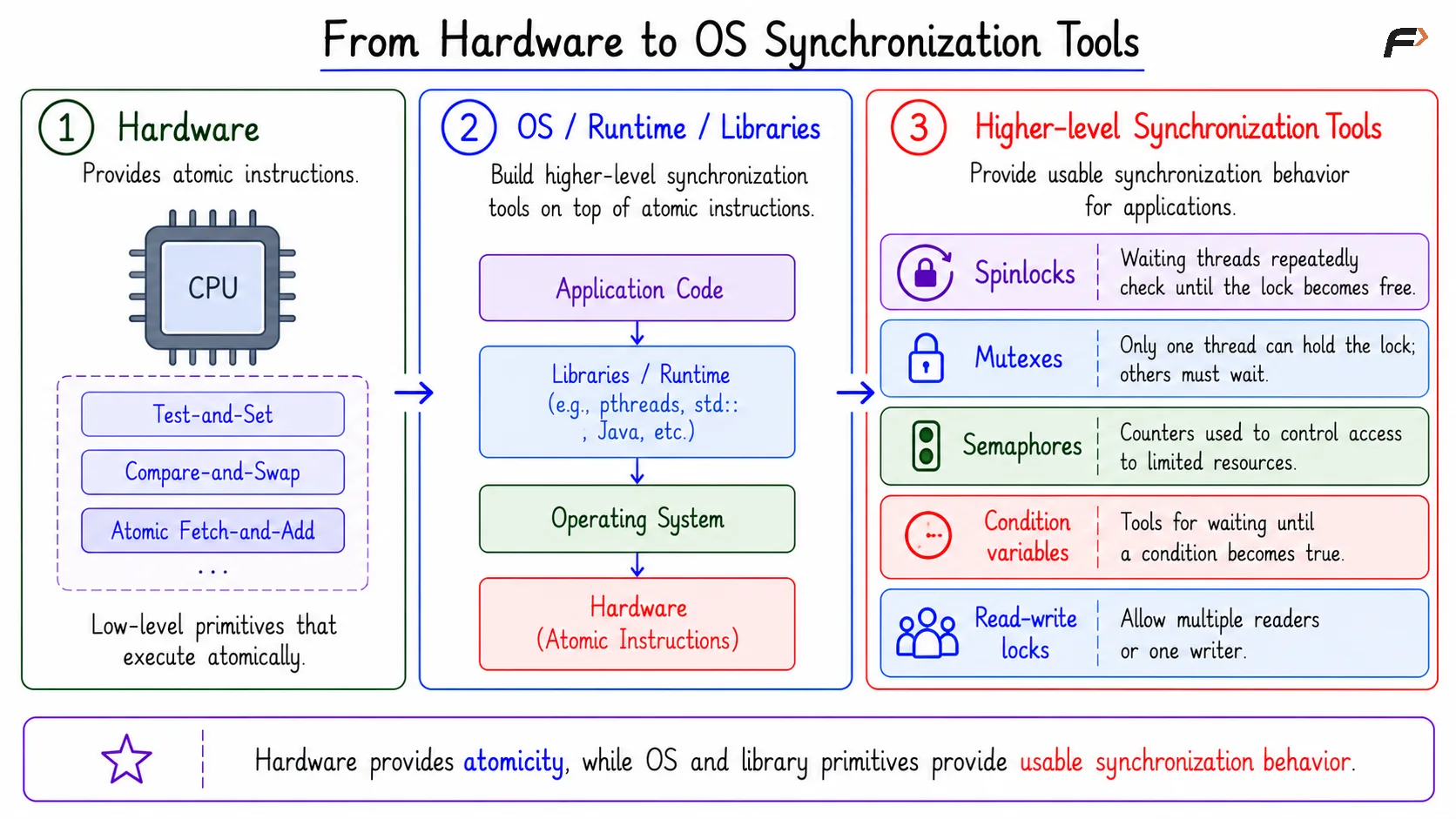
From Hardware to OS Synchronization Tools
Busy Waiting and Blocking
Hardware atomic operations are often used in locks, but waiting still has a cost. Two common waiting styles are busy waiting and blocking.
Waiting style | Meaning | Main tradeoff |
|---|---|---|
Busy waiting | The thread keeps checking while the lock is busy | Fast for tiny waits, but wastes CPU if the wait is long |
Blocking | The OS puts the thread to sleep and wakes it later | Saves CPU, but sleep and wakeup add overhead |
How Real Mutexes Combine Both
Many real mutex implementations combine a fast path and a blocking path.
The basic flow is:
Fast path: Try to acquire the lock in user space using an atomic operation.
Short wait: Spin briefly if the lock may be released soon.
Slow path: If waiting becomes longer, block the thread through the operating system.
Wakeup: When the lock is released, a waiting thread may be woken.
This mixed design keeps uncontended locks fast while avoiding long CPU-wasting spins. Linux futex-based mutexes are a common example of this fast-user-space plus kernel-waiting idea.
Summary
Hardware synchronization exists because real machines make simple shared-variable reasoning unreliable. Multiple cores, caches, preemption, and memory reordering require operations that cannot be split.
Atomic read-modify-write instructions provide that indivisible step. Operating systems and libraries use them to build spinlocks, mutexes, semaphores, condition variables, read-write locks, barriers, and lock-free data structures.
Be the first to add a comment.