Introduction
Frame allocation decides how physical memory frames are divided among processes. It is closely related to page replacement, but both solve different parts of virtual memory management.
Page replacement asks which page should be removed when memory is full. Frame allocation asks how many frames each process should receive before those replacement decisions happen.
Why Frame Allocation Is Needed
When a process references a page that is not present in RAM, a page fault occurs. The operating system must bring that page into a physical frame. If no free frame exists, some page must be replaced.
Frame allocation matters because the number of frames given to a process directly affects how often it faults. Too few frames can make a process fault again and again, while too many frames for one process can reduce memory available for others.
The main goal is balance: enough frames for each process to make progress, without allowing one process to unfairly consume memory.
Equal Allocation
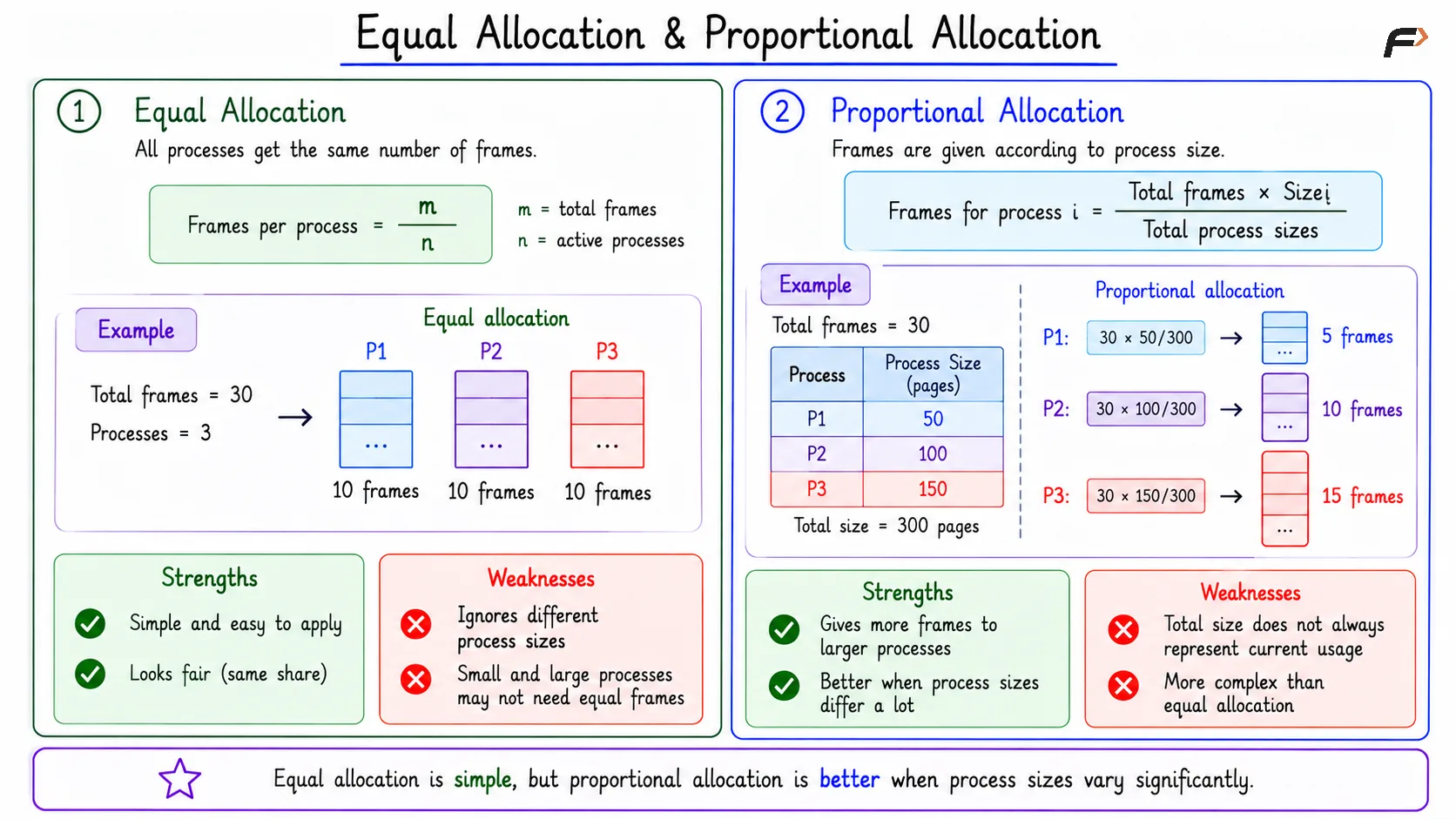
Equal allocation gives the same number of frames to every active process. If there are m available frames and n active processes, each process gets approximately m / n frames.
For example, if the system has 30 frames and 3 active processes, then each process gets 10 frames.
Strength | Weakness |
|---|---|
Simple and easy to apply | Ignores different process sizes |
Looks fair because each process gets the same share | A small process and a large process may not need equal frames |
Equal allocation is easy to understand, but it may not match actual memory demand.
Equal Allocation & Proportional Allocation
Proportional Allocation
Proportional allocation gives frames according to process size. Larger processes receive more frames because they have a larger virtual memory requirement.
The formula is: Frames for process i = (Total frames * Size of process i) / Total process sizes
Suppose the system has 30 frames, while P1 has a process size of 50 pages, P2 has 100 pages, and P3 has 150 pages. The total process size is 300 pages.
So the allocation becomes:
Process | Calculation | Frames |
|---|---|---|
P1 |
| 5 |
P2 |
| 10 |
P3 |
| 15 |
This strategy is better than equal allocation when process sizes differ a lot. Its limitation is that total size does not always represent current active usage.
Priority Allocation
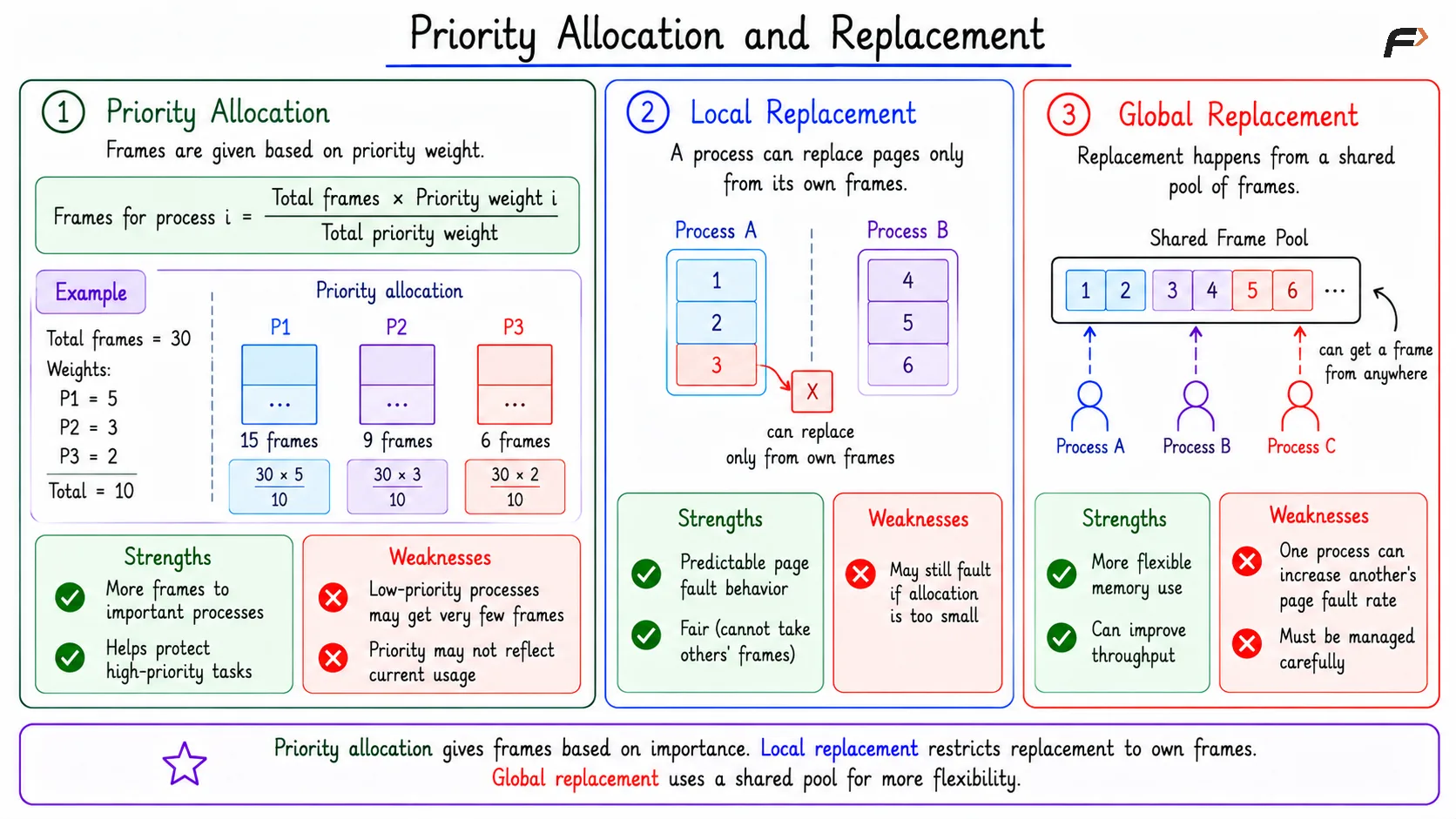
Priority allocation gives frames based on priority weight. More important processes receive a larger share of memory.
The formula is: Frames for process i = (Total frames * Priority weight i) / Total priority weight
Suppose the system has 30 frames, and three processes have priority weights of 5 for P1, 3 for P2, and 2 for P3. Total weight is 5 + 3 + 2 = 10.
Process | Calculation | Frames |
|---|---|---|
P1 |
| 15 |
P2 |
| 9 |
P3 |
| 6 |
Priority allocation helps protect important processes. However, low-priority processes may receive too few frames and suffer frequent page faults.
Local Replacement
In local replacement, a process can replace pages only from its own allocated frames. It cannot take frames from another process.
For example, if Process A has frames containing pages 1, 2, 3, and Process B has frames containing pages 4, 5, 6, then Process A can evict only from its own three frames.
Local replacement has two main benefits:
Predictability: A process’s page fault behavior depends mostly on its own allocation.
Fairness: One process cannot directly take frames assigned to another process.
The limitation is that a process may continue faulting if its allocation is too small, even if some other process is not using its frames efficiently.
Priority Allocation and Replacement
Global Replacement
In global replacement, replacement happens from a shared pool of frames. A process may receive a frame that was previously used by another process.
This makes memory use more flexible. If one process suddenly needs more frames, the operating system can give it frames from the global pool instead of forcing it to stay inside a fixed allocation.
Global replacement can improve throughput, but it must be managed carefully because one process can indirectly increase another process’s page fault rate.
Minimum Frames
Every process needs some minimum number of frames to execute properly. If it receives fewer frames than this minimum, it may not be able to keep the pages required for an instruction sequence in memory together.
For example: If a process needs pages P1, P2, P3, P4 together but receives only one frame, it may load P1, fault on P2, evict P1, fault on P3, and continue cycling. Stable progress becomes difficult because the needed pages cannot remain in memory at the same time.
Frame Allocation and Thrashing
Frame allocation is directly connected to thrashing. If active processes receive fewer frames than their working needs, page faults rise sharply.
Too many active processes can also make the total memory demand exceed available frames. In that case, the system may spend more time paging than executing useful instructions.
A practical frame allocation policy should consider:
Process size: Larger processes may need more frames.
Priority: Important processes may deserve more protection.
Working set demand: Active pages should fit in memory as much as possible.
Minimum frame requirement: A process must receive enough frames to execute safely.
The purpose is not just to divide memory, but to keep processes making progress without creating excessive paging.
Summary
Frame allocation is the operating system’s decision about how physical memory frames are divided among active processes. It affects fairness, page fault rate, throughput, and the risk of thrashing.
Equal allocation is simple, proportional allocation considers process size, and priority allocation protects important processes. Local replacement gives control, global replacement gives flexibility, and minimum frame requirements ensure a process can make stable progress.
Be the first to add a comment.