Introduction
The Dining Philosophers Problem is a classic synchronization problem in operating systems. It models threads competing for shared resources that must be acquired together before work can continue.
The story uses philosophers and chopsticks, but the real lesson is about resource allocation. If every thread holds one resource and waits for another, the system can stop making progress.
Problem Setup
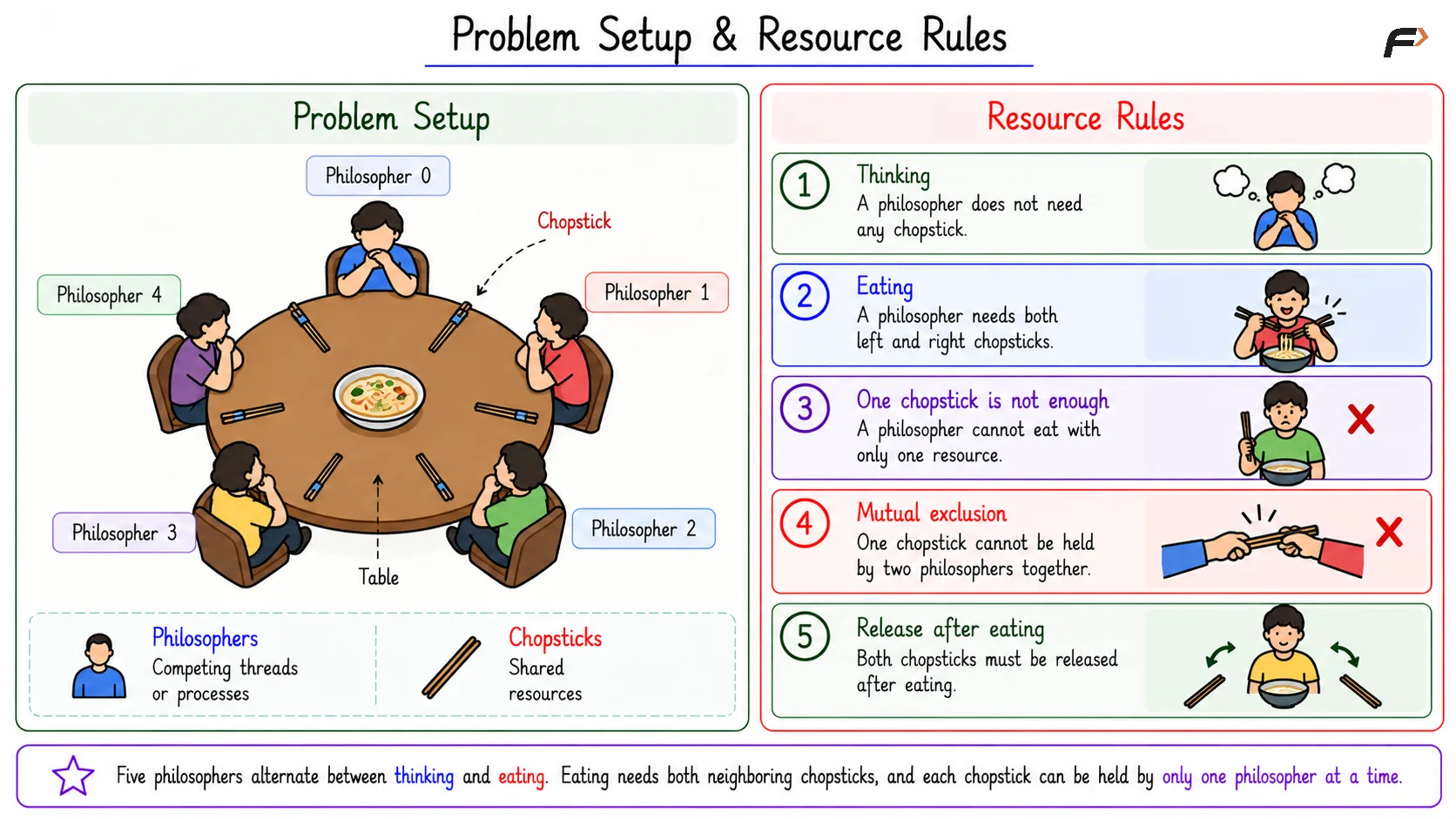
Five philosophers sit around a circular table. Five chopsticks are placed between them.
Each philosopher alternates between thinking and eating. Thinking needs no chopstick, but eating needs both neighboring chopsticks.
In synchronization terms:
Philosophers: Competing threads or processes.
Chopsticks: Shared resources.
Eating: Critical work that needs two resources.
Thinking: Work that does not need shared resources.
Each chopstick can be held by only one philosopher at a time, so mutual exclusion applies to every chopstick.
Resource Rules
The basic rules are:
Thinking: A philosopher does not need any chopstick.
Eating: A philosopher needs both left and right chopsticks.
One chopstick is not enough: The philosopher cannot eat with only one resource.
Mutual exclusion: One chopstick cannot be held by two philosophers together.
Release after eating: Both chopsticks must be released after eating.
The difficulty is making this flow safe when all philosophers run concurrently.
Problem Setup & Resource Rules
Naive Solution and Deadlock
A simple first attempt is:
pick left chopstick
pick right chopstick
eat
release both chopsticks
This looks reasonable for one philosopher, but it can fail when all philosophers act at the same time.
Suppose every philosopher picks the left chopstick first. Now each philosopher holds one chopstick and waits for the right chopstick. But every right chopstick is already held by a neighbor.
No philosopher can get the second chopstick, no one can eat, and no one releases the chopstick already held. This is deadlock.
Solution 1: Allow At Most Four
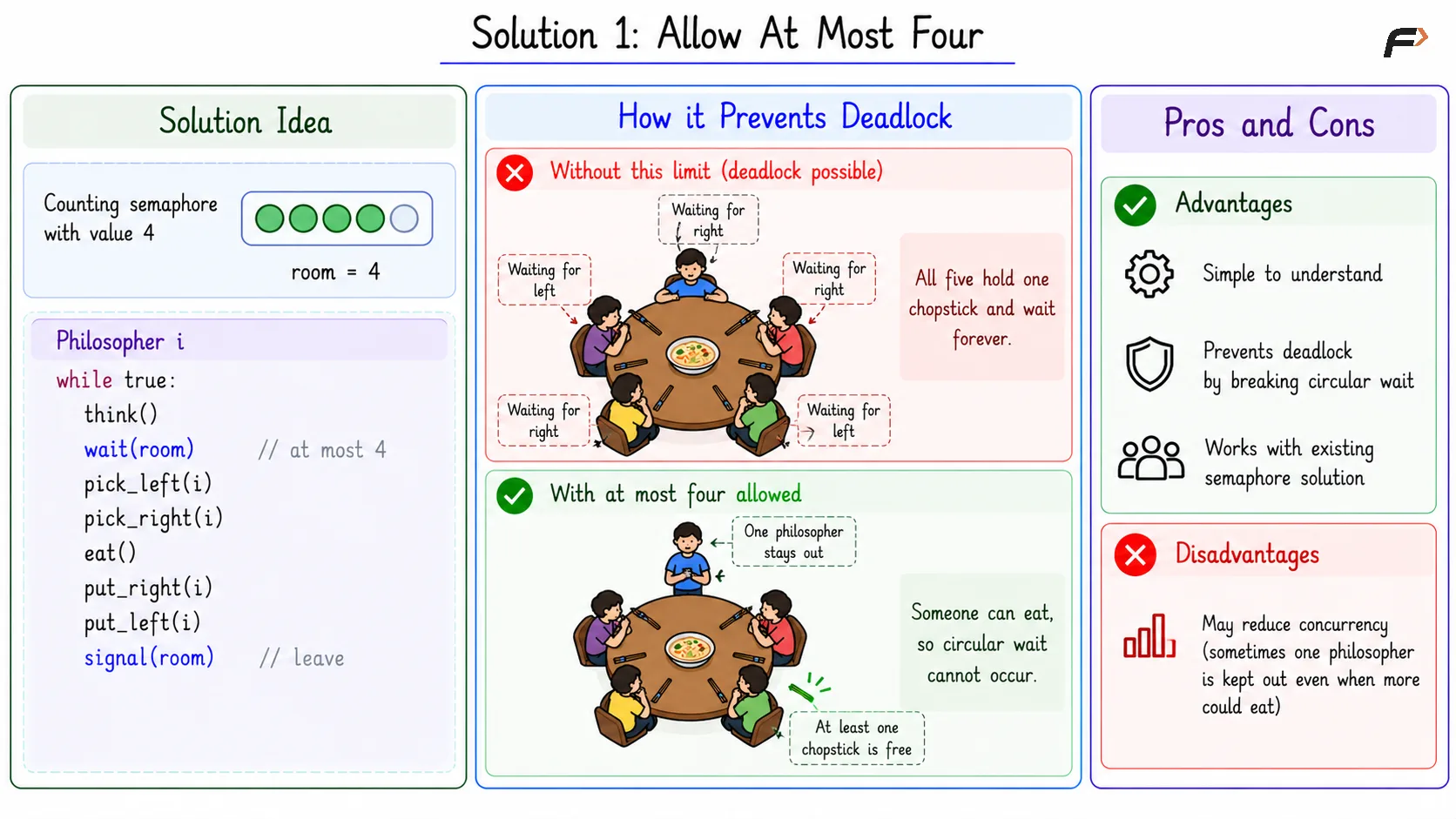
One common solution is to allow at most four philosophers to try eating at once. A counting semaphore can limit the number of philosophers entering the resource-acquisition phase.
The basic idea is: At most four compete => One philosopher stays out => Circular wait breaks => Someone can eat
If only four philosophers are allowed to pick chopsticks, at least one chopstick remains available. This prevents the situation where all five philosophers each hold one chopstick and wait forever.
This solution is easy to understand, but it may reduce concurrency slightly because one philosopher is kept out even when a safe schedule might have allowed more progress.
Allow At Most Four
Solution 2: Resource Ordering
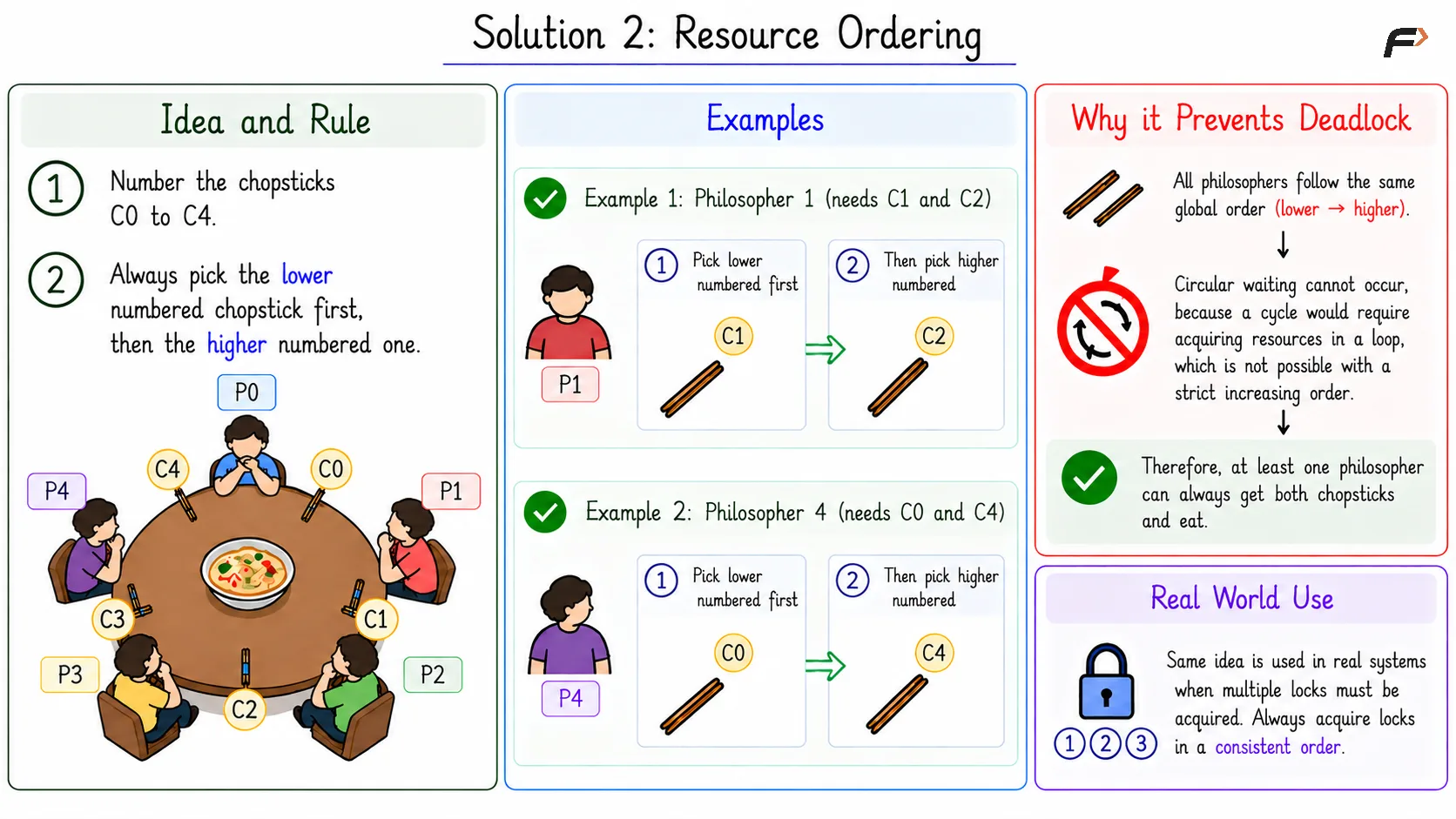
Another solution is resource ordering. Number the chopsticks from C0 to C4, and require every philosopher to acquire the lower-numbered chopstick first, then the higher-numbered chopstick.
For example, if a philosopher needs C1 and C2, the philosopher picks C1 first. If another philosopher needs C0 and C4, the philosopher picks C0 first.
This prevents circular waiting because all threads follow the same global order. The same idea is used in real systems when multiple locks must be acquired: always acquire locks in a consistent order.
Resource Ordering
What the Problem Teaches
The Dining Philosophers Problem brings several synchronization ideas together.
Mutual exclusion : A chopstick can be held by only one philosopher
Multiple resources : Eating needs two chopsticks, not one
Deadlock : Everyone waits forever for a resource held by someone else
Resource ordering : Consistent acquisition order can prevent circular wait
The main lesson is that locking one resource at a time without a global rule can create a circular wait.
Starvation and Fairness
Avoiding deadlock is not the only goal. A solution should also consider starvation and fairness.
Starvation happens when one philosopher keeps failing to get both chopsticks while others continue eating. The system is moving, but one participant is not making progress.
Fairness means every philosopher should eventually get a reasonable chance to eat. Some solutions prevent deadlock but still need additional scheduling or queueing rules to prevent starvation.
Summary
The Dining Philosophers Problem models threads competing for shared resources. Philosophers are threads, chopsticks are exclusive resources, and eating requires acquiring two neighboring resources.
The naive left-then-right solution can deadlock if every philosopher holds one chopstick and waits for the other. Common fixes include allowing at most four philosophers to compete or enforcing a global resource ordering rule.
Be the first to add a comment.