Introduction
Deadlock avoidance is a flexible way to control deadlock before it happens. Instead of permanently changing resource-use rules, the system checks each request while the program is running.
The main idea is safety before allocation. A resource request is granted only if the system can still guarantee some order in which all processes can finish.
What Deadlock Avoidance Means
Deadlock avoidance is a dynamic strategy where the system grants a resource request only if the resulting state remains safe. It does not permanently break Coffman conditions like deadlock prevention does.
Before granting a request, the system asks one important question: if this request is granted, will there still be a safe sequence for all processes?
If the answer is yes, the request can be granted. If the answer is no, the process must wait, even when the requested resources are currently available.
How Deadlock Avoidance Works
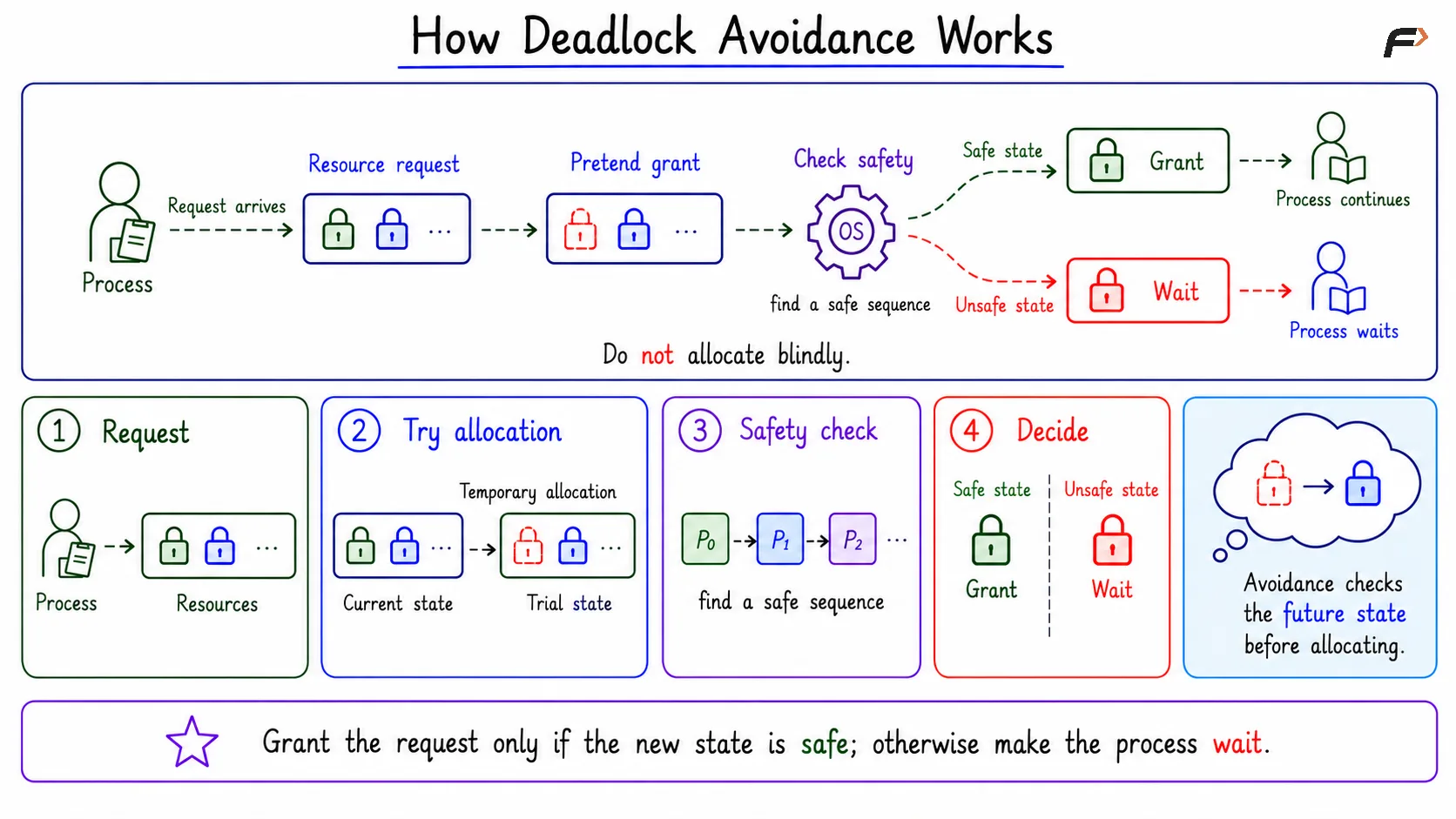
Deadlock avoidance works through runtime checking. The system does not blindly allocate resources just because they are free at the moment.
The basic flow is:
A process requests resources: The request arrives during execution.
The system pretends to grant it: It temporarily calculates the new state after allocation.
The system checks safety: It looks for at least one safe sequence.
The system decides: If the state is safe, the request is granted; otherwise, the process waits.
The key point is that avoidance blocks unsafe allocation decisions before they create serious deadlock risk.
How Deadlock Avoidance Works
Information Needed for Avoidance
Deadlock avoidance needs extra information about the system. Without future-need information, the system cannot judge whether a request keeps the state safe.
The main data items are:
Current allocation: Resources already held by each process.
Available resources: Resources free right now.
Maximum claim: Maximum resources each process may need in total.
Remaining need: Resources still needed by a process to complete.
The formula is: Remaining Need = Maximum Claim - Current Allocation
This information is used to search for a safe sequence. If a safe sequence exists after the request, the system remains safe.
Why a Request May Be Denied
A request may be denied even when the resources are available. This can feel strict, but it is the main purpose of deadlock avoidance.
The system is not only checking the present moment. It is checking whether the allocation could remove the guarantee that all processes can finish later.
So avoidance is conservative. It may delay a process today to prevent the system from entering an unsafe state tomorrow.
Prevention Versus Avoidance
Deadlock prevention and deadlock avoidance both try to stop deadlock, but their methods are different.
Point | Deadlock Prevention | Deadlock Avoidance |
|---|---|---|
Main idea | Break at least one Coffman condition | Avoid unsafe states |
Timing | Uses fixed design rules | Checks each request at runtime |
Flexibility | More restrictive | More flexible |
Information needed | Usually less future information | Needs maximum claim and current state |
The key difference is simple: prevention changes the rules so deadlock cannot form, while avoidance allows requests only when the resulting state remains safe.
Summary
Deadlock avoidance is a runtime strategy that checks each resource request before granting it. The system temporarily simulates the allocation and grants the request only if a safe sequence still exists.
Avoidance needs current allocation, available resources, maximum claim, and remaining need. It is more flexible than prevention, but it requires extra information and may delay requests to keep the system in a safe state.
Be the first to add a comment.