Introduction
Daemon processes explain how operating systems keep important services running in the background. These services usually do not have a visible window or terminal, but they continue doing useful system or application work.
Examples include web servers, database servers, SSH services, logging services, and scheduled-job services. They are different from foreground interactive programs that wait for direct user input.
What Is a Daemon Process?
A daemon process is a background service process that runs without direct interactive control. It provides system or application functionality while staying independent of a user-facing terminal.
A foreground process is usually tied to a terminal or user session. A daemon is meant to keep running as a service, often started during boot or managed by a service supervisor.
Why Daemons Are Needed
Many services must keep running even when no user is directly controlling them. A web server should keep accepting requests, a database server should keep responding to queries, and a logging service should keep recording events.
Common daemon examples include:
Web server: Handles HTTP requests in the background.
Database server: Serves database operations for applications.
SSH service: Allows remote login and remote access.
Logging service: Collects and stores system or application logs.
Cron-like scheduler: Runs scheduled tasks at configured times.
These services need reliability and independence, not direct terminal interaction.
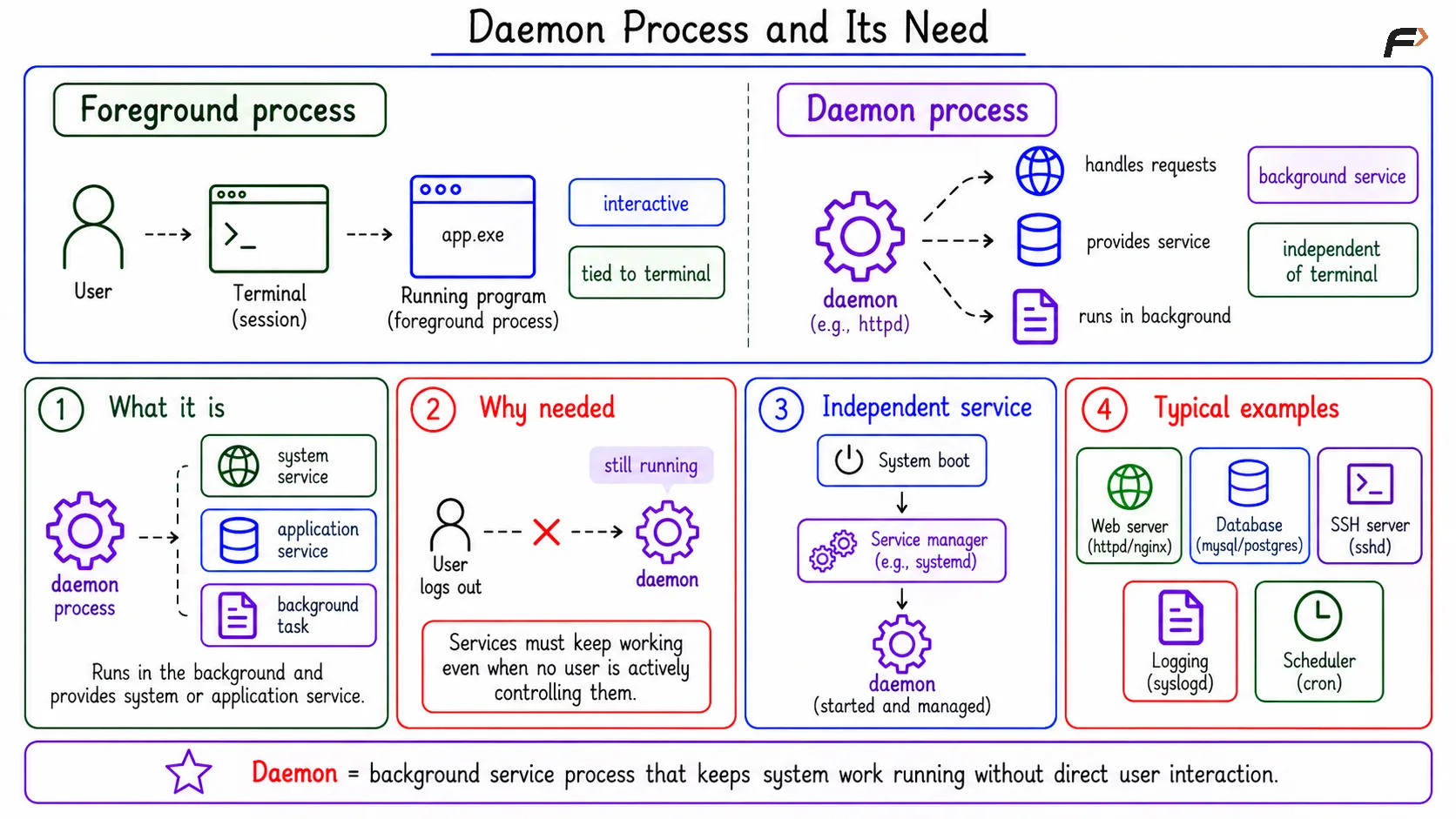
Daemon Process and its Need
Traditional Daemon Traits
Traditional Unix daemons were designed to become independent, controlled, long-running background processes. The exact steps can vary, but the purpose is the same: detach the service from the original user session and make it manageable.
Common traits include:
Detach from terminal: The daemon should not depend on a user's controlling terminal.
Run in background: It continues without direct interactive control.
Redirect standard streams: Standard input, output, and error may be closed or redirected.
Create a new session: The daemon separates from the original session context.
Write a PID file: The system can track the process identifier.
Handle signals: Signals may be used for reload, shutdown, or status behavior.
Log to system logs: Output goes to logs instead of a terminal.
Drop privileges: The daemon reduces permissions when possible for safety.
These traits help the daemon behave like a proper background service rather than a normal command-line program.
Modern systemd View
On many modern Linux systems, services are supervised by systemd. This changes the focus from manually daemonizing a process to defining how the service should be started, tracked, logged, stopped, and restarted.
With systemd, service management may include:
Service unit configuration: A unit file describes how the service should run.
Service startup:
systemdstarts the service under supervision.Main process tracking: The service manager tracks the important process.
Journal logging: Logs can be captured through the journal.
Restart policy: A failed service can be restarted based on configuration.
Socket activation: A service may start when socket activity arrives.
So the modern view is less about background tricks and more about supervision, lifecycle control, logging, and reliability.
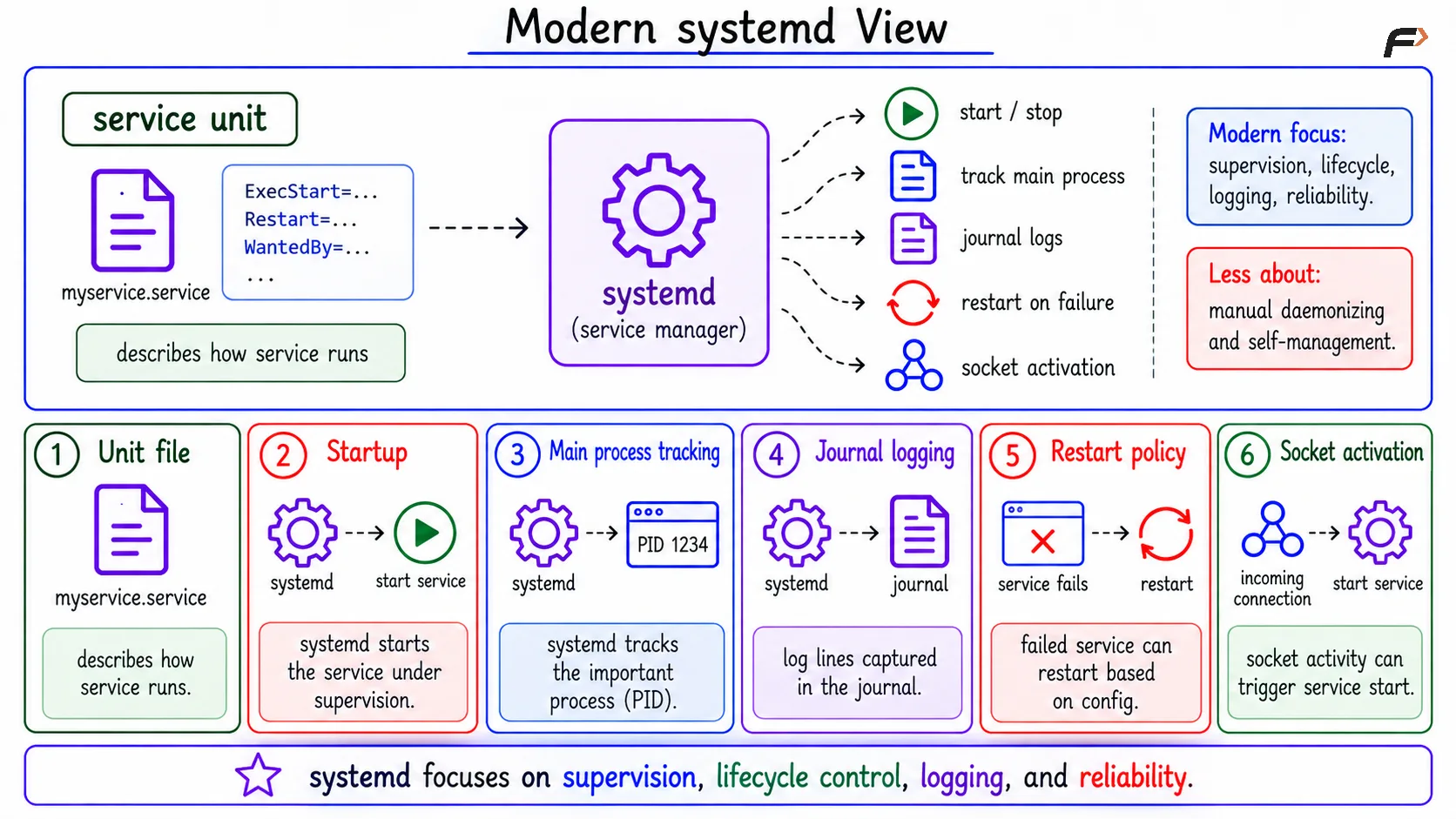
Modern systemd View
Summary
A daemon process is a background service process that runs without direct interactive control. It is used for long-running services such as web servers, database servers, SSH services, logging services, and scheduled-job systems.
Traditional Unix daemons often detach from terminals, redirect streams, create sessions, write PID files, handle signals, log properly, and drop privileges. Modern Linux systems commonly manage daemons through systemd, where supervision, lifecycle control, logging, restart policy, and reliability become central.
Be the first to add a comment.