Introduction
Context switching is the process in which the CPU moves from one task to another, even when the first task has not finished. The operating system pauses one process or thread, saves its current state, and later resumes it from the same point.
This is needed because a CPU core can execute only one thread at a given instant. If many processes are ready, the OS needs a controlled way to share CPU time among them.
Why Context Switching Exists
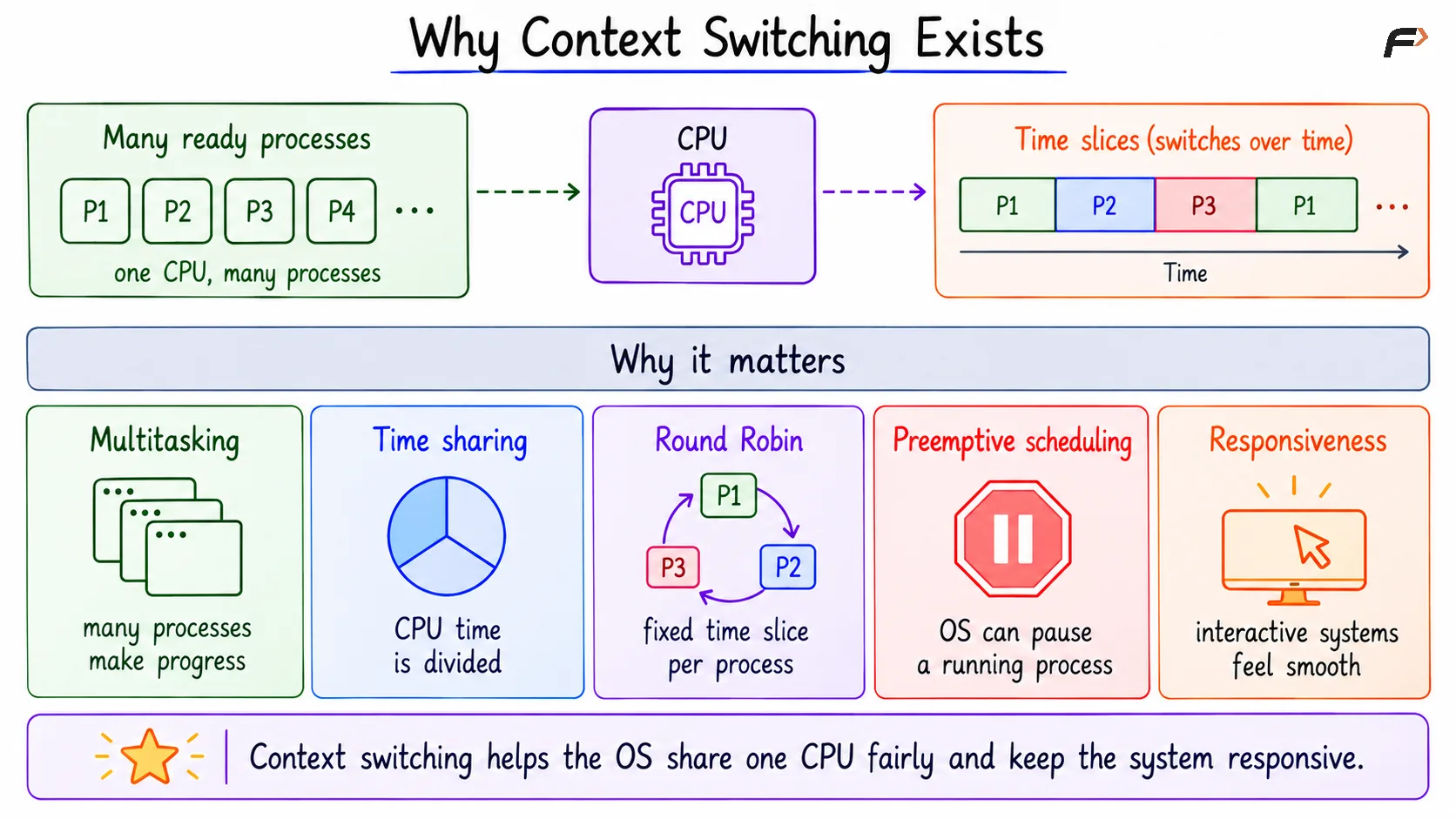
Context switching lets the operating system share the CPU among multiple processes and threads. Without it, one process could keep the CPU for too long while other ready processes remain stuck.
It also supports time sharing and preemptive scheduling. The OS can give one process a time slice, pause it when needed, and then let another ready process run.
Context switching is especially important for:
Multitasking: Many processes can make progress over time.
Time sharing: CPU time can be divided among processes.
Round Robin scheduling: Each process gets a fixed time slice.
Preemptive scheduling: The OS can pause a running process before it finishes.
Responsiveness: Interactive systems do not feel frozen when one process runs for long.
The goal is not to make one CPU core execute many threads at the exact same instant. The goal is to switch between them quickly and safely.
Why Context Switching Exists
Basic Meaning Of Context
In operating systems, context means the information needed to pause and resume a process or thread correctly. If this information is saved properly, the task can continue later as if it was never interrupted.
A process context commonly includes:
Program counter: Address of the next instruction to execute.
CPU registers: Temporary values currently being used by the CPU.
Stack pointer: Current position in the process stack.
Process state: Running, ready, waiting, or another state.
Scheduling information: Priority, queue information, and related data.
Memory context: Address-space or page-table-related information.
This context is usually stored in kernel-side process or thread records such as the PCB or TCB, depending on the operating system design.
Context Switch Flow
A context switch follows a controlled sequence. The exact internal details differ across operating systems and CPU architectures, but the broad idea remains the same.
The basic flow is:
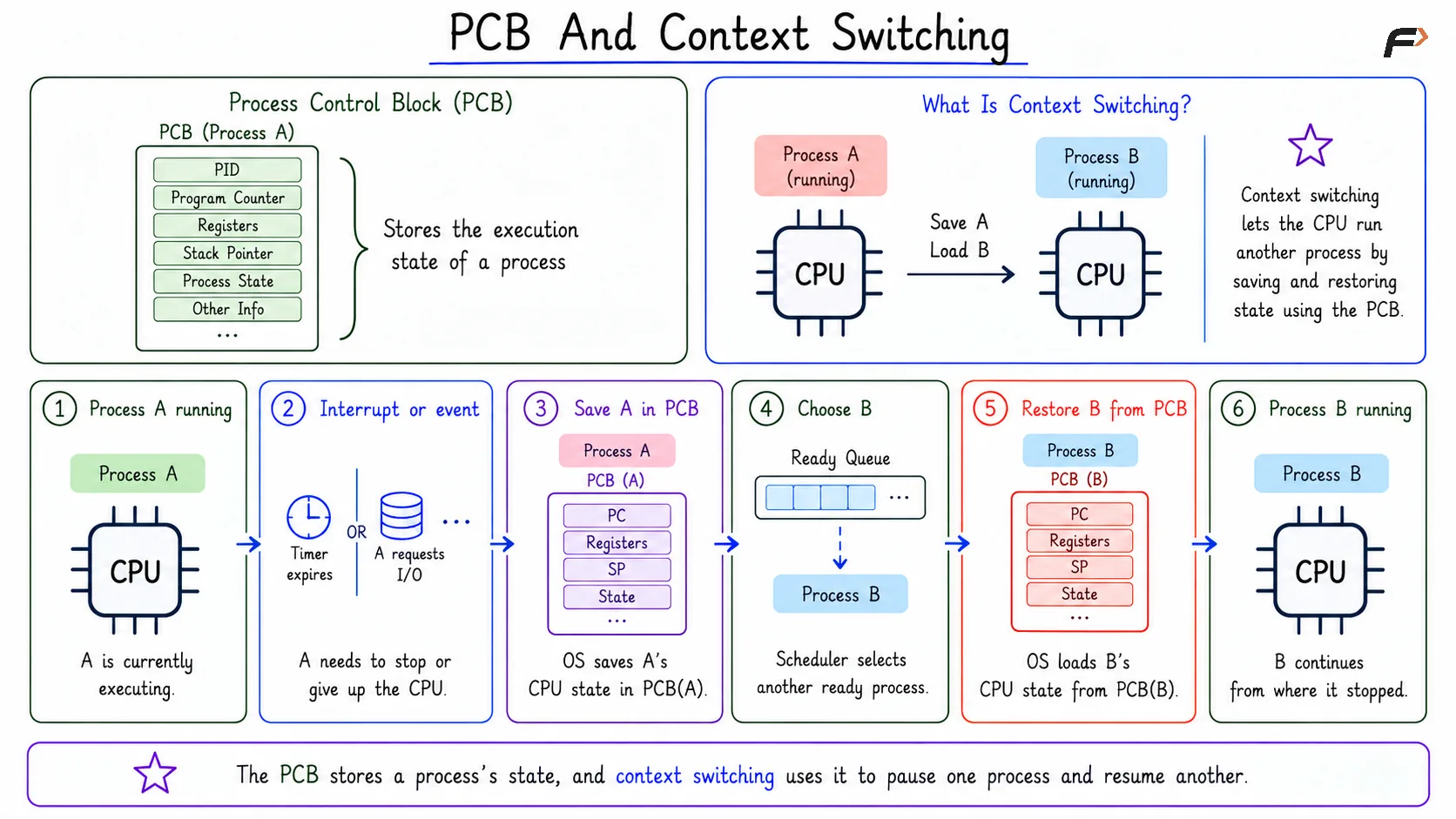
Process A is running: A is currently executing on the CPU.
An event occurs: A timer interrupt, blocking system call, wakeup, or priority event happens.
OS enters kernel mode: The kernel takes control to manage the switch.
A’s context is saved: Registers, program counter, stack pointer, and related state are stored.
Scheduler chooses B: The OS selects another ready process or thread.
B’s context is restored: B’s saved CPU state and memory context are loaded.
CPU resumes B: B continues from where it previously stopped.
A shorter way to remember it is: save old task, choose new task, restore new task, continue execution.
Context Switch Flow
Voluntary Context Switch
A voluntary context switch happens when a process gives up the CPU naturally. The OS is not forcibly taking the CPU away from it.
This usually happens when the process cannot continue until some event occurs. For example, it may be waiting for disk I/O, network data, keyboard input, a lock, sleep, or a timer.
Involuntary Context Switch
An involuntary context switch happens when the operating system takes the CPU away from a running process. The process may still be runnable, but the OS decides that another task should run.
This can happen when the time slice expires, a higher-priority task becomes ready, or the scheduler decides to preempt the current task.
Cost Of Context Switching
Context switching is useful, but it is not free. During a context switch, the CPU is doing operating-system work, not direct application work.
Common costs include:
Saving and restoring registers: The OS must preserve old CPU values and load new ones.
Scheduler work: The OS must decide which process or thread should run next.
Address-space switch: A different process may need a different virtual memory context.
Cache disruption: Data useful for the old process may not help the new process.
TLB disruption: Virtual-to-physical address translations may need to be refreshed.
Pipeline and branch effects: Prepared CPU instruction work may be disturbed.
This overhead is why too much context switching can reduce performance. Switching is necessary, but excessive switching wastes CPU time.
Summary
Context switching allows the CPU to move from one process or thread to another without losing the old task’s state. The OS saves the current context, chooses another task, restores its context, and resumes execution.
It supports multitasking, time sharing, Round Robin scheduling, preemptive scheduling, and responsive systems. Context switching is powerful, but too much of it creates overhead through scheduler work, saved CPU state, address-space changes, cache disruption, TLB effects, and pipeline costs.
Be the first to add a comment.