Introduction
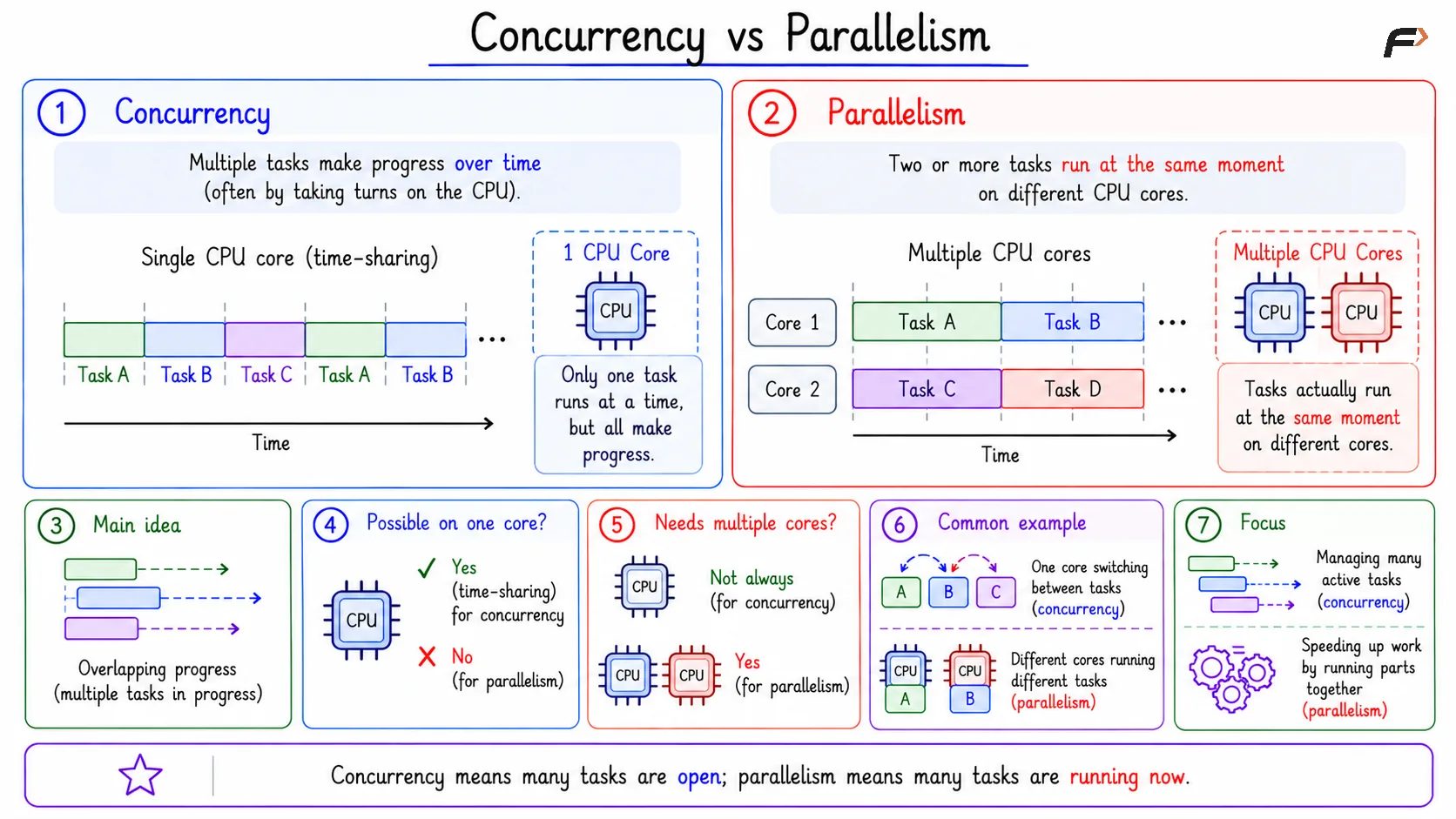
Concurrency and parallelism are related, but they are not the same idea. Concurrency is about multiple tasks being in progress during the same time period.
Parallelism is about multiple tasks executing at the exact same instant. This difference matters in operating systems, CPU scheduling, threads, multicore processors, and asynchronous I/O.
Core Difference
Concurrency means the system is handling more than one task over an overlapping time interval. The tasks may take turns using the CPU, but they are still all in progress.
Parallelism means two or more tasks are actually running at the same moment. This usually needs multiple CPU cores or some other hardware execution capacity.
Concurrency vs Parallelism
Aspect | Concurrency | Parallelism |
|---|---|---|
Main idea | Overlapping progress | Simultaneous execution |
Possible on one CPU core | Yes, through time-sharing | No, not for normal CPU threads |
Usually needs multiple cores | Not always | Yes |
Common example | One core switching between threads | Different cores running different threads |
Focus | Managing many active tasks | Speeding up work by running parts together |
A simple memory line is: concurrency means many tasks are open; parallelism means many tasks are running now.
Single-Core Concurrency
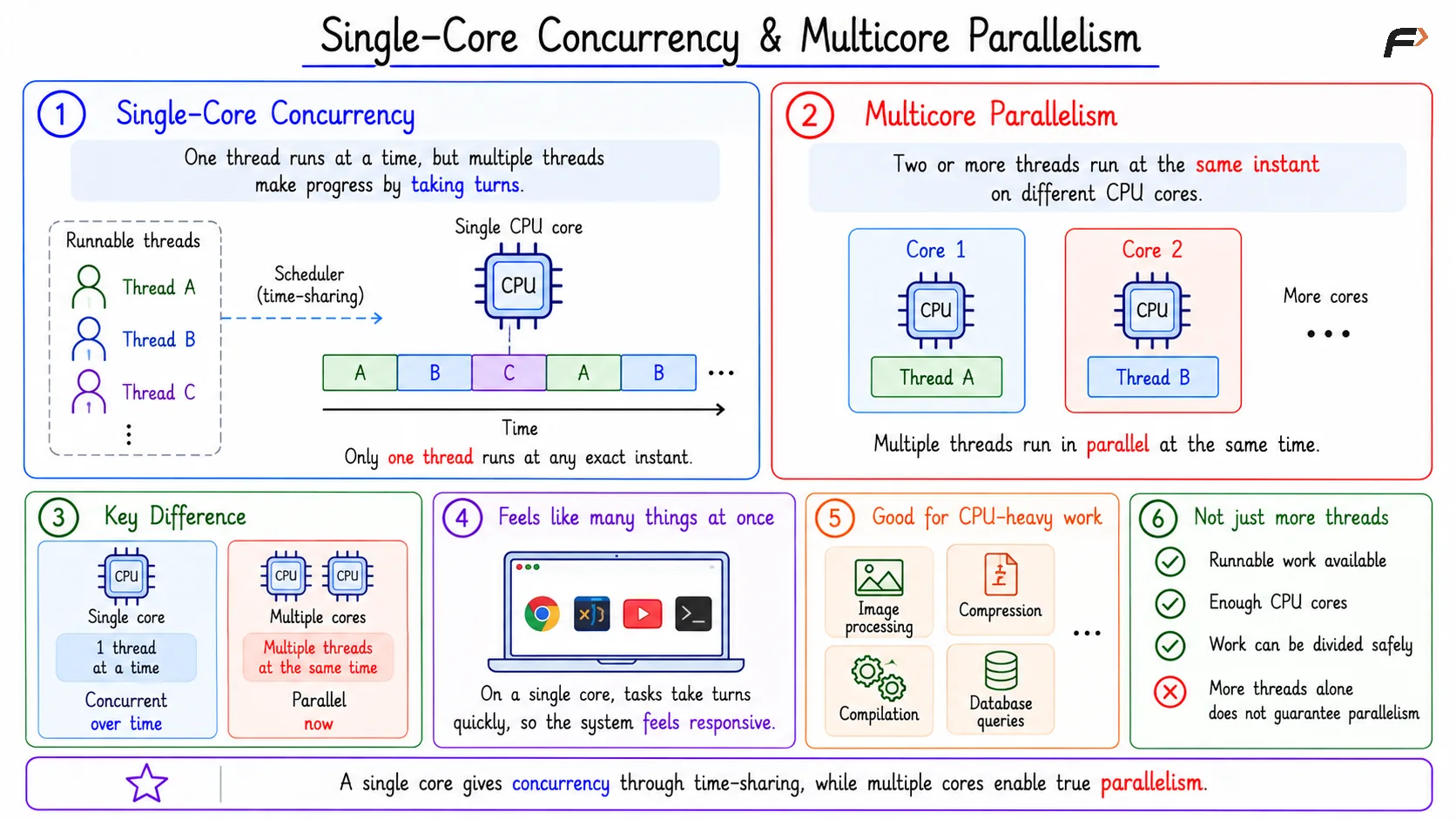
A single-core CPU can run only one thread at an exact instant. Still, it can support concurrency because the operating system scheduler gives CPU time to different runnable tasks one by one.
For example, Thread A may run for a few milliseconds, then Thread B, then Thread C, and then Thread A again. At any exact instant only one thread is running, but across the whole interval multiple threads make progress.
This is why a single-core system can feel like it is doing many things at once. It is concurrent because tasks overlap in time, but it is not CPU-parallel because only one task executes at a precise instant.
Single-Core Concurrency & Multicore Parallelism
Multicore Parallelism
A multicore CPU can run multiple threads at the same instant. If Core 1 runs Thread A while Core 2 runs Thread B, that is parallelism.
Parallelism is useful when work can be divided safely. CPU-heavy tasks such as image processing, compression, compilation, database query execution, and numerical computation can benefit when different parts run on different cores.
But more threads alone do not guarantee parallelism. The system needs runnable work, available cores, and work that can be split without causing incorrect results or too much coordination overhead.
Async I/O and Concurrency
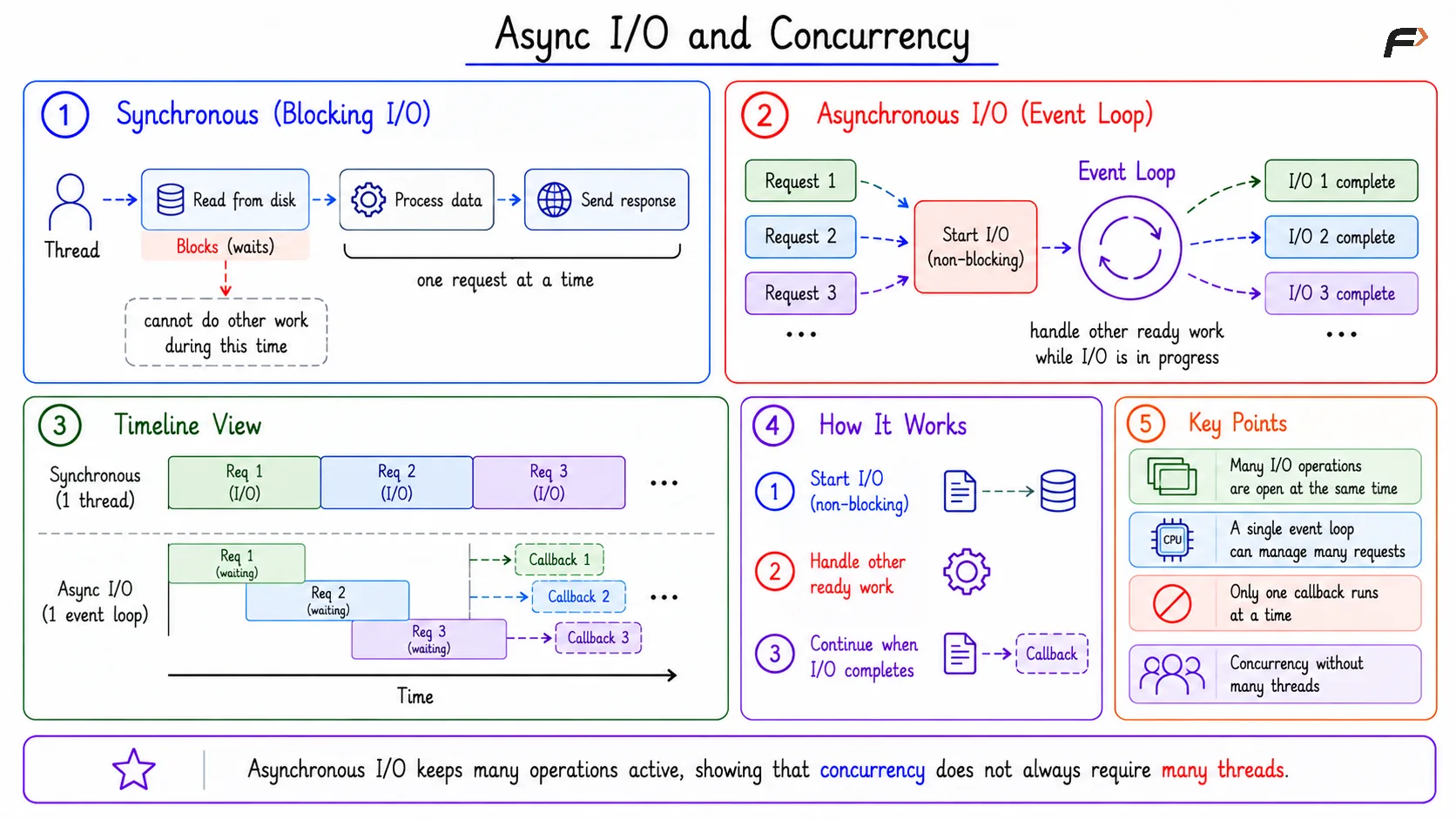
Concurrency does not always require many threads. A single event loop can manage many I/O operations that are open during the same time period.
The basic idea is: Start I/O => Handle other ready work => Continue when I/O completes
For example, a server may start reading data for one request, then handle another request while the first one waits for I/O. Many requests are in progress, even if only one callback runs at a time.
This is concurrency, not necessarily parallelism. It shows that threads are one tool for concurrency, but asynchronous I/O can also keep many operations active.
Async I/O and Concurrency
Threads, Cores, and Execution
Thread count is not the same as parallelism. Having 100 threads on a 4-core machine does not mean 100 threads run at once.
At a given instant, threads may be in different states:
Running: Currently executing on a CPU core.
Ready: Runnable, but waiting for CPU time.
Blocked: Waiting for I/O, sleep, lock, or another event.
Finished or waiting cleanup: No longer actively running work.
On a 4-core machine, a simplified view is that only up to 4 CPU threads can run at the same instant. The remaining threads may be ready, blocked, or waiting in some other state.
Common Misunderstandings
Single-core systems are not CPU-parallel: One normal core cannot run multiple CPU threads at the exact same instant.
More threads do not always improve performance: Too many threads can increase context switching and resource pressure.
Async I/O can be concurrent: Many operations can stay in progress without many threads.
Summary
Concurrency means multiple tasks are active and making progress over the same time period. It can happen through scheduling, threads, async I/O, and event loops, even on a single CPU core.
Parallelism means multiple tasks run at the exact same instant, usually on multiple CPU cores. The clean final rule is: concurrency is overlapping progress; parallelism is simultaneous execution.
Be the first to add a comment.