Introduction
The Bakery Algorithm extends mutual-exclusion reasoning from two processes to many processes. Peterson’s Algorithm works for two processes, but the Bakery Algorithm gives a conceptual solution for n competing processes.
Its central idea is similar to taking a ticket in a queue. A process chooses a ticket, waits behind earlier tickets, enters the critical section, and clears its ticket after leaving.
Core Idea
The Bakery Algorithm creates an order among processes that want to enter the critical section. The process with the smallest active ticket gets priority.
If two processes get the same ticket number, the smaller process ID wins. So priority is decided using the pair (ticket number, process ID).
This ticket-based order gives the algorithm its fairness intuition.
Shared Variables
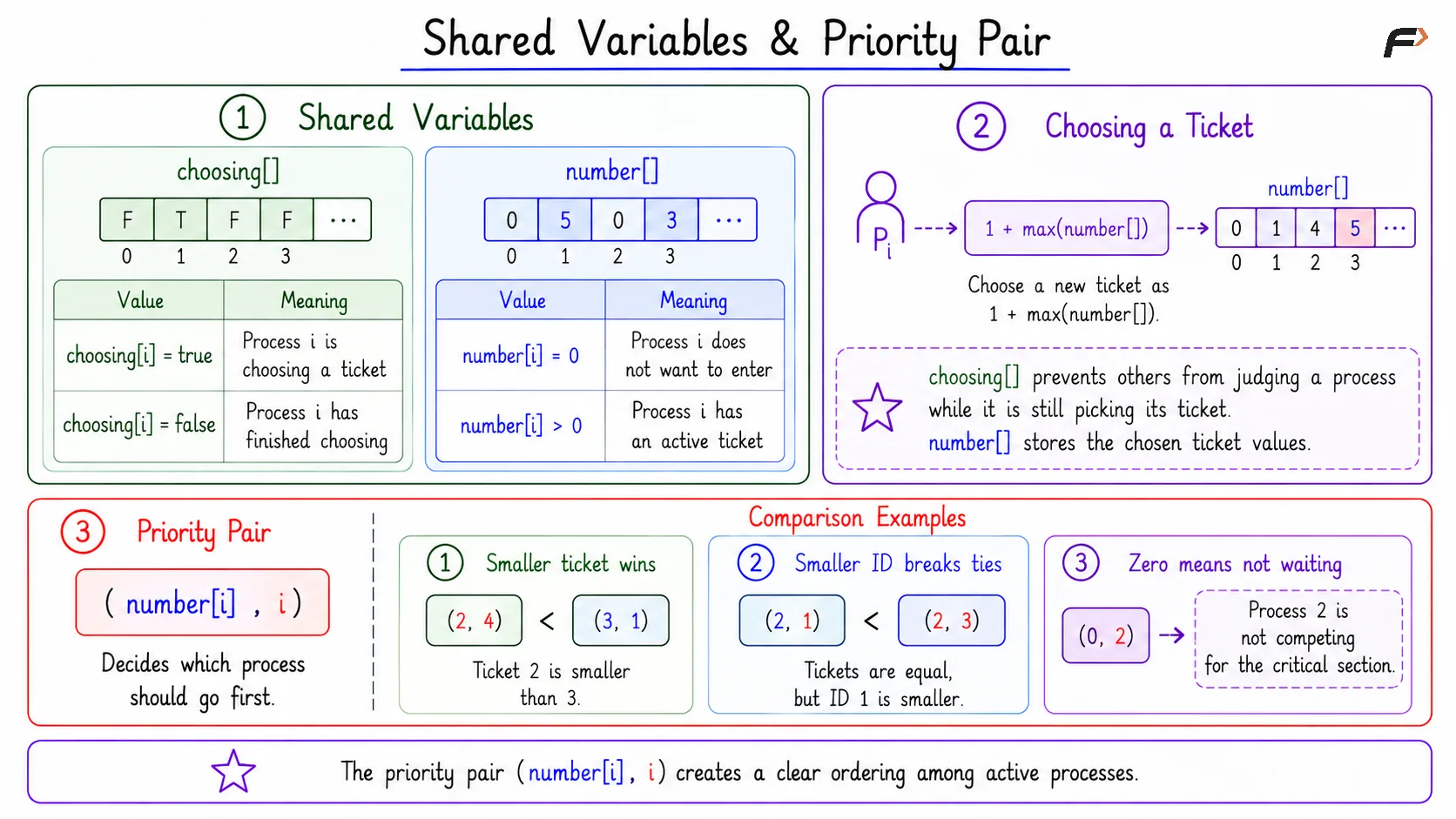
The Bakery Algorithm uses two shared arrays: choosing[] and number[].
Shared variable | Meaning |
|---|---|
| Process |
| Process |
| Process |
| Process |
A new ticket is usually chosen as 1 + max(number[]), based on the ticket values visible to that process.
The choosing[] array prevents other processes from judging a process while it is still picking its ticket. The number[] array stores the chosen ticket values.
Shared Variables & Priority Pair
Priority Pair
The priority pair is written as (number[i], i). This pair decides which process should go first.
Smaller ticket wins:
(2, 4)has priority over(3, 1)because ticket2is smaller than ticket3.Smaller ID breaks ties:
(2, 1)has priority over(2, 3)because both tickets are equal, but process ID1is smaller.Zero means not waiting: If
number[i] = 0, processiis not competing for the critical section.
This pair creates a clear ordering among active processes.
Algorithm Flow
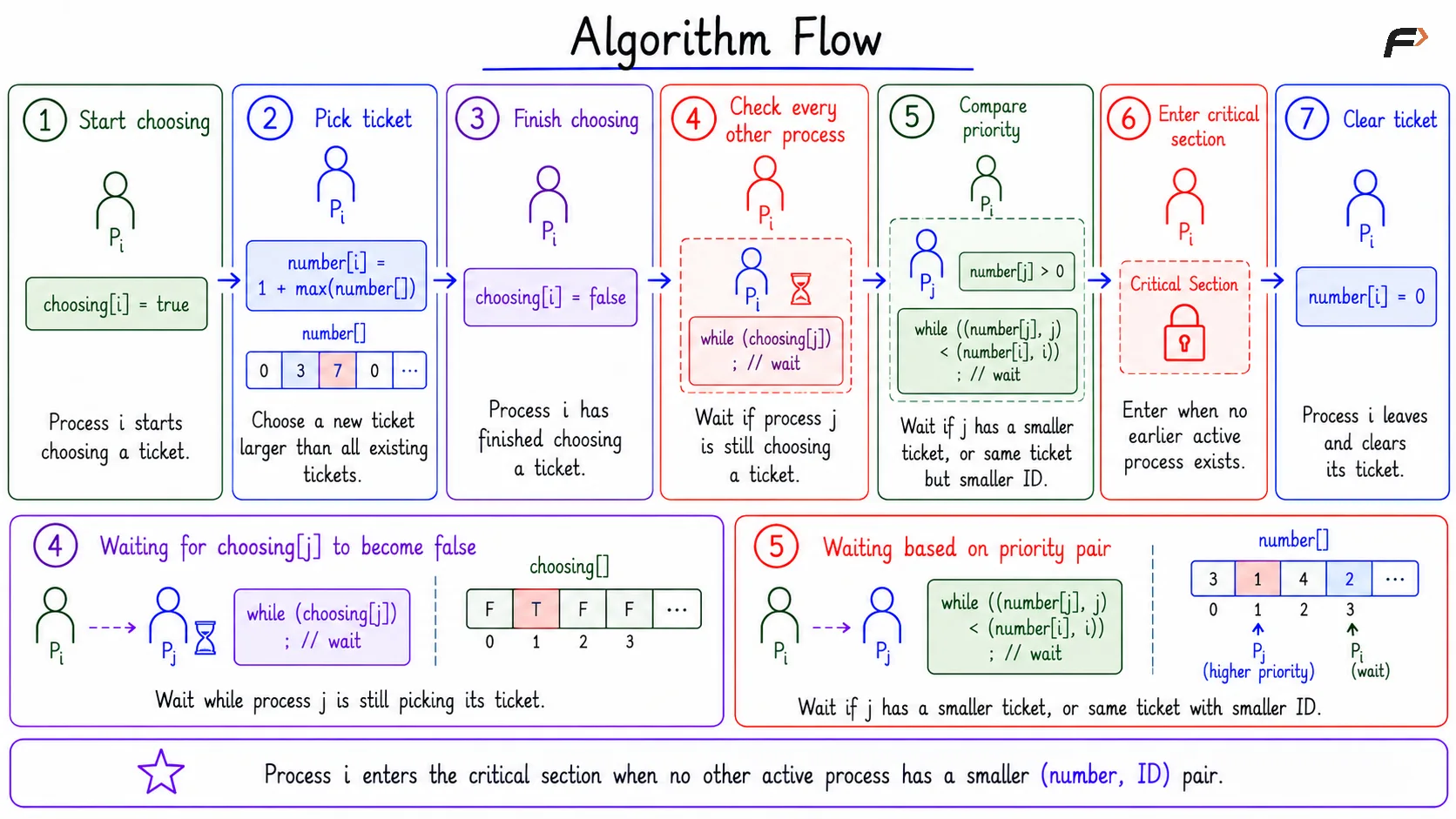
For process i, the flow is:
Start choosing: Set
choosing[i] = true.Pick ticket: Set
number[i] = 1 + max(number[]).Finish choosing: Set
choosing[i] = false.Check every other process: For each process
j, wait ifjis still choosing.Compare priority: Wait if
jhas a nonzero ticket and(number[j], j)has higher priority.Enter critical section: Enter when no earlier active process exists.
Clear ticket: Set
number[i] = 0after leaving.
Bakery Algorithm Flow
Why Mutual Exclusion Holds
Mutual exclusion means two processes must not be inside the critical section at the same time.
In the Bakery Algorithm, every interested process has a nonzero ticket. All interested processes are compared using (number, process ID), so one active process has the smallest priority pair.
Only the process with the smallest pair can pass the waiting checks first. Any process with a larger pair must wait. Because ties are broken by process ID, two processes cannot both be first at the same time.
Progress and Bounded Waiting
Progress means that if processes are waiting and the critical section is free, entry should not be postponed forever. The process with the smallest active ticket can move forward.
Bounded waiting means a process should not be skipped endlessly. Once a process has a ticket, newer or larger tickets must wait behind it according to the ordering rule.
Assumptions and Limitations
The Bakery Algorithm is mainly studied as a teaching-model software solution. Its reasoning depends on predictable shared-variable behavior.
Important assumptions include:
Distinct process IDs: IDs must be unique so ties can be broken.
Consistent comparison rule: All processes compare
(ticket, ID)pairs the same way.Shared reads and writes: The model assumes shared-variable operations behave as expected.
Memory ordering: The reasoning assumes memory operations appear in the needed order.
Busy waiting: Processes may spin while waiting for their turn.
In modern systems, production synchronization usually uses hardware atomics, mutexes, semaphores, monitors, or runtime lock libraries instead of directly implementing the Bakery Algorithm.
Bakery vs Peterson Algorithm
Dimension | Peterson Algorithm | Bakery Algorithm |
|---|---|---|
Scope | Two processes |
|
Main idea |
| Ticket ordering |
Conflict handling | One process gives priority to the other | Smallest |
Fairness view | Two-process bounded waiting | Queue-like ordering for many processes |
The Bakery Algorithm is more general than Peterson’s Algorithm, but also more complex.
Summary
The Bakery Algorithm is a classic mutual exclusion algorithm for n processes. It uses choosing[] to protect ticket creation and number[] to store each process’s active ticket.
The process with the smallest (ticket, process ID) pair gets priority. This ordering supports mutual exclusion, progress, and bounded waiting in the teaching model, while modern systems usually rely on stronger synchronization primitives.
Be the first to add a comment.