Introduction
The static keyword in Java is a non-access modifier used to create members that belong to a class instead of individual objects.
A static member is shared by all objects of the class and can be accessed using the class name. An object is not required to access it.
The static keyword is commonly used with:
Variables
Methods
Blocks
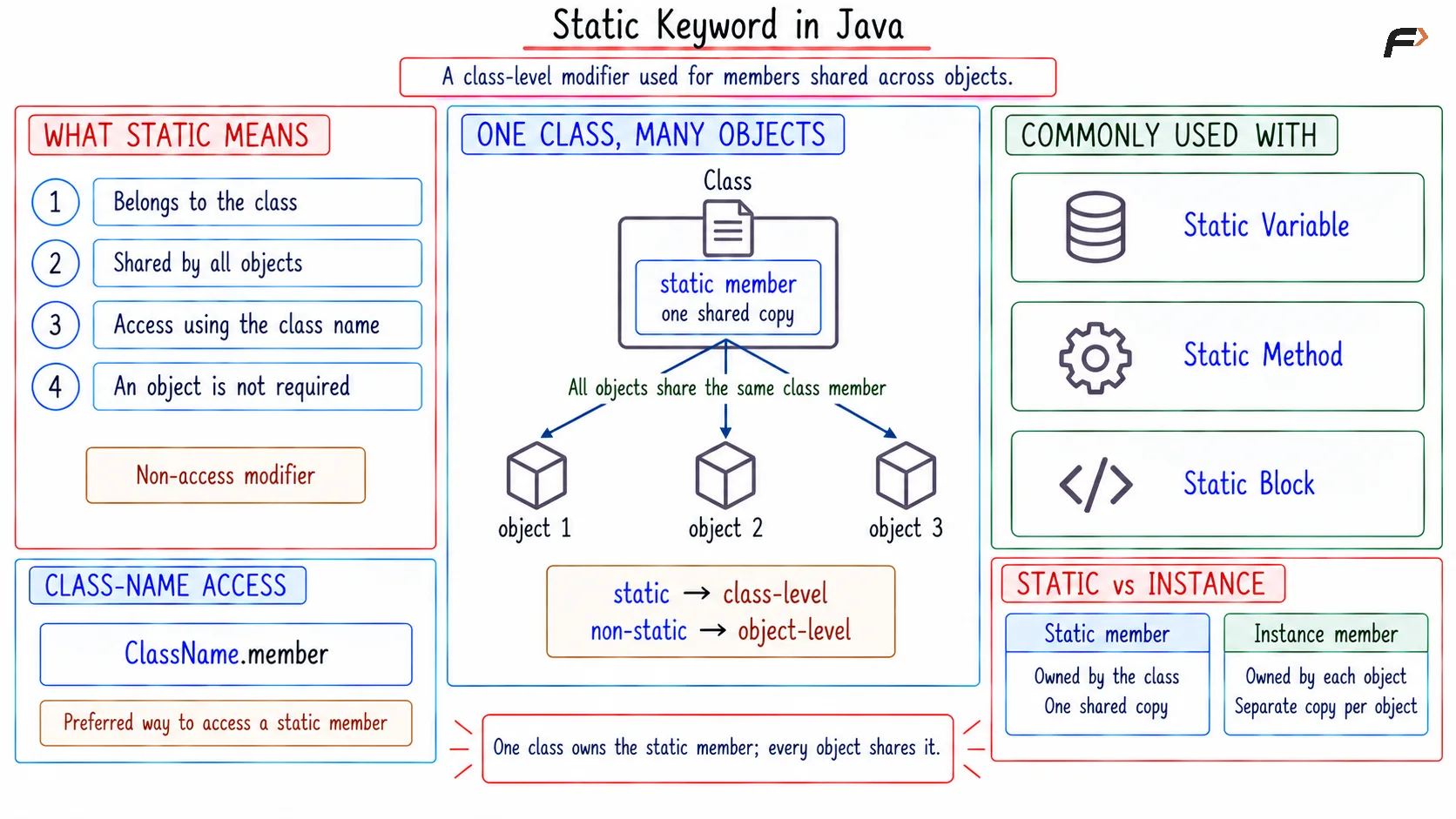
Static Keyword
Static Variable in Java
A static variable, also called a class variable, belongs to the class and is shared among all its objects.
Only one copy of a static variable is created. If one object changes its value, the updated value is visible to the other objects.
Static Variable Example
// Class used to count created objectsclass Counter { // Static variable is shared by all Counter objects static int count = 0; // Constructor runs whenever an object is created Counter() { // Increase the shared static variable count++; }}public class Main { public static void main(String[] args) { // Create the first Counter object Counter first = new Counter(); // Create the second Counter object Counter second = new Counter(); // Access the static variable using the class name System.out.println("Total objects: " + Counter.count); // Output :- Total objects: 2 }}In this example, count is shared by both objects. Each time an object is created, the same variable is increased.
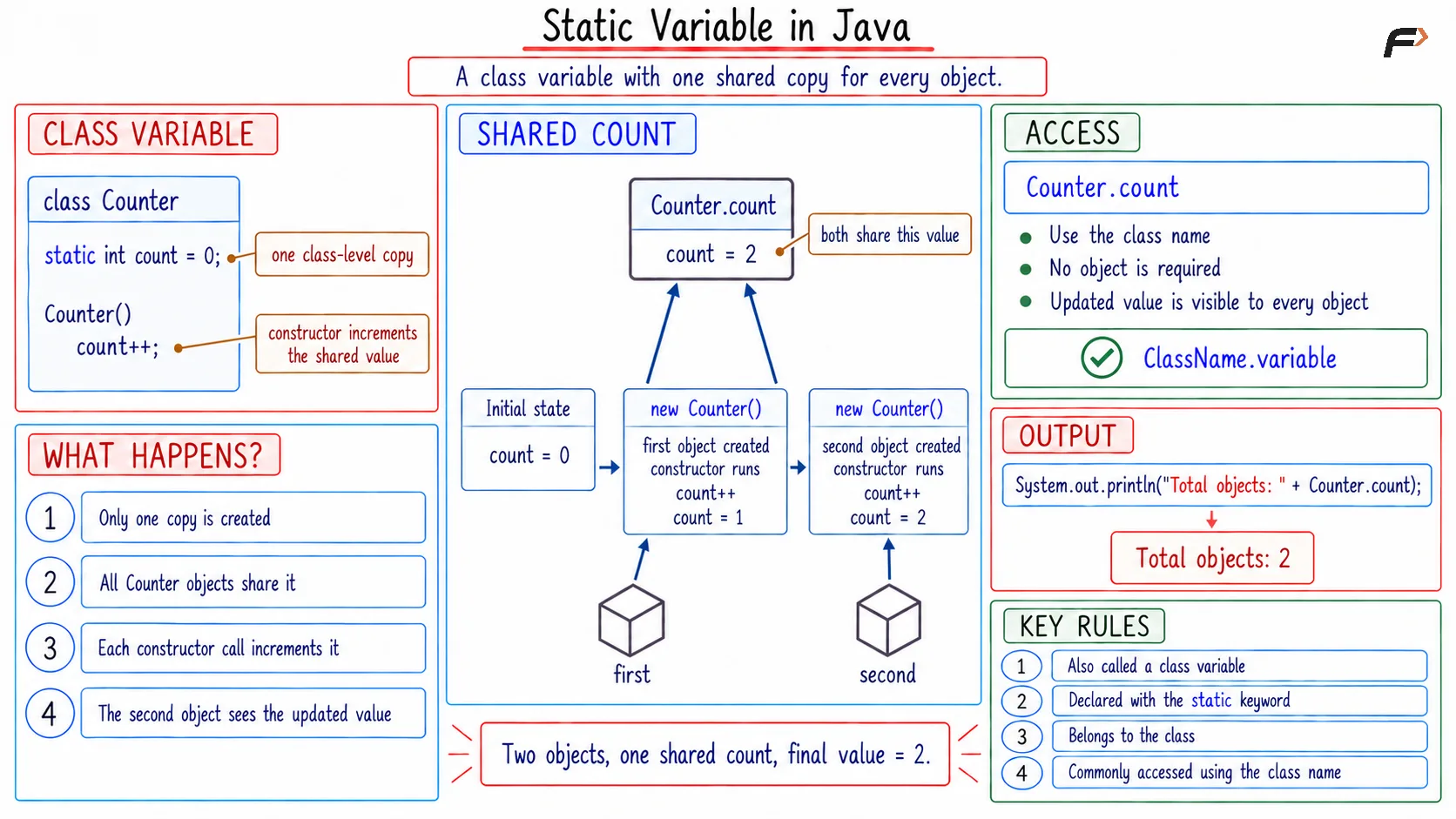
Static Variable
Static Method in Java
A static method belongs to the class instead of an object. It can be called directly using the class name.
Static methods are commonly used for operations that do not depend on an object’s individual data.
Static Method Example
// Utility class containing a static methodclass MathUtils { // Static method calculates the square of a number static int square(int number) { // Return the calculated result return number * number; }}public class Main { public static void main(String[] args) { // Call the static method using the class name int result = MathUtils.square(5); // Display the returned value System.out.println(result); // Output :- 25 }}The square() method is called using MathUtils.square(5). No MathUtils object is required.
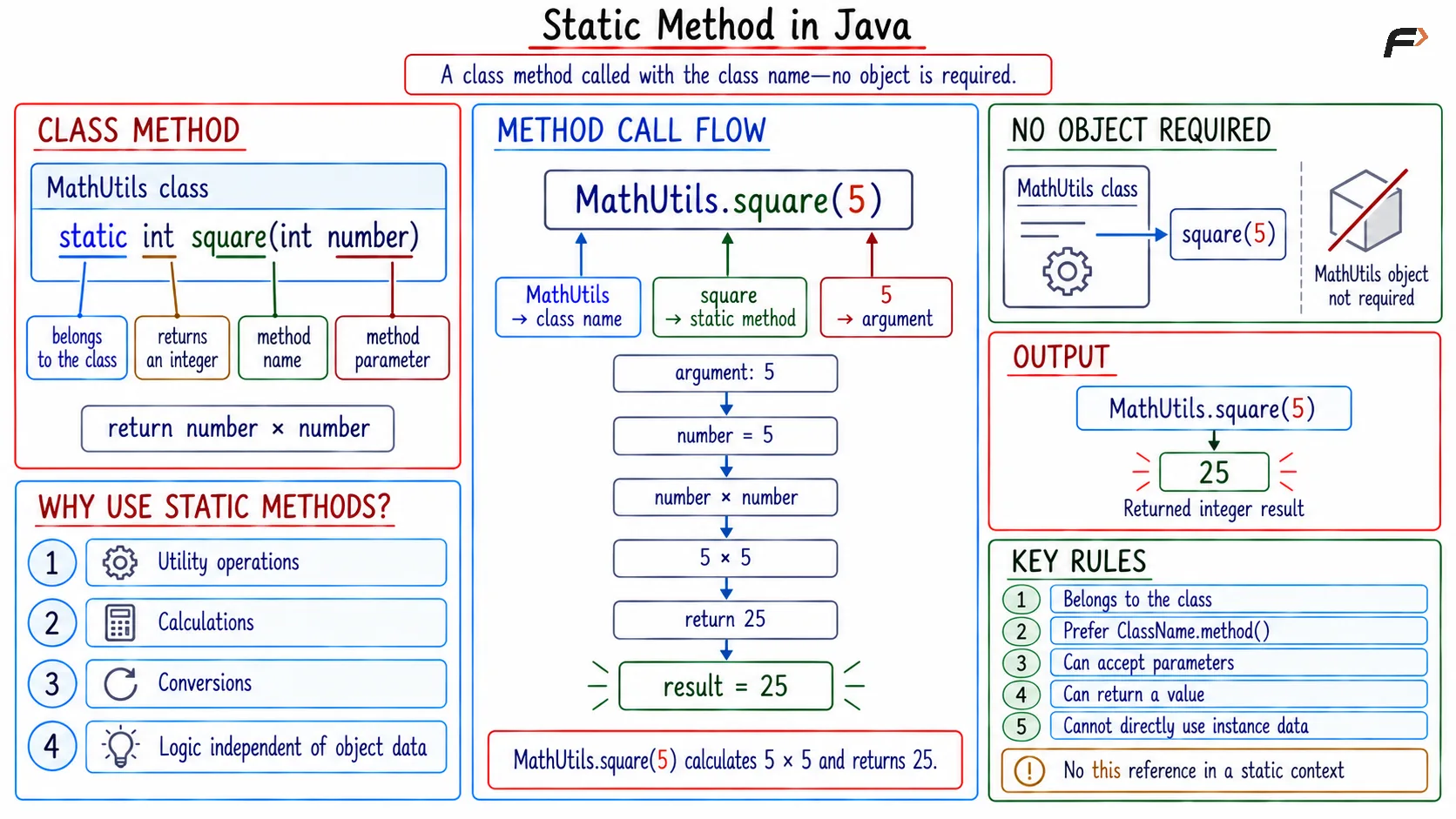
Static Method
Static Block in Java
A static block is a block of code used to initialize static variables. It runs once when the class is initialized.
A static block runs before objects of the class are created and before the class’s static members are used.
Static Block Example
// Class containing a static variable and static blockclass Configuration { // Declare a static variable static String applicationName; // Static block runs once when the class is initialized static { // Initialize the static variable applicationName = "Learning App"; // Confirm that the static block has executed System.out.println("Static block executed."); // Output :- Static block executed. }}public class Main { public static void main(String[] args) { // Accessing the class causes its static initialization System.out.println(Configuration.applicationName); // Output :- Learning App }}Static blocks are useful when initializing static variables requires calculations or multiple statements.
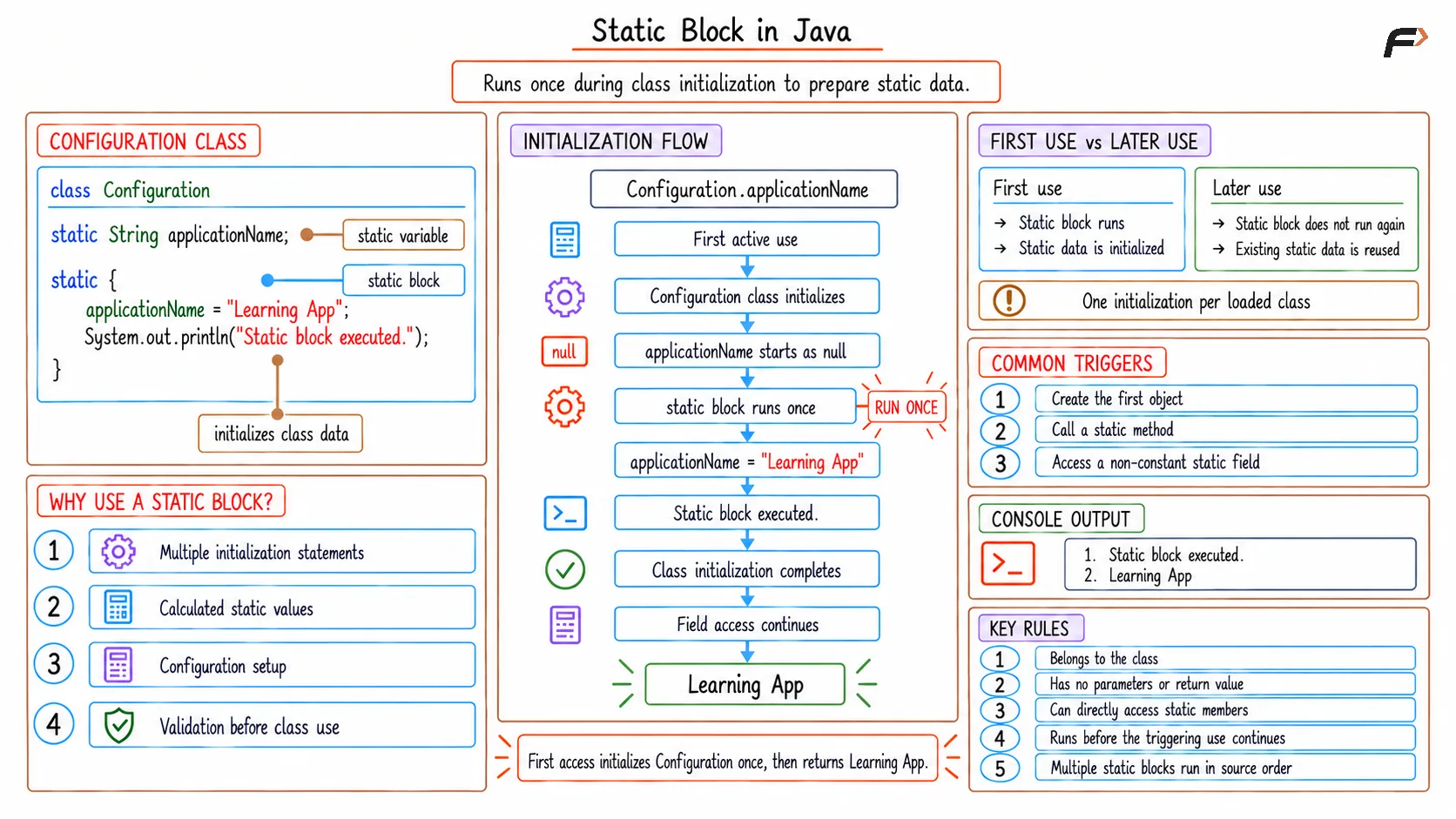
Static Block
Static vs Non-Static Members
Static Members | Non-Static Members |
|---|---|
Belong to the class | Belong to individual objects |
Shared by all objects | Each object has its own copy |
Accessed using the class name | Accessed using an object |
Do not require object creation | Require an object for access |
Cannot directly access instance members | Can access static and instance members |
Advantages of the Static Keyword
Shares common data among objects
Allows methods to run without object creation
Provides one-time class initialization
Helps create utility methods
Can be used to define shared counters and constants
Summary
The static keyword in Java creates members that belong to a class rather than its objects.
A static variable stores shared data, a static method can run without an object, and a static block performs one-time initialization of static members.
Be the first to add a comment.