Introduction
Object cloning in Java is the process of creating a copy of an existing object. The cloned object contains the same field values as the original object but occupies a different memory location.
Java supports cloning through:
The
CloneableinterfaceThe
clone()method of theObjectclass
Why Is Object Cloning Used?
Object cloning is useful when:
An existing object needs to be duplicated
The current state of an object must be preserved
Reinitializing an object would require additional work
A separate copy is required before making changes
How Object Cloning Works
To clone an object in Java:
The class implements the
Cloneableinterface.The class overrides the
clone()method.The
super.clone()method creates the copy.
class ClassName implements Cloneable { @Override public ClassName clone() throws CloneNotSupportedException { return (ClassName) super.clone(); }}Cloneable is a marker interface, meaning it does not contain methods. If a class does not implement it, calling Object.clone() results in a CloneNotSupportedException.
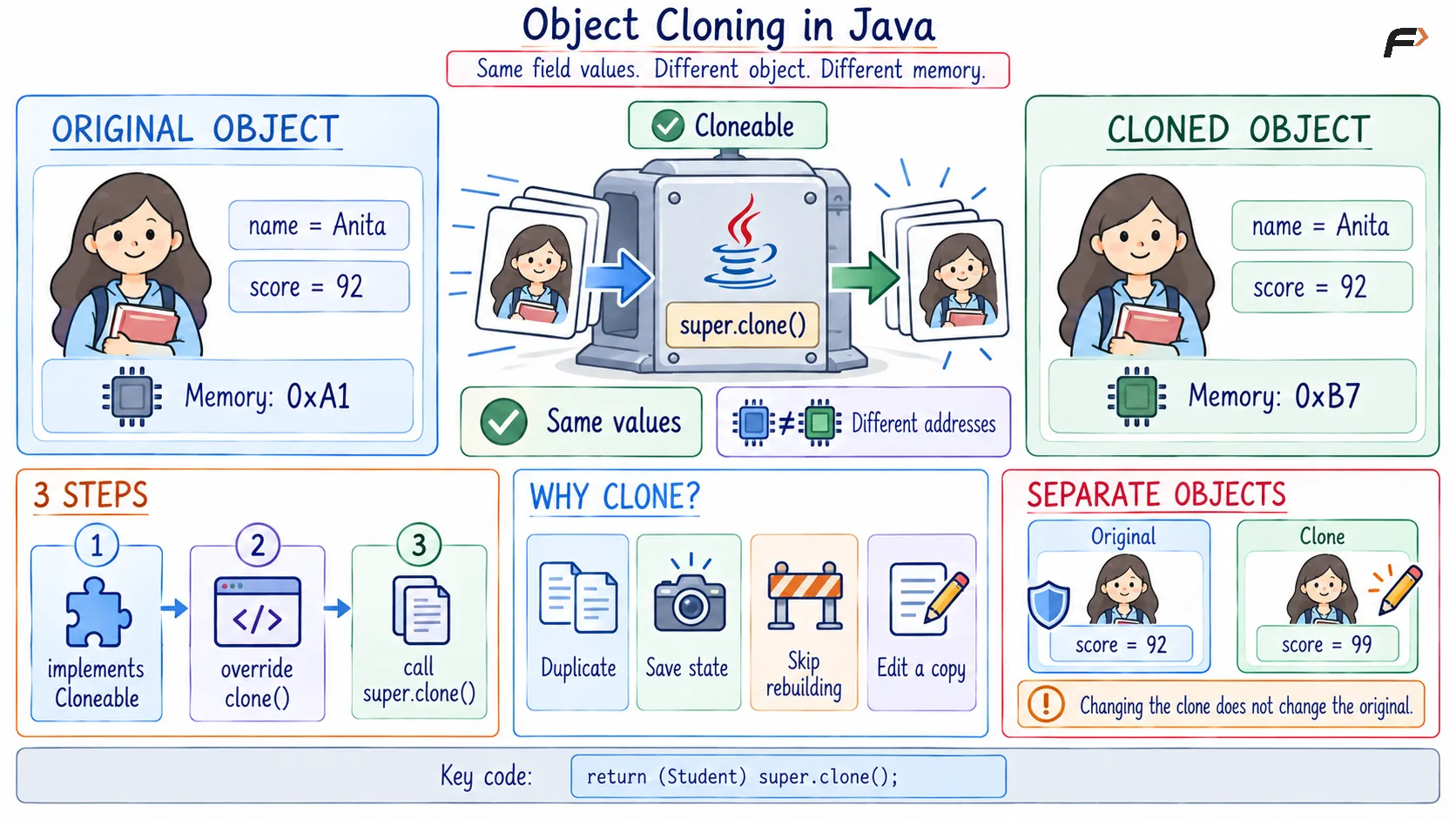
Object Cloning in Java
Types of Object Cloning
Java object cloning is mainly divided into:
Shallow cloning
Deep cloning
Shallow Cloning in Java
Shallow cloning creates a new outer object but copies references to nested objects.
This means:
Primitive values are copied.
The outer cloned object is separate.
Referenced mutable objects remain shared.
Changing a shared nested object affects both copies.
The default Object.clone() method performs a shallow copy.
Shallow Cloning Example
// Address is a nested object used by Personclass Address { // Store the city name String city; // Initialize the city Address(String city) { this.city = city; }}// Person supports cloningclass Person implements Cloneable { // Store the person's name String name; // Store a reference to an Address object Address address; // Initialize the Person object Person(String name, Address address) { this.name = name; this.address = address; } // Create a shallow copy using Object.clone() @Override public Person clone() throws CloneNotSupportedException { return (Person) super.clone(); }}public class Main { public static void main(String[] args) throws CloneNotSupportedException { // Create the original nested object Address address = new Address("Mumbai"); // Create the original Person Person original = new Person("Rahul", address); // Create a shallow clone Person cloned = original.clone(); // Change the nested Address through the cloned object cloned.address.city = "New Delhi"; // Both objects refer to the same Address System.out.println(original.name + " lives in " + original.address.city); // Output :- Rahul lives in New Delhi System.out.println(cloned.name + " lives in " + cloned.address.city); // Output :- Rahul lives in New Delhi }}The original and cloned objects are different, but their address fields refer to the same Address object.
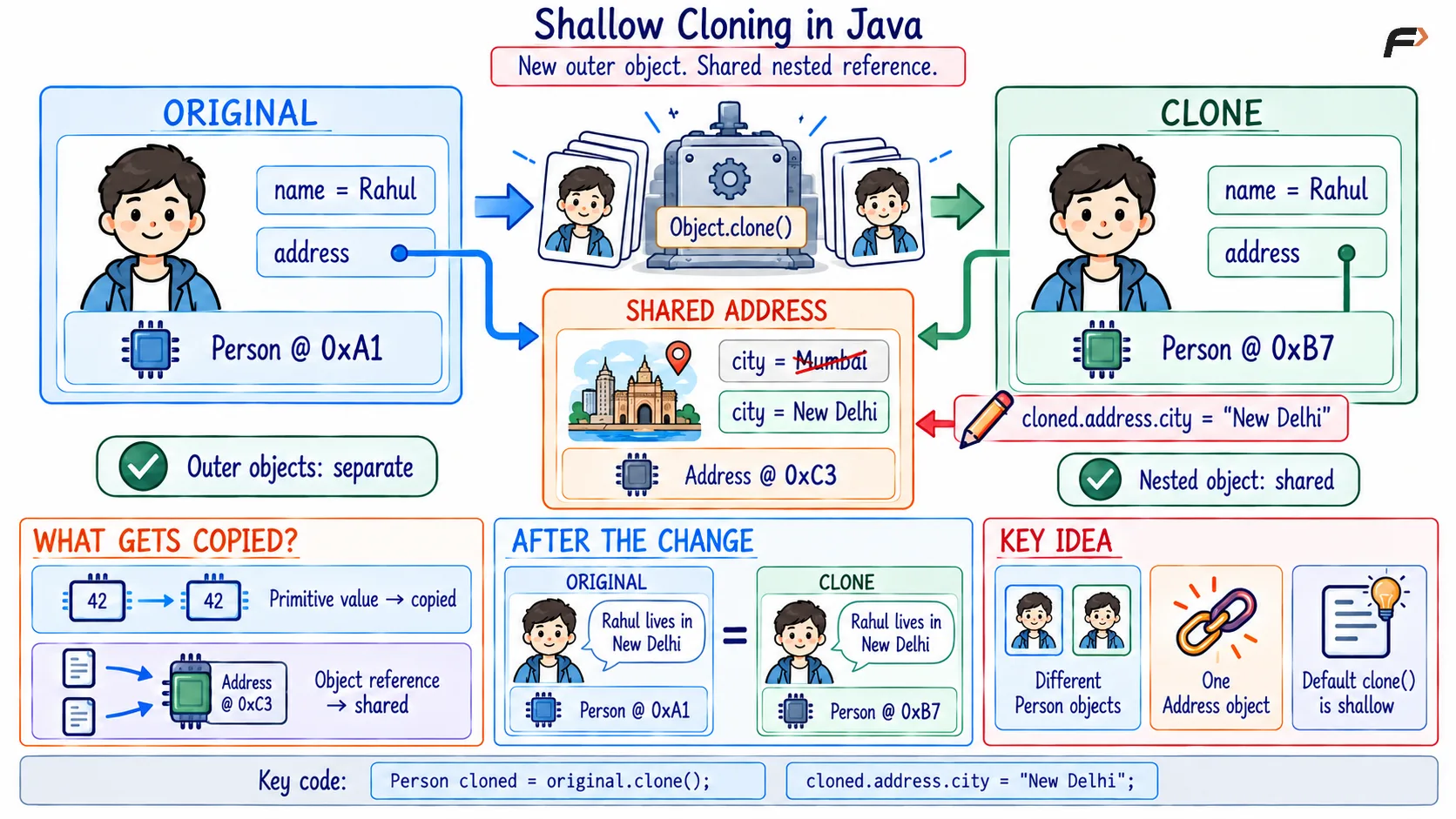
Shallow Cloning in Java
Deep Cloning in Java
Deep cloning creates a separate copy of the outer object and its nested mutable objects.
This means:
Primitive values are copied.
Nested objects are also copied.
The original and cloned objects do not share mutable nested data.
Changes to the clone do not affect the original.
Java does not perform deep cloning automatically through super.clone(). Nested objects must also be copied manually.
Deep Cloning Example
// Address also supports cloningclass Address implements Cloneable { // Store the city name String city; // Initialize the city Address(String city) { this.city = city; } // Create a separate Address copy @Override public Address clone() throws CloneNotSupportedException { return (Address) super.clone(); }}// Person supports deep cloningclass Person implements Cloneable { // Store the person's name String name; // Store the nested Address object Address address; // Initialize the Person object Person(String name, Address address) { this.name = name; this.address = address; } // Create a deep copy of Person @Override public Person clone() throws CloneNotSupportedException { // First create a shallow copy of Person Person cloned = (Person) super.clone(); // Then create a separate copy of the nested Address cloned.address = address.clone(); // Return the fully independent copy return cloned; }}public class Main { public static void main(String[] args) throws CloneNotSupportedException { // Create the original Address and Person Address address = new Address("Mumbai"); Person original = new Person("Rahul", address); // Create a deep clone Person cloned = original.clone(); // Change only the cloned person's Address cloned.address.city = "New Delhi"; // The original Address remains unchanged System.out.println(original.name + " lives in " + original.address.city); // Output :- Rahul lives in Mumbai System.out.println(cloned.name + " lives in " + cloned.address.city); // Output :- Rahul lives in New Delhi }}Here, the Address object is also cloned. Therefore, changing the cloned person’s city does not affect the original person.
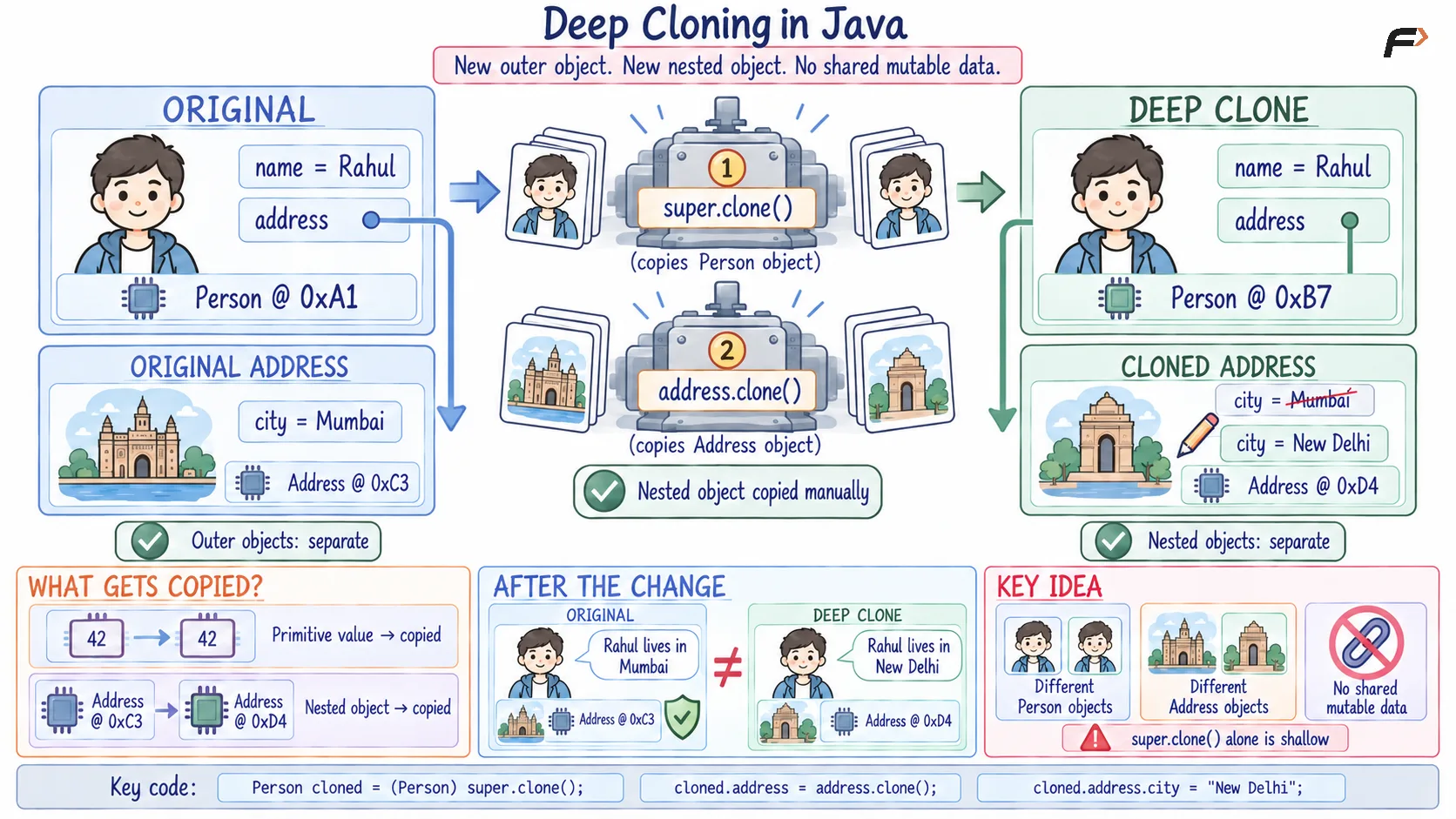
Deep Cloning in Java
Shallow Cloning vs Deep Cloning
Shallow Cloning | Deep Cloning |
|---|---|
Creates a new outer object | Creates a new outer object |
Copies primitive values | Copies primitive values |
Shares nested object references | Copies nested objects |
Nested changes may affect both copies | Nested changes remain independent |
Easier and faster to implement | Requires additional cloning logic |
Suitable when nested objects are immutable or sharing is acceptable | Suitable when complete independence is required |
Summary
Object cloning in Java creates a copy of an existing object using the Cloneable interface and clone() method.
Shallow cloning creates a new outer object but shares nested object references. Deep cloning copies both the outer object and its nested mutable objects, producing a more independent copy.
Be the first to add a comment.