Introduction
A constructor in Java is a special block of code used to initialize an object. It is called automatically when an object of a class is created using the new keyword. Constructor usually assigns initial values to an object’s attributes.
Features of Java Constructors
A constructor has the same name as its class.
It does not have a return type, not even
void.It is called automatically when an object is created.
It can initialize an object’s attributes.
A class can contain multiple constructors.
Constructors can use access modifiers such as
public,private, andprotected.
Syntax of a Constructor
class ClassName { ClassName() { // Constructor body }}Types of Constructors in Java
The main types of constructors in Java are:
Default constructor
No-argument constructor
Parameterized constructor
1. Default Constructor
When a class does not contain any constructor, the Java compiler automatically provides a no-argument constructor. This compiler-provided constructor is called the default constructor.
It initializes fields with their default values, such as:
0for integer types0.0for decimal typesfalseforbooleannullfor reference types
Java provides a default constructor only when no constructor has been explicitly declared.
// Declare a class without explicitly defining any constructorclass Student { // Define a data member with a default value String name = "Aman"; // Define a method to display the student's name void display() { System.out.println(name); }}public class Main { public static void main(String[] args) { // Create an object using the default constructor provided by Java Student student = new Student(); // Display the value stored in the object's data member student.display(); // Aman }}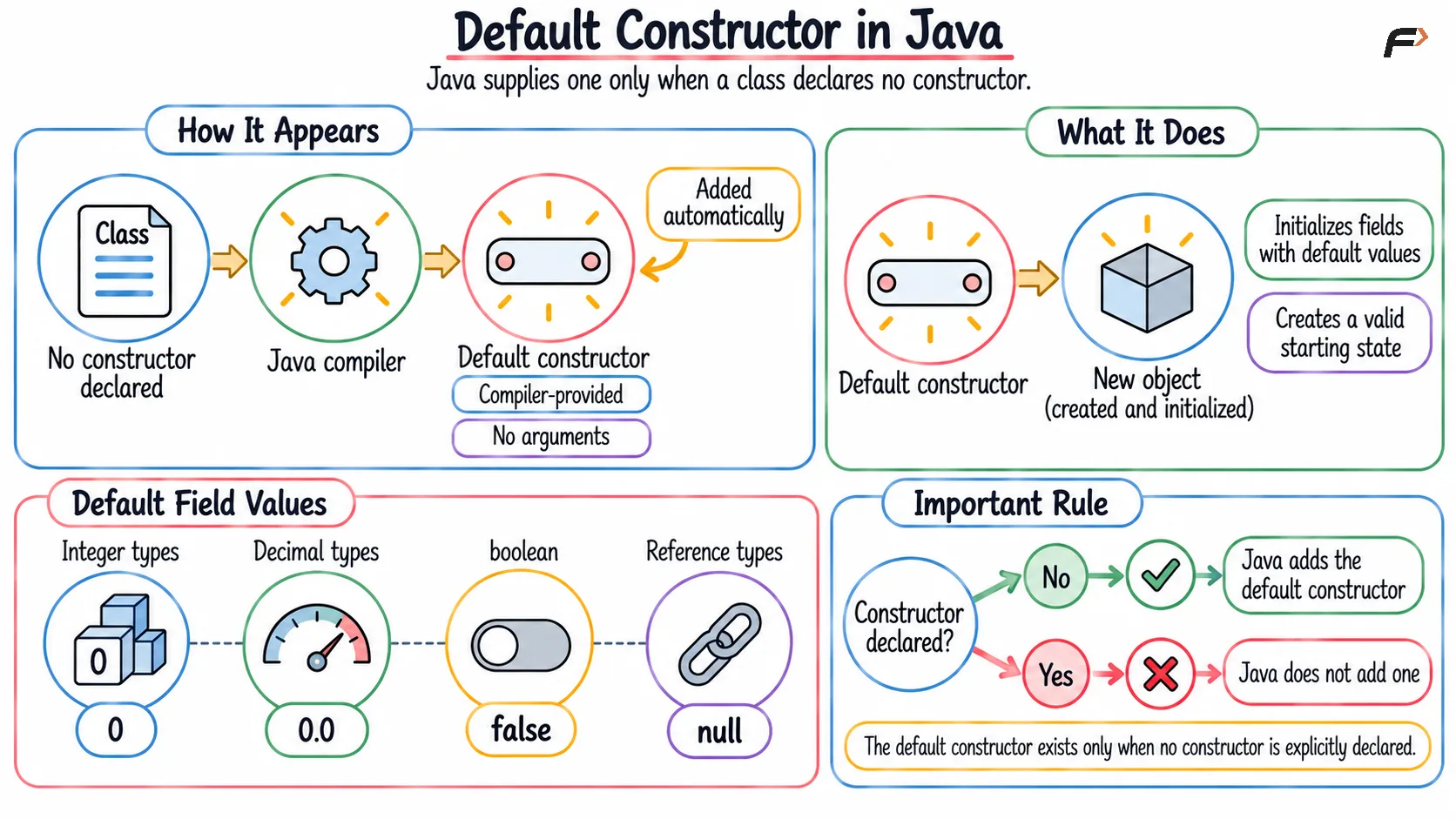
Default Constructor
2. No-Argument Constructor
A no-argument constructor is a constructor written by the programmer that does not accept any parameters.
// Declare a class with a data member and a no-argument constructorclass Student { String name; // Define a no-argument constructor to initialize the student's name Student() { name = "Unknown"; } // Define a method to display the student's name void display() { System.out.println(name); }}public class Main { public static void main(String[] args) { // Create an object, which automatically calls the no-argument constructor Student student = new Student(); // Display the value initialized by the constructor student.display(); // Unknown }}Here, Student() is a no-argument constructor. It assigns Unknown as the initial value of name.
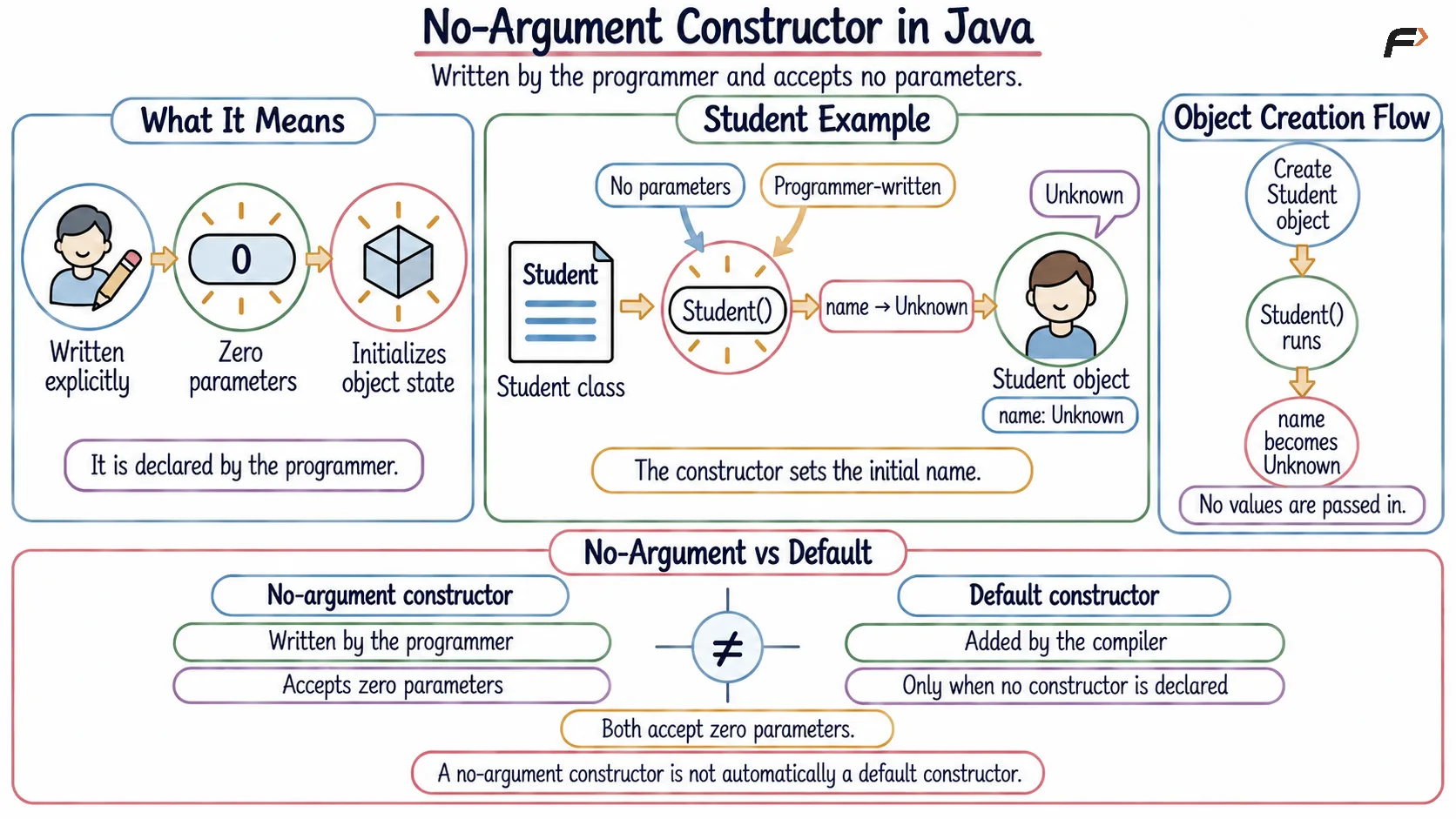
No argument Constructor
3. Parameterized Constructor
A parameterized constructor accepts values when an object is created. It allows different objects to start with different data.
// Declare a class with data members and a parameterized constructorclass Student { String name; int age; // Define a parameterized constructor to initialize the object's data members Student(String studentName, int studentAge) { name = studentName; age = studentAge; } // Define a method to display the student's details void display() { System.out.println(name + " is " + age + " years old."); }}public class Main { public static void main(String[] args) { // Create an object and pass arguments to the parameterized constructor Student student = new Student("Aman", 20); // Display the values initialized by the constructor student.display(); // Aman is 20 years old. }}In this example, "Aman" and 20 are passed to the constructor and assigned to the object’s attributes.
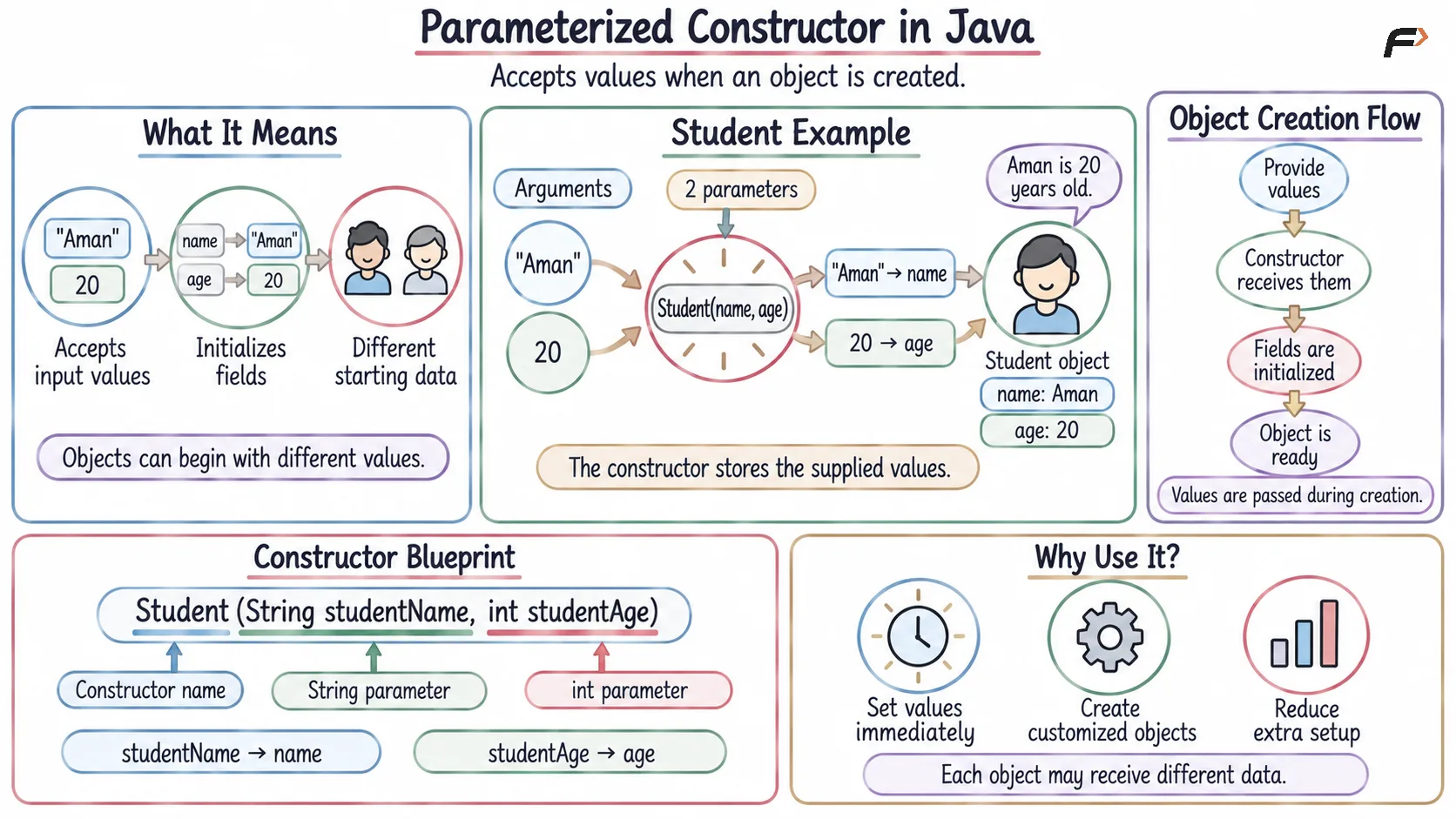
Parameterized Constructor
Constructor Overloading
Constructor overloading means creating multiple constructors in the same class with different parameter lists.
For example, a class may contain:
class Student { String name; int age; // No-argument constructor Student() { name = "Unknown"; age = 0; } // Constructor with one parameter Student(String name) { this.name = name; age = 0; } // Constructor with two parameters Student(String name, int age) { this.name = name; this.age = age; } // Display the student's details void displayDetails() { System.out.println("Name: " + name); System.out.println("Age: " + age); System.out.println(); }}public class Main { public static void main(String[] args) { // Calls the no-argument constructor Student student1 = new Student(); student1.displayDetails(); // Calls the constructor with one argument Student student2 = new Student("Aman"); student2.displayDetails(); // Calls the constructor with two arguments Student student3 = new Student("Rahul", 21); student3.displayDetails(); }}Java selects the appropriate constructor based on the number and types of arguments passed while creating the object.
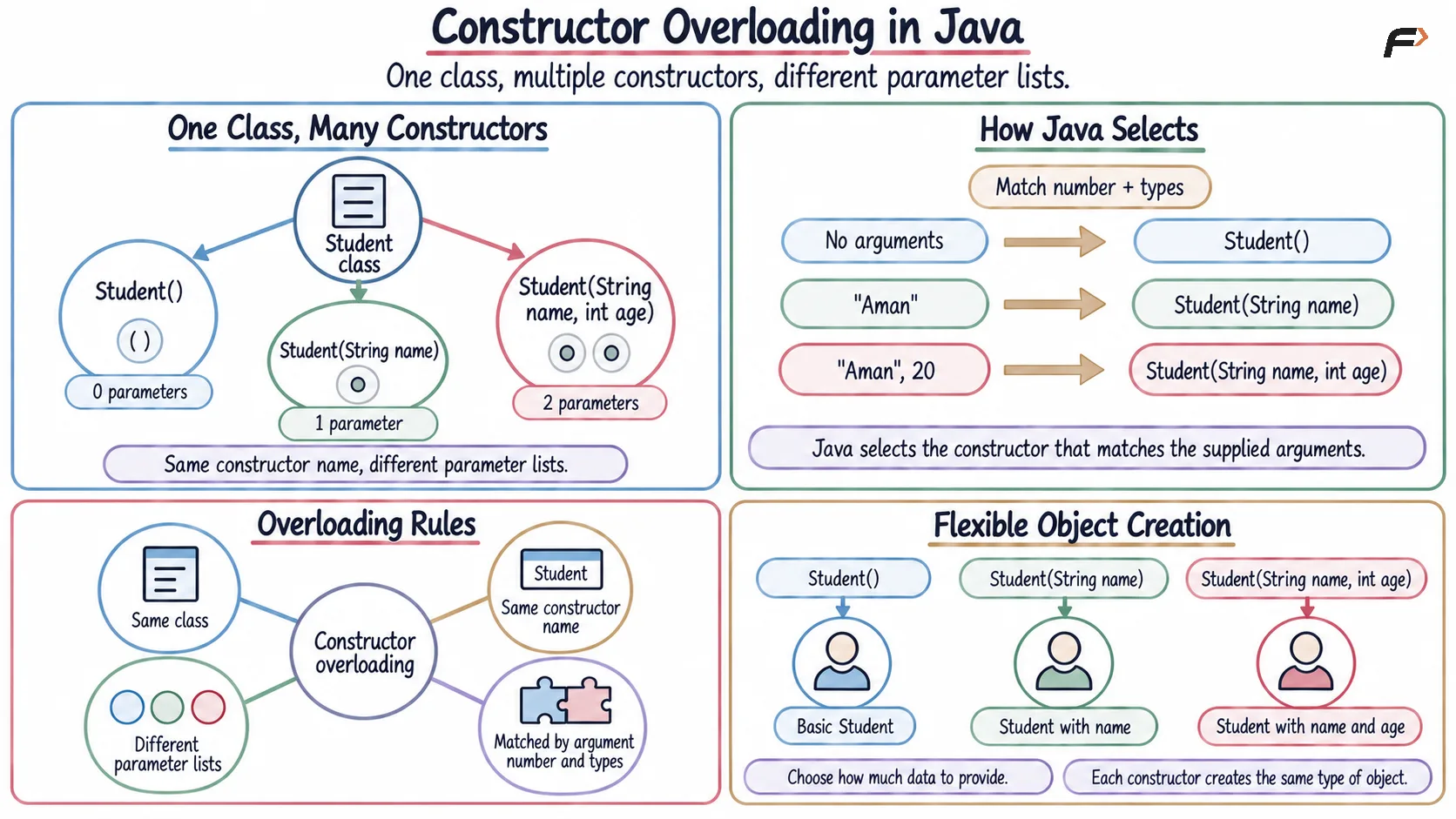
Constructor Overloading
Summary
A constructor in Java is a special block of code that initializes an object when it is created using the new keyword. It has the same name as the class, no return type, and can initialize an object's attributes.
Java supports default, no-argument, and parameterized constructors, allowing objects to be initialized in different ways. Constructor overloading allows multiple constructors with different parameter lists, and Java selects the appropriate one based on the arguments provided.
Be the first to add a comment.