Introduction
Classes and objects are the basic building blocks of object-oriented programming in Java. A class defines the data and behaviour of an entity, while an object represents an actual instance of that class.
What Is a Class in Java?
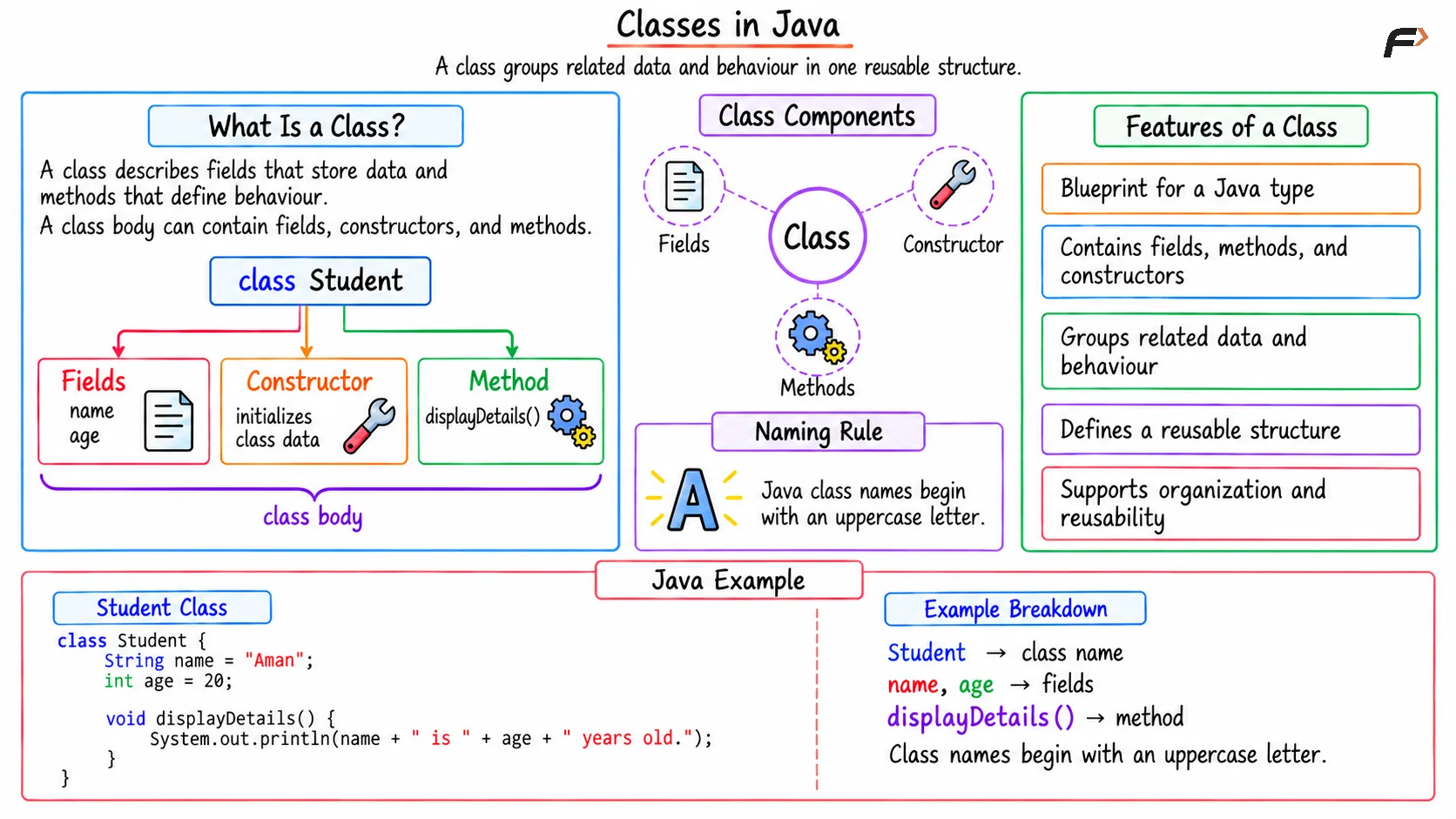
A class in Java is a blueprint or template used to create objects. It describes the fields that store data and the methods that define behaviour.
A class body can contain fields, constructors, and methods.
For example, a Student class can contain fields such as name and age, along with a method for displaying student details.
Features of a Class
A class is a blueprint for creating objects.
It can contain fields, methods, and constructors.
It groups related data and behaviour.
One class can be used to create multiple objects.
It supports code organization and reusability.
How to Create a Class in Java
The class keyword is used to declare a class.
// Declare a class named Studentclass Student { // Define data members to store student information String name = "Aman"; int age = 20; // Define a method to display the student's details void displayDetails() { System.out.println(name + " is " + age + " years old."); }}In this example:
Studentis the class name.nameandageare fields.displayDetails()is a method.
By convention, a Java class name begins with an uppercase letter.
Classes in java
What Is an Object in Java?
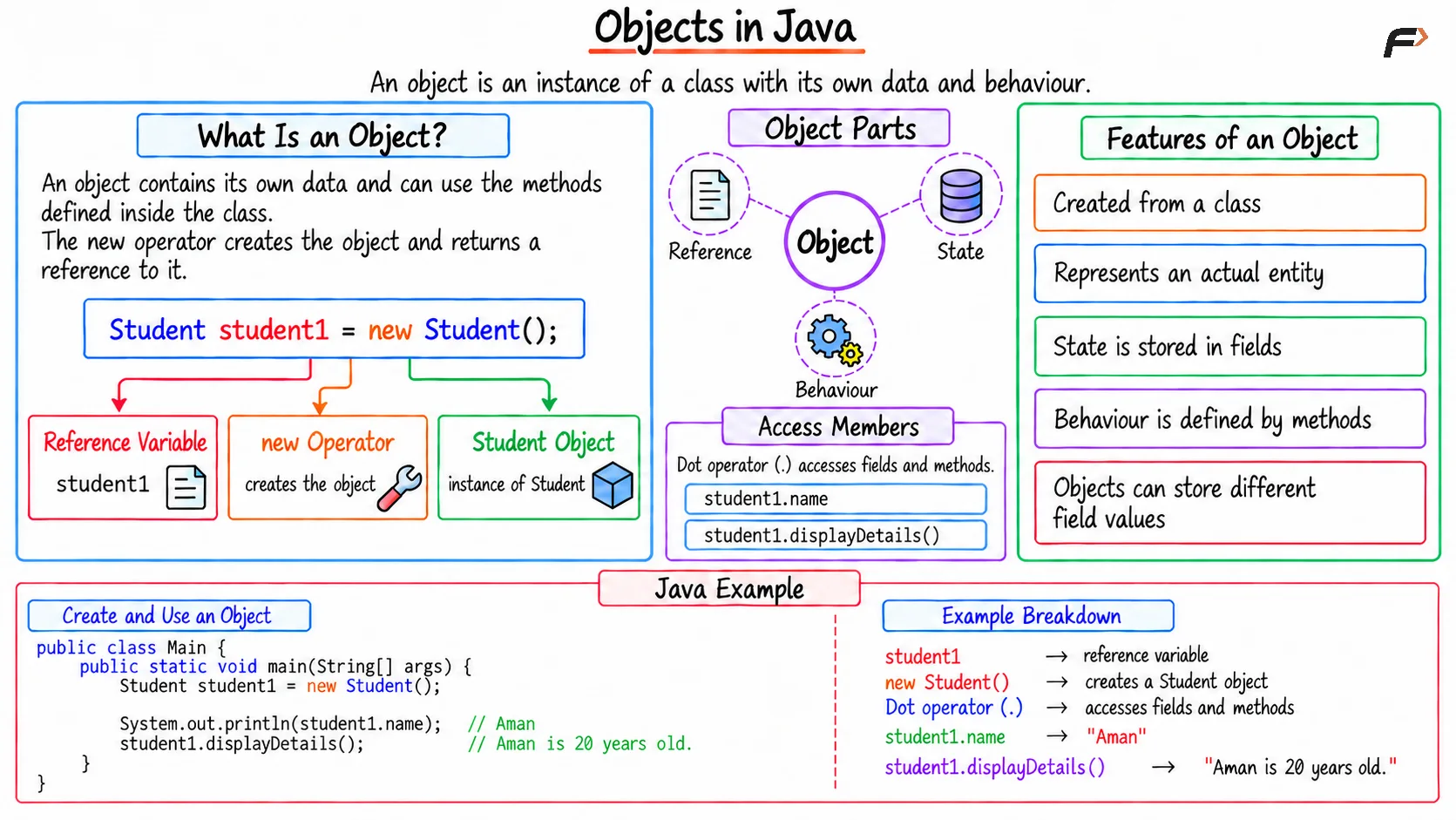
An object in Java is an instance of a class. It contains its own data and can use the methods defined inside the class.
Objects are generally created using the new keyword. The new operator creates the object and returns a reference to it.
Features of an Object
An object is created from a class.
It represents an actual entity.
It has a state represented by fields.
It has behaviour represented by methods.
Different objects can store different field values.
How to Create an Object in Java
The following program creates an object of the Student class:
public class Main { public static void main(String[] args) { // Create an object of the Student class Student student1 = new Student(); // Access the object's data member using the dot (.) operator System.out.println(student1.name); // Aman // Call the object's method using the dot (.) operator student1.displayDetails(); // Aman is 20 years old. }}Here:
student1is a reference variable.new Student()creates aStudentobject.The dot operator (
.) accesses the object’s fields and methods.
Objects in java
Difference Between Class and Object in Java
Class | Object |
|---|---|
A class is a blueprint or template. | An object is an instance of a class. |
It defines fields and methods. | It stores actual field values and uses methods. |
It is declared using the | It is generally created using the |
One class can create many objects. | Each object can have its own state. |
Summary
A class in Java is a blueprint that defines the data and behaviour of an entity using fields, methods, and constructors. It helps organize and reuse related data and functionality.
An object is an instance of a class that stores actual data and can access the class methods. Objects are generally created using the new keyword, allowing multiple objects of the same class to have different states.
Be the first to add a comment.