Introduction
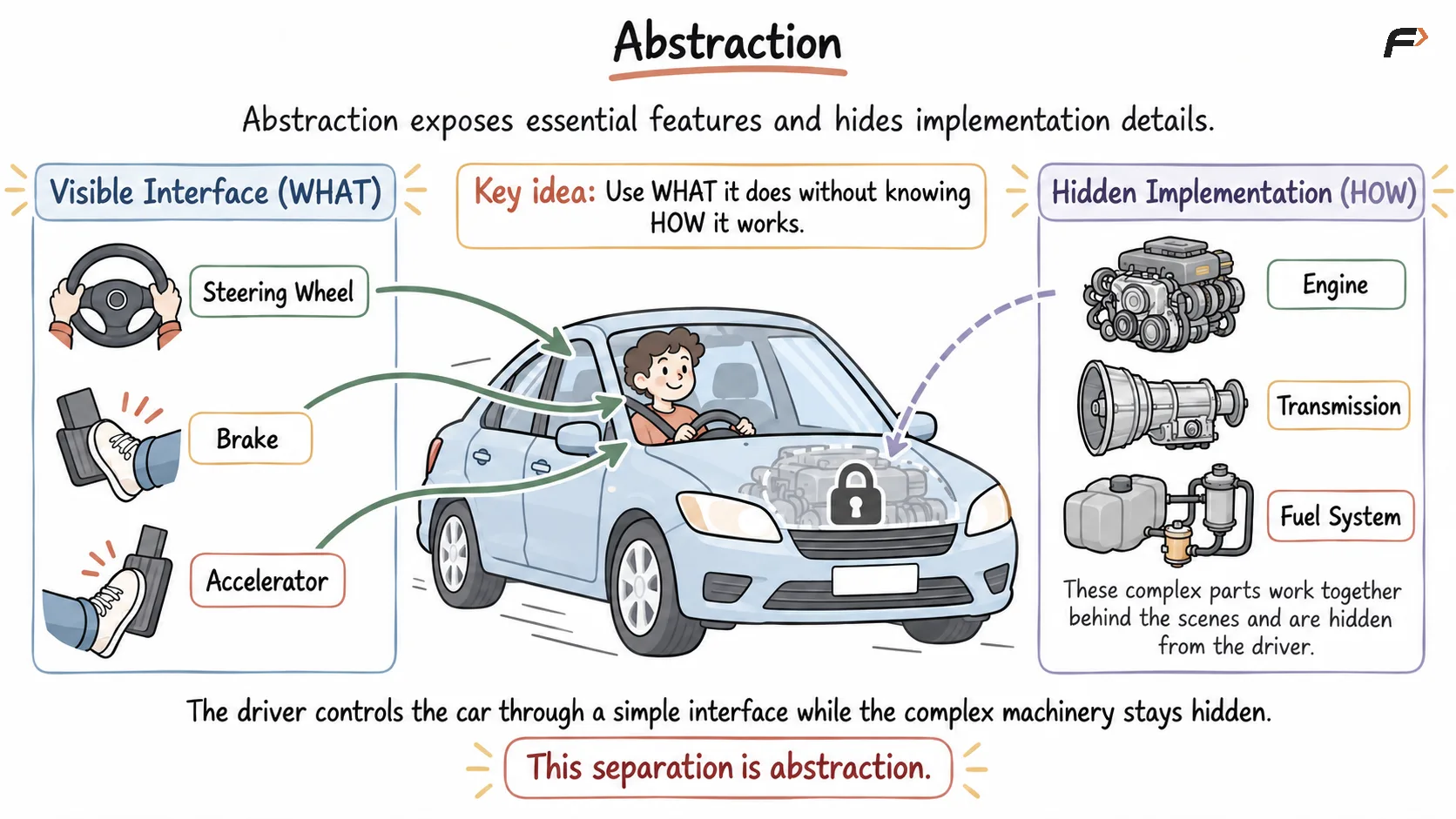
Abstraction means hiding internal implementation details and showing only the essential functionality of an object. Abstraction reduces complexity by allowing users to focus on what an object does instead of how it performs the operation.
For example, a person can drive a car using the steering wheel, brakes, and accelerator without understanding every internal part of the engine.
Abstraction
Features of Abstraction
Hides unnecessary implementation details
Shows only essential functionality
Reduces program complexity
Improves code organization
Makes implementation easier to modify
Allows different classes to implement the same operation differently
How Is Abstraction Achieved in Java?
Java mainly provides two ways to achieve abstraction:
Abstract classes
Interfaces
Abstract Class in Java
An abstract class is a class declared using the abstract keyword. It cannot be instantiated directly and is designed to be extended by other classes.
An abstract class can contain:
Abstract methods
Regular methods
Attributes
Constructors
Static methods
Abstract Method
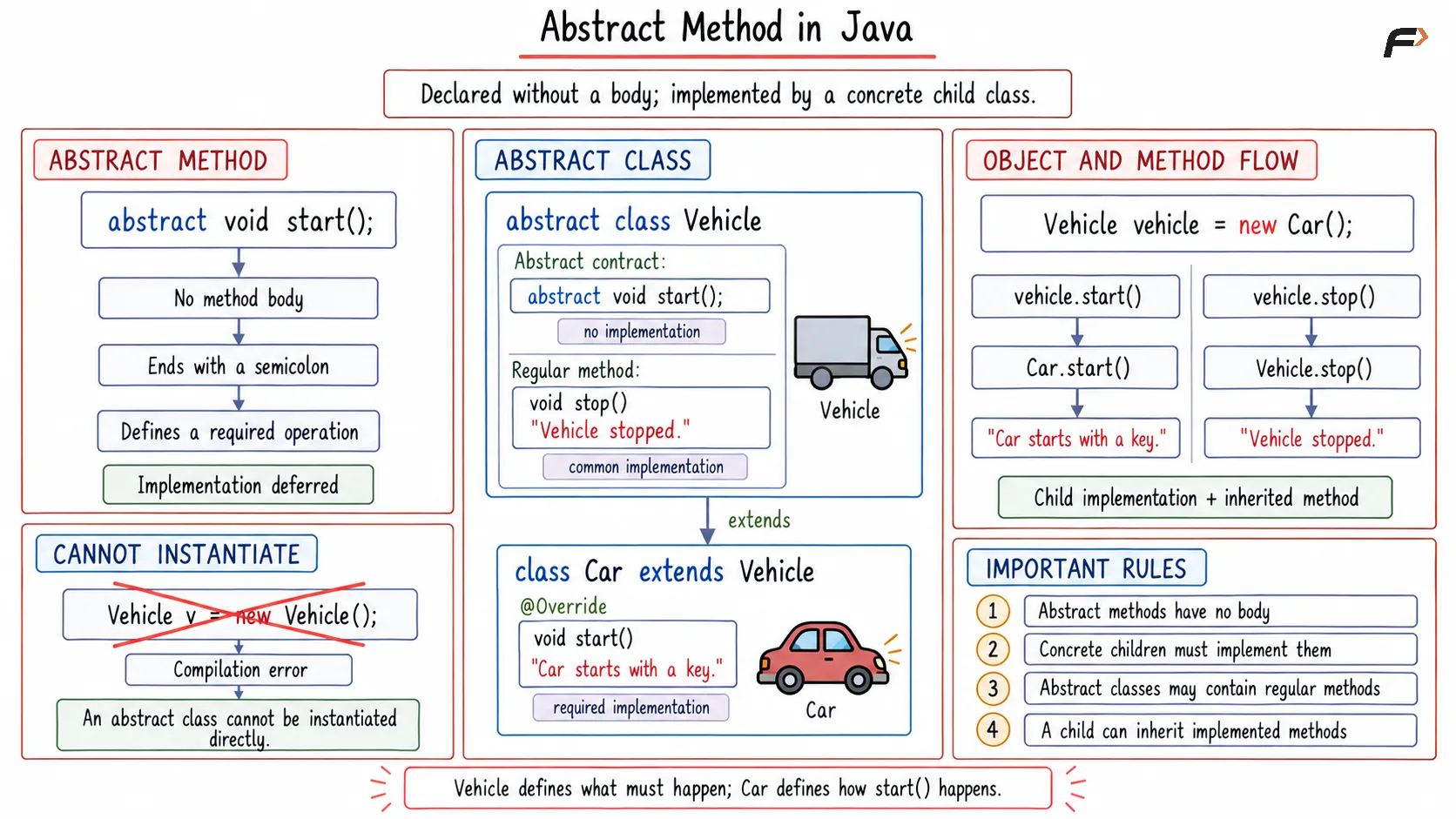
An abstract method is declared without a method body. A concrete child class must provide its implementation.
abstract void start();Abstract Class Example in Java
// Abstract class represents a general vehicleabstract class Vehicle { // Abstract method has no implementation // Child classes must provide its implementation abstract void start(); // Regular method contains a common implementation void stop() { System.out.println("Vehicle stopped."); }}// Car extends the abstract Vehicle classclass Car extends Vehicle { // Provide the implementation of the abstract method @Override void start() { System.out.println("Car starts with a key."); }}public class Main { public static void main(String[] args) { // Create a Car object using a Vehicle reference Vehicle vehicle = new Car(); // Call the implemented abstract method vehicle.start(); // Output :- Car starts with a key. // Call the regular method inherited from Vehicle vehicle.stop(); // Output :- Vehicle stopped. // An abstract class cannot be instantiated directly // Vehicle v = new Vehicle(); // Compilation error }}In this example, Vehicle defines the required start() operation without explaining how a vehicle starts. The Car class provides the actual implementation.
Abstract method
Important Features of Abstract Classes
Declared using the
abstractkeywordCannot be instantiated directly
Can contain abstract and regular methods
Can contain attributes and constructors
Extended using the
extendskeywordA class can extend only one abstract class
Interface in Java
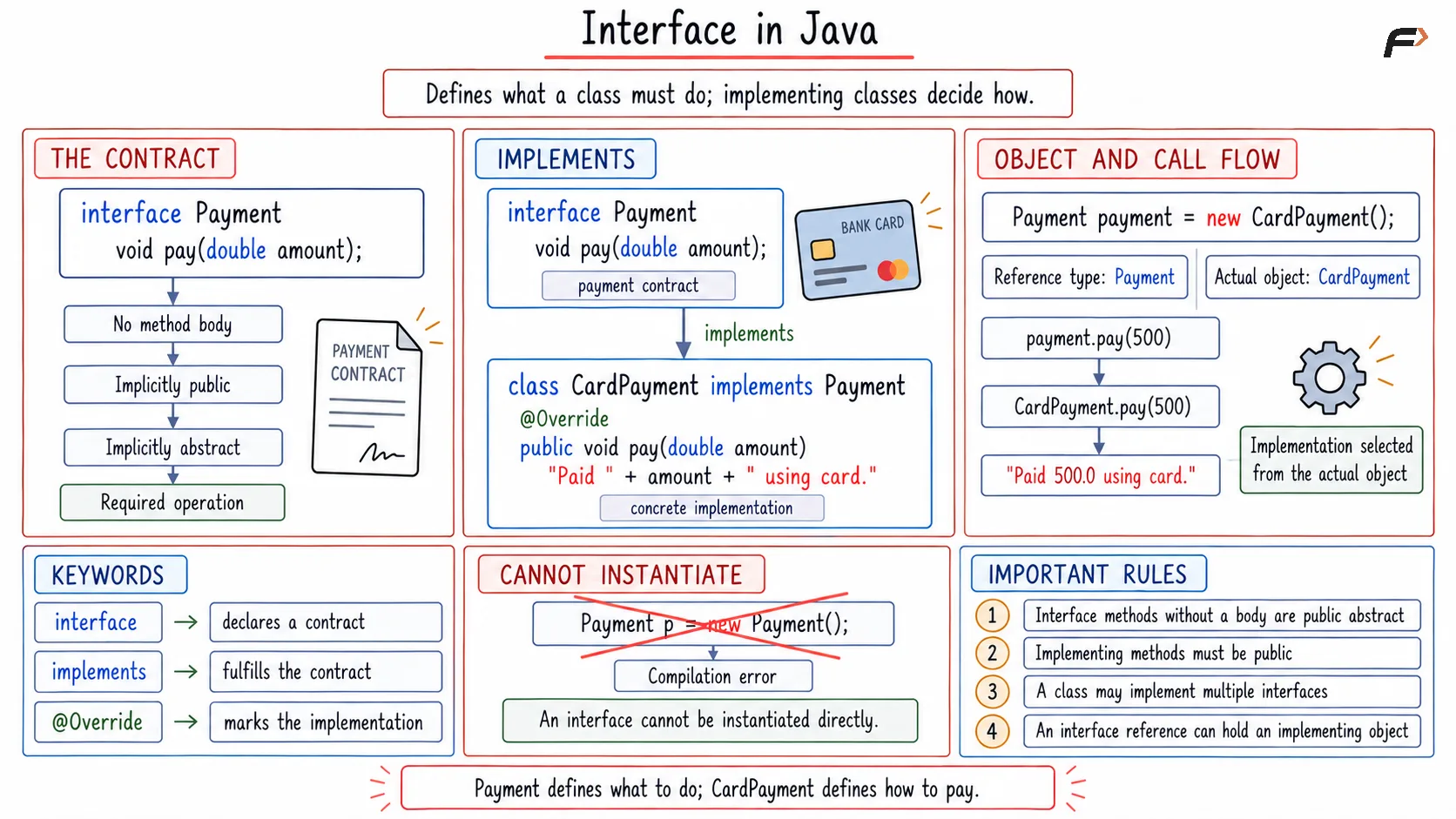
An interface in Java defines a set of operations that implementing classes must provide. It specifies what a class should do without requiring one specific implementation.
An interface is declared using the interface keyword. A class uses the implements keyword to implement it.
interface InterfaceName { void methodName();}Methods declared without a body in an interface are implicitly public and abstract.
Interface Example in Java
// Interface defines the required payment operationinterface Payment { // Interface method has no implementation void pay(double amount);}// CardPayment implements the Payment interfaceclass CardPayment implements Payment { // Provide the implementation of the interface method @Override public void pay(double amount) { System.out.println("Paid " + amount + " using card."); }}public class Main { public static void main(String[] args) { // Create a CardPayment object using an interface reference Payment payment = new CardPayment(); // Call the implemented interface method payment.pay(500); // Output :- Paid 500.0 using card. }}In this example, the Payment interface defines a pay() method. The CardPayment class decides how that payment operation is performed.
Interface
Important Features of Interfaces
Declared using the
interfacekeywordCannot be instantiated directly
Implemented using the
implementskeywordDefines common behaviour for implementing classes
A class can implement multiple interfaces
Implementing classes must provide the required method implementations
Abstract Class vs Interface
Abstract Class | Interface |
|---|---|
Declared using | Declared using |
Extended using | Implemented using |
Can contain abstract and regular methods | Mainly defines behaviour that classes must implement |
Can contain instance attributes | Fields are constants by default |
Can have constructors | Cannot have constructors |
A class can extend only one abstract class | A class can implement multiple interfaces |
Suitable for closely related classes | Suitable for defining common behaviour across classes |
Advantages of Abstraction
Reduced complexity: Unnecessary implementation details remain hidden.
Flexibility: Internal code can change without affecting its usage.
Reusability: Common behaviour can be shared through abstract classes.
Consistency: Interfaces can require multiple classes to follow the same structure.
Maintainability: Programs become easier to update and manage.
Abstraction vs Encapsulation
Abstraction hides implementation details and exposes essential behaviour.
Encapsulation protects data by restricting direct access to it.
Abstraction focuses on what an object does, while encapsulation focuses on protecting the object’s internal data.
Summary
Abstraction in Java hides internal implementation details and displays only essential functionality. Java achieves abstraction using abstract classes and interfaces.
Abstract classes can contain both abstract and regular methods, while interfaces mainly define operations that implementing classes must provide.
Be the first to add a comment.