Introduction
Understanding why SQL exists begins with the way software accessed data before relational databases became practical. Earlier data systems often required programs to know where records were stored and which path should be followed to reach them. Even a simple request could require detailed instructions for opening files, navigating records, comparing values, and constructing results.
SQL introduced a higher-level approach. It allowed a request to describe the required data while leaving the retrieval strategy to the database system.
The Problem Before SQL
In many earlier file-based and navigational systems, programs needed to know both what data to retrieve and how to reach it. This meant working with details such as record layouts, file structures, or predefined access paths.
For example, finding employees in the Sales department could require a program to open an employee file, read records, check each employee’s department, and collect the matching records.
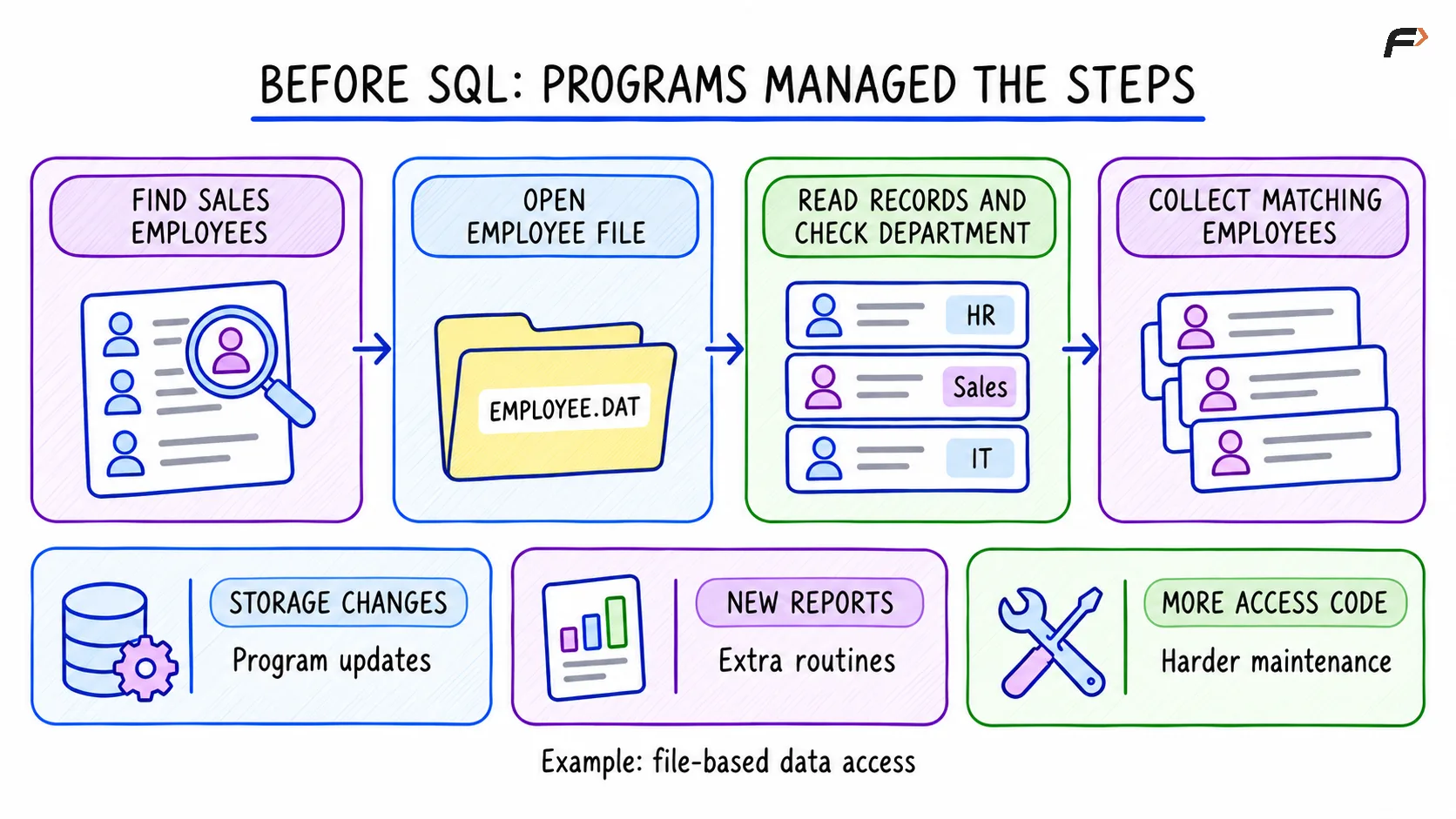
Before SQL: Programs Managed the Steps
This made data access harder to change and maintain. The problem was not that earlier systems had no useful features. The problem was that applications often carried too much responsibility for describing how data should be reached.
The Relational Model Changed the Approach
The relational model organized data into tables and reduced the need for applications to manage storage access paths.
Logical structure: Data was represented through tables, rows, and columns.
Simpler requests: SQL let users describe the result they wanted.
Database responsibility: The database chose how to retrieve the requested data.
For example, users could request Sales employees without writing instructions to open files and check each record.
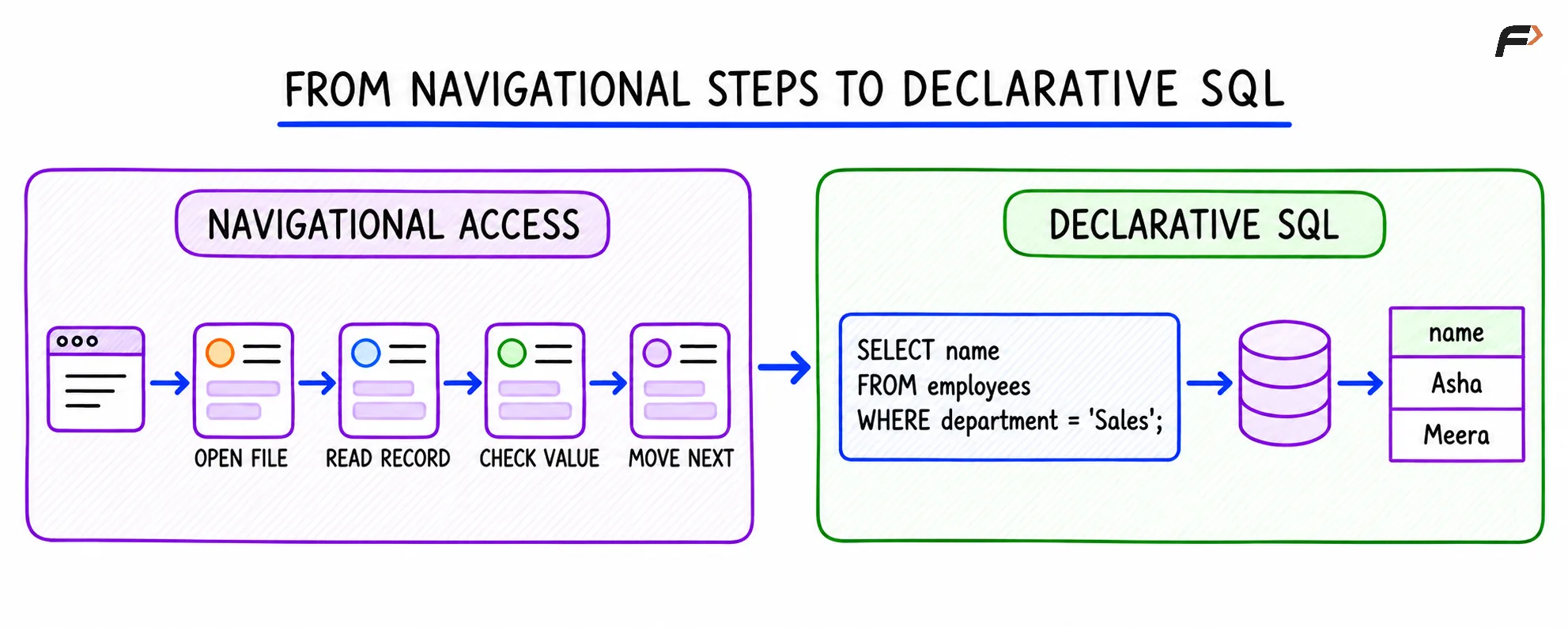
From Navigational Steps to Declarative SQL
SQL Separates What from How
The main reason SQL exists is to separate what data is required from how the database retrieves it.
Consider a request for employees in the Sales department.
SELECT name, salaryFROM employeesWHERE department = 'Sales';This query uses the same syntax in MySQL and PostgreSQL. The database selector can therefore display the same query for both systems.
The query describes:
The columns to return
The source table
The condition that matching rows must satisfy
It does not specify:
Which record should be read first
Whether an index should be used
How records are arranged on disk
How much memory should be allocated
Which internal algorithm should process the condition
Those execution decisions belong to the database management system.
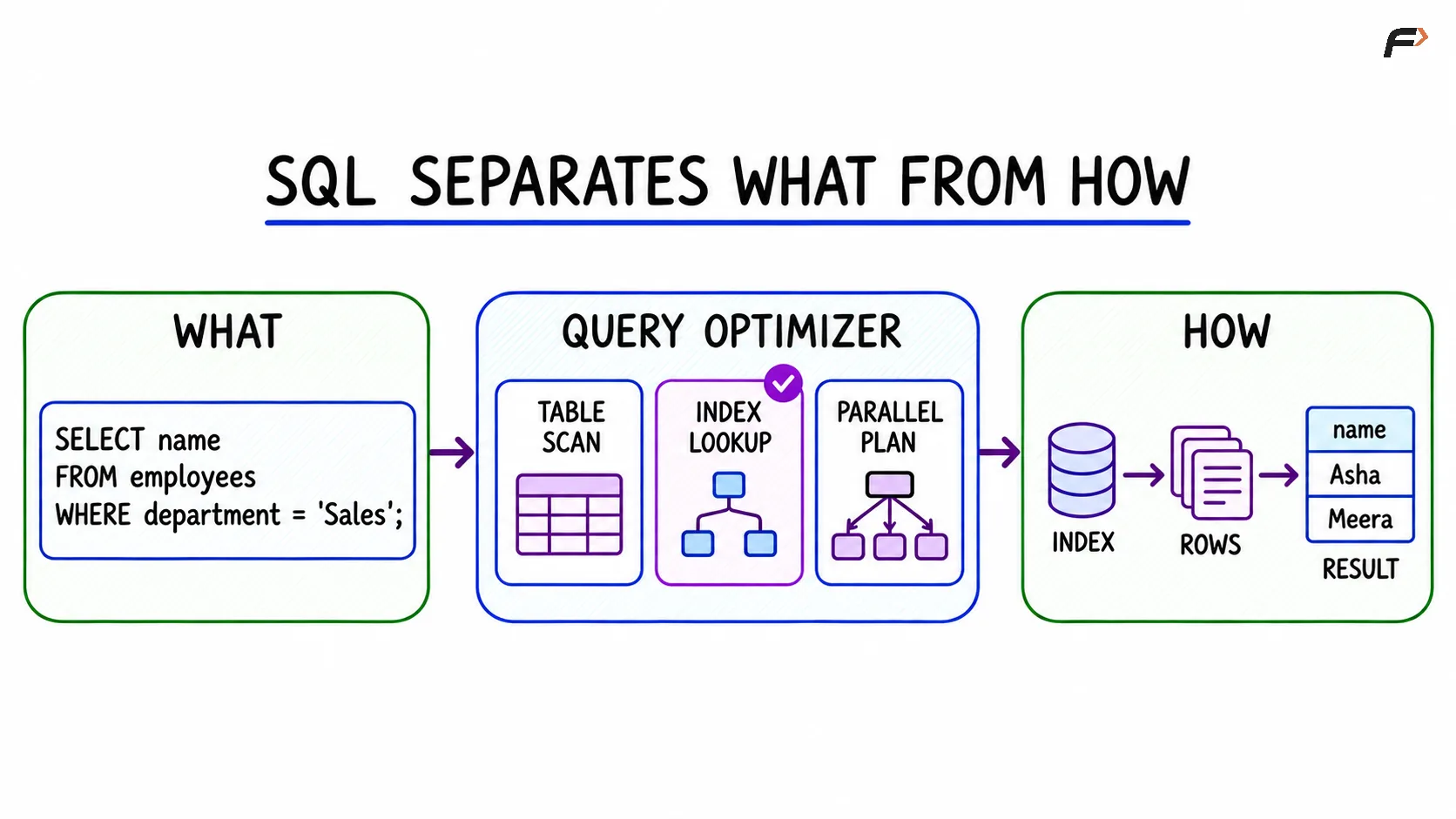
SQL Separates What from How
The Main Problems SQL Was Designed to Address
Different data access interfaces: SQL gave applications, analysts, and reporting tools a common language for querying data.
Dependence on storage details: Queries referenced tables and columns rather than disk locations or pointer paths.
Record-by-record processing: A single SQL statement could filter, combine, summarize, or update multiple rows.
Fixed reporting routines: New queries could answer different questions using the same stored data.
Rules scattered across applications: Constraints, keys, permissions, and transactions helped enforce rules centrally.
Why Declarative SQL Matters
Declarative SQL gives the database freedom to improve execution without changing the meaning of a query.
A database may process the same SQL statement using:
A full table scan
An index lookup
A different join order
A temporary result
Parallel workers
A revised plan based on updated statistics
The query continues to describe the required result. The database selects a physical strategy based on available information.
This separation creates an important division of responsibility:
SQL statement | Database system |
|---|---|
Describes the required data | Chooses an execution plan |
Identifies tables and columns | Locates stored records |
Defines filtering conditions | Selects indexes and algorithms |
Expresses logical relationships | Manages physical access |
States the intended change | Coordinates execution and storage |
SQL therefore acts as a stable logical interface between data requests and changing storage technologies.
How SQL Developed
The development of SQL followed the emergence of the relational model.
Period | Development |
|---|---|
1970 | Edgar F. Codd published the relational model |
Early 1970s | IBM began developing System R to test relational database ideas |
Mid-1970s | Donald Chamberlin and Raymond Boyce developed SEQUEL |
Later development | The name became SQL |
1980s | SQL became an ANSI and ISO standard |
Modern period | Database systems continue to implement standard SQL with their own extensions |
A 1975 IBM Research paper described SEQUEL as a relational data language intended to support interactive, ad hoc problem-solving, including use by non-specialists.
Standardization later gave SQL a common foundation across database products. MySQL, PostgreSQL, Oracle Database, Microsoft SQL Server, and other systems implement SQL while adding product-specific features.
Why SQL Remains Relevant
SQL continues to serve the same fundamental purpose even though database technology has changed substantially.
Applications still need a way to:
Retrieve selected data
Combine related records
Summarize large sets of rows
Add and modify data
Define database structures
Control access
Coordinate related changes
Modern database systems may store data across distributed servers, cloud infrastructure, memory, or specialized storage engines. SQL allows many of those physical details to remain behind a logical data interface.
Its continued use also provides a broad ecosystem of database products, development tools, reporting platforms, educational resources, and professional knowledge.
SQL is not ideal for every kind of data or computation. Its endurance comes from providing a practical, standardized, and expressive interface for structured and relational data.
Common Misconceptions About SQL’s Purpose
SQL was not created only to make database syntax easier
Readable syntax was valuable, but the deeper purpose was to provide a higher-level relational data language that reduced dependence on physical navigation.
SQL did not create the relational model
The relational model came first. SQL was developed as a practical language for working with relational database systems.
SQL does not remove the need for database design
Declarative queries hide many execution details, but tables, relationships, constraints, and indexes still require thoughtful design.
SQL does not guarantee fast queries
SQL gives the database freedom to optimize execution. Performance still depends on data volume, indexing, statistics, query structure, schema design, and system resources.
SQL does not eliminate all differences between database systems
Standard SQL provides a shared foundation. MySQL, PostgreSQL, and other systems still implement different functions, data types, extensions, and administrative features.
SQL is not a replacement for general-purpose programming languages
SQL focuses on defining and manipulating data. Application logic, interfaces, network communication, and many other tasks remain the responsibility of general-purpose languages.
Summary
SQL was created to solve a fundamental problem in early data management: the tight coupling between applications and physical data storage. By introducing a declarative, set-based language for relational databases, SQL shifted the focus from how to navigate to a record to what data is required. This separation of logical requests from physical execution allows database engines to dynamically optimize performance without breaking application code. Today, despite massive advancements in storage and distributed computing, SQL remains the industry standard because it provides a stable, highly expressive, and universal interface that elegantly hides physical complexity.
Be the first to add a comment.