Introduction
A college database stores students, courses, instructors, and departments. These records become useful when their connections are defined: students enroll in courses, instructors belong to departments, and instructors may receive office assignments.
Relationships describe these connections. Cardinality specifies how many associations are permitted, while optionality determines whether an association is required. Together, they turn statements about the organization into precise database rules.
Relationships Describe Meaningful Connections
A relationship represents an association between entities. For example, ENROLLS_IN connects STUDENT and COURSE.
A relationship type defines the association in the model. A relationship instance records one occurrence, such as student S1 enrolling in course C1.
Read Every Relationship in Both Directions
For DEPARTMENT and INSTRUCTOR, consider both statements:
A department can employ several instructors.
Each instructor belongs to exactly one department.
The second statement cannot be inferred from the first. A complete model must establish the rules independently in both directions.
Attributes Can Belong to Relationships
Some values describe an association rather than either participant alone.
For example, EnrolledAt records when a particular student joined a particular course. It belongs to the enrollment. The same student may join different courses at different times.
Recognizing relationship attributes helps identify associations that deserve their own records.
Cardinality Specifies the Maximum
For the binary relationships discussed here, the cardinality ratio describes the maximum permitted associations on each side.
The diagram below illustrates the common patterns.
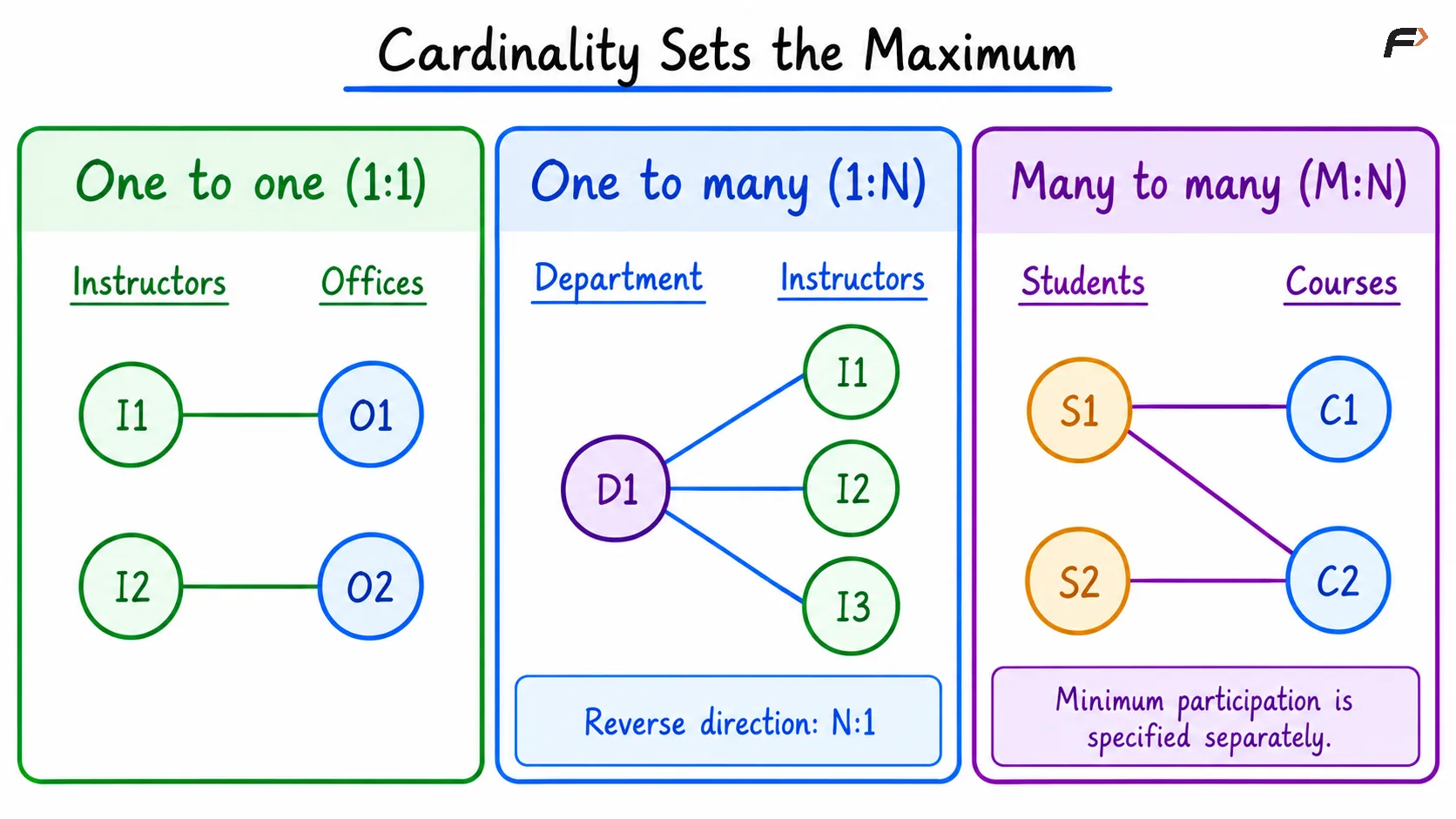
Cardinality
One to One
In a 1:1 relationship, an entity on either side can be associated with at most one entity on the other side.
Suppose an instructor can receive at most one reserved office, and each reserved office can be assigned to at most one instructor.
This rule does not require every instructor to have an office.
One to Many
In a 1:N relationship, one entity on the first side can be associated with several entities on the second side. Each entity on the second side has at most one association with the first.
A department can employ many instructors, while each instructor belongs to at most one department. Viewed from INSTRUCTOR to DEPARTMENT, the same relationship is N:1.
Many to Many
In an M:N relationship, entities on both sides can have several associations. A student can enroll in several courses, and a course can have several students. “Many” expresses an allowed maximum category. It does not mean that every entity currently has several connections.
Optionality Specifies Whether Participation Is Required
Optionality concerns minimum participation.
An optional relationship allows zero associations. A mandatory relationship requires at least one. A relationship can be mandatory on one side and optional on the other.
For example:
Every instructor must belong to a department.
A department may exist before any instructors are assigned.
These rules describe the same relationship from opposite directions.
Combine Minimum and Maximum
The following illustrations show four common combinations. They explain the rules conceptually rather than providing complete ER notation.
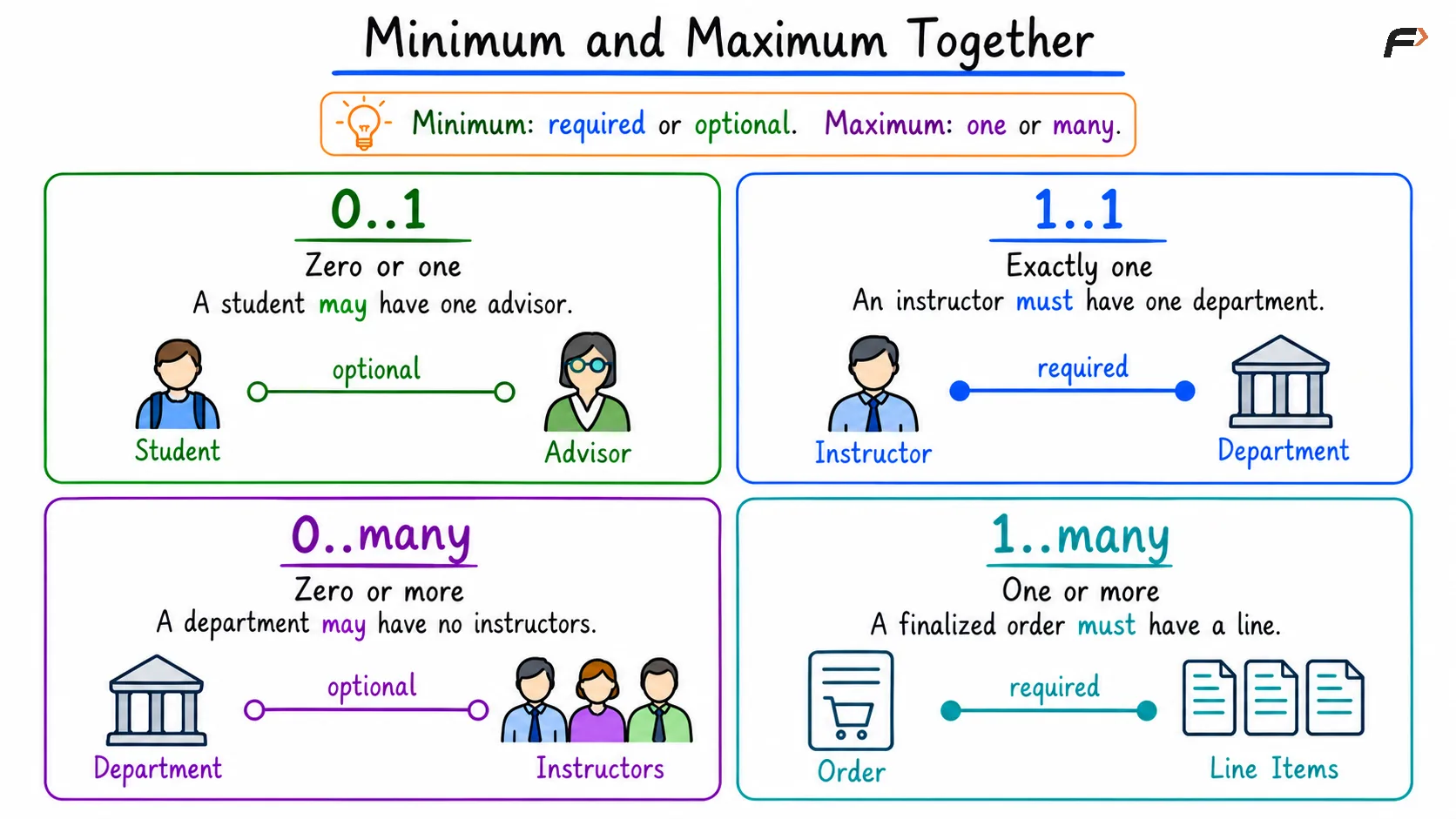
Minimum and Maximum Participation Constraints in ER Modeling
For the department example:
For each instructor: The number of related departments is 1..1.
For each department: The number of related instructors is 0..many.
Some modeling conventions use “cardinality” for the complete minimum–maximum range. Stating the range explicitly avoids ambiguity.
Translate Relationships into Tables and Constraints
Relational implementation uses foreign keys, nullability, uniqueness constraints, and association tables to preserve these rules.
One to Many
Place the foreign key on the many side. For DEPARTMENT and INSTRUCTOR, DepartmentID belongs in INSTRUCTOR.
The following example implements these rules:
Every instructor references exactly one existing department.
A department may have zero or many instructors.
The two versions create equivalent structures. Run the version matching the selected database.
CREATE TABLE department ( department_id INT PRIMARY KEY, department_name VARCHAR(100) NOT NULL);CREATE TABLE instructor ( instructor_id INT PRIMARY KEY, instructor_name VARCHAR(100) NOT NULL, department_id INT NOT NULL, CONSTRAINT fk_instructor_department FOREIGN KEY (department_id) REFERENCES department(department_id));The foreign key requires an existing department. NOT NULL makes the reference compulsory. Multiple instructor rows can reference the same department.
If department assignment becomes optional, permit NULL in DepartmentID. Do not use a fabricated identifier such as zero to represent “unassigned.”
One to One
For the instructor–office example, a foreign key alone does not prevent several instructors from referencing the same office.
Add UNIQUE to the office-reference column to enforce the maximum of one instructor per office. Whether that column permits NULL determines whether an instructor may remain unassigned.
Many to Many
Create an association table containing references to both participants. Relationship attributes belong there.
The following diagram makes enrollment explicit.
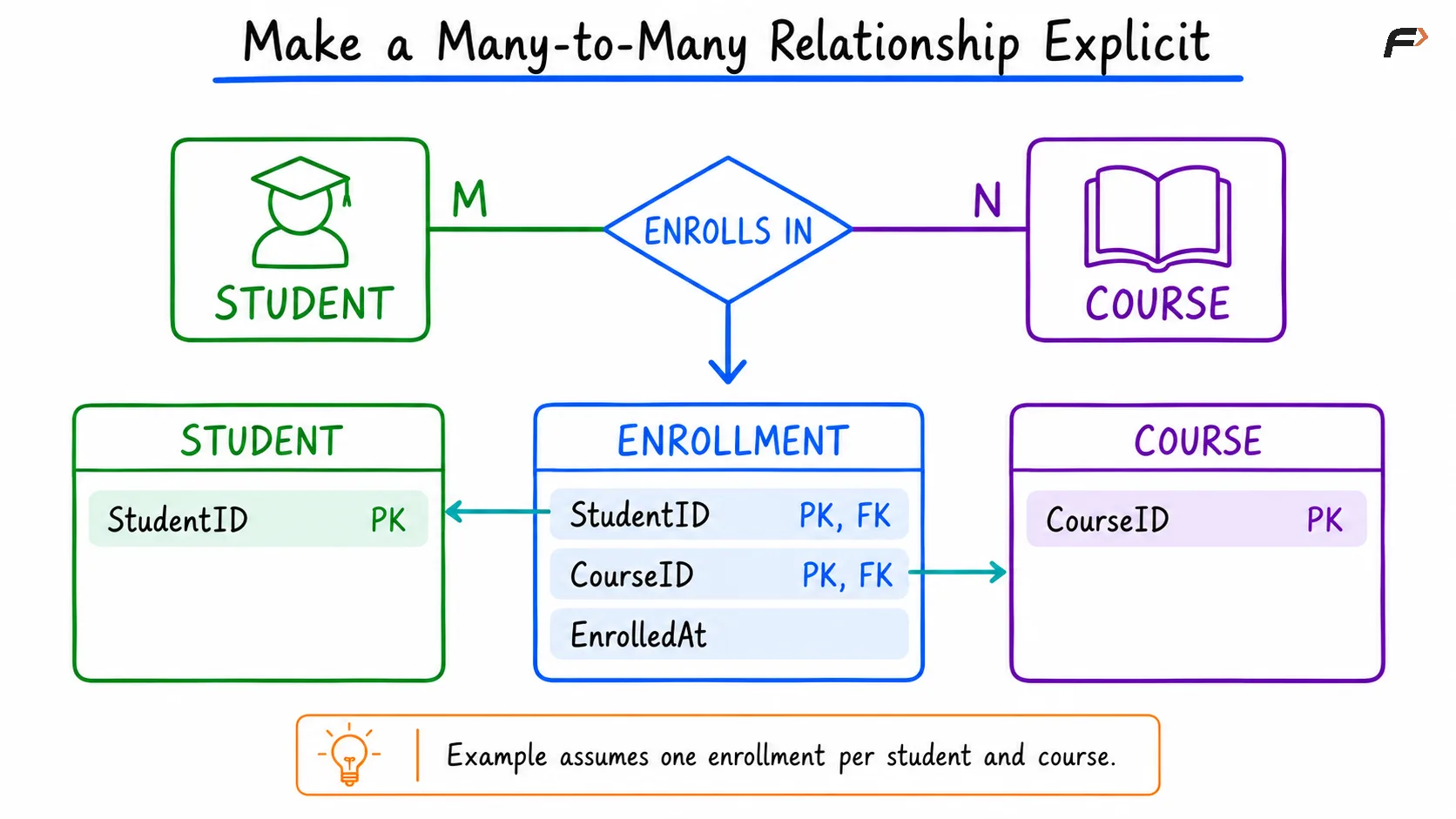
Make a Many to Many Relationship Explicit
In this simplified example, StudentID and CourseID together identify an enrollment. If students can repeat a course, the design must additionally distinguish the term, course offering, or attempt.
Each enrollment requires its participants, even when students and courses are allowed to exist without enrollments.
Validate the Rules with Realistic Cases
A relationship model should describe permitted situations, including those absent from the current dataset.
Test the empty case: Can a department exist without instructors? If yes, its minimum instructor count is zero.
Test the second association: Can one instructor belong to two departments simultaneously? If yes, the proposed 1:N model needs revision.
Test repeated events: Can a student enroll in the same course again? If yes, a student–course pair alone cannot identify every enrollment.
Test missing references: An instructor referencing a nonexistent department should be rejected.
Test deletion behavior: Decide what happens when a referenced department is removed. Deletion policy is a separate design choice.
A foreign key from INSTRUCTOR to DEPARTMENT does not require every department to have an instructor. Enforcing such a parent-side minimum requires additional logic.
Relationships may also change over time. “One department at a time” differs from “one department throughout an instructor’s history.” A historical assignment model must record the relevant periods.
Summary
Relationships describe associations between entities. Cardinality ratios establish maximum connections, while optionality determines whether participation is required. Express both directions using explicit minimum–maximum rules. Foreign keys, NOT NULL, UNIQUE, and association tables implement many of these restrictions, but some minimum-participation and historical rules require additional enforcement.
Be the first to add a comment.