Introduction
A SQL query describes the information you want, but it does not usually specify how the database should retrieve it. The database must interpret the statement, choose a suitable execution strategy, and perform the required operations.
This journey is called the query lifecycle. Understanding its main stages helps explain why a query can fail before execution, how indexes influence retrieval, and why the same SQL statement may use different execution plans.
What Is the SQL Query Lifecycle?
The SQL query lifecycle is the process through which a database receives, interprets, plans, executes, and responds to a statement.
SQL is largely declarative. When you request students with marks above 80, the database decides how to locate those rows rather than requiring you to specify a storage-access procedure.
For a typical SELECT query, the basic flow is:
Submission: The client sends the SQL statement through a database connection.
Parsing and analysis: The database checks its syntax and resolves the referenced objects and expressions.
Rewriting: Applicable transformations produce an equivalent internal representation.
Optimization: The database evaluates execution strategies and selects a plan.
Execution: The executor carries out the plan.
Result delivery: Rows and completion information are returned to the client.
This is a conceptual overview. Database systems differ in how they organize these stages, and prepared statements may reuse earlier processing.
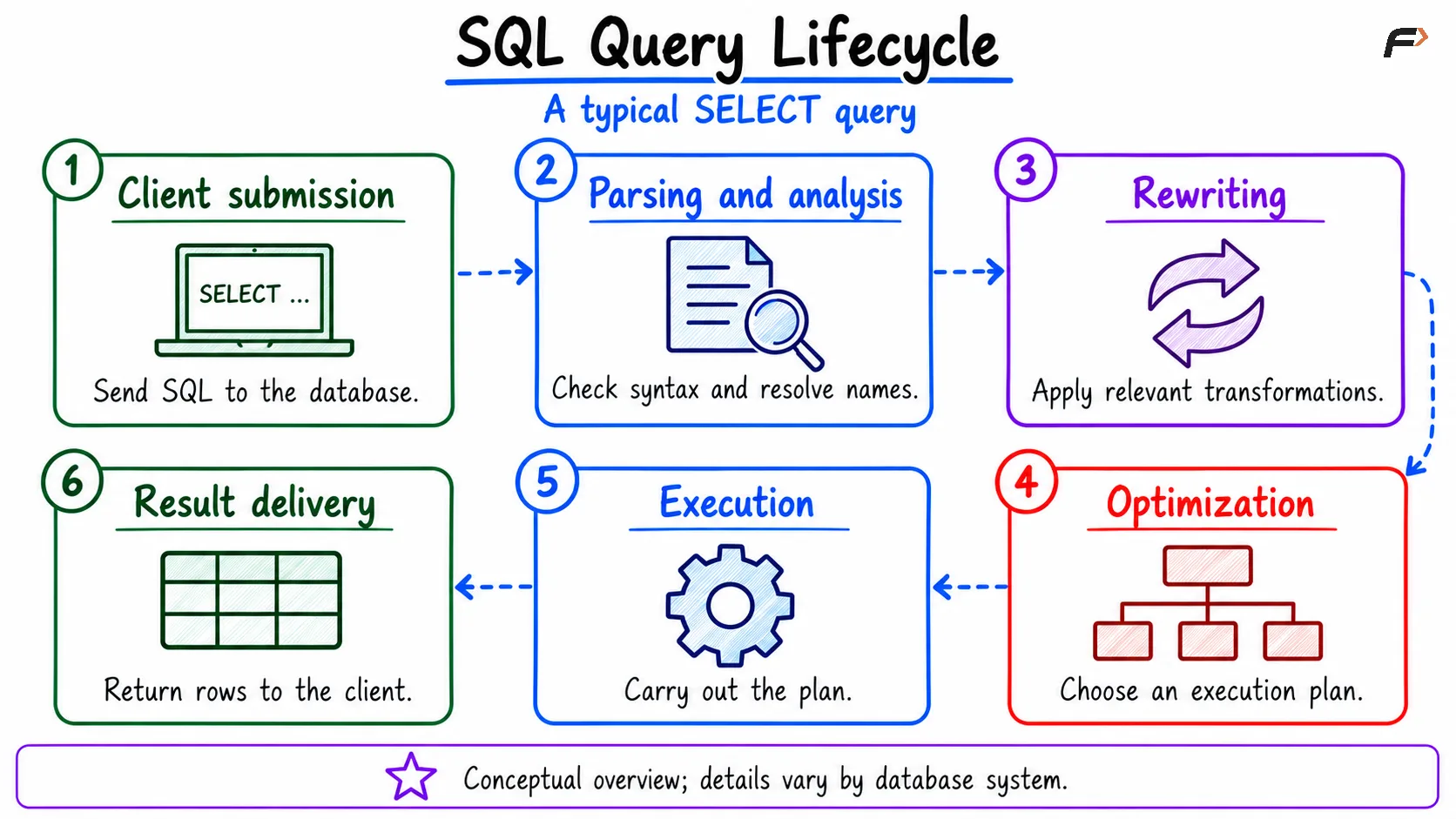
SQL query lifecycle
Parsing and Semantic Analysis
Parsing checks whether the SQL statement follows the language’s grammar and builds an internal representation of it.
For example, a misspelled keyword can cause a syntax error:
SELEC student_nameFROM students;A correctly written statement then needs semantic analysis. The database resolves table and column names, determines expression types, and checks whether operations make sense.
SELECT student_nameFROM studentsWHERE marks >= 80;For this query, the database needs to resolve students, locate student_name and marks, and determine how to evaluate the comparison. It uses metadata describing database objects, commonly stored in a system catalog.
Authorization must also be enforced. The exact timing of permission checks depends on the database system and operation.
Query Rewriting and Optimization
Query rewriting transforms the internal query representation while preserving its meaning. For example, a database may expand a view reference into the query that defines the view.
The optimizer then considers ways to execute the query. Its choices can include:
Access methods: Scan a table or use an available index.
Join strategies: Choose suitable algorithms and ordering when combining tables.
Filtering and sorting: Decide how these operations fit into the plan.
Parallel processing: Use multiple workers when supported and considered worthwhile.
The optimizer estimates costs using information such as table size, available indexes, and data-distribution statistics. It chooses a plan based on those estimates; it does not guarantee the fastest possible execution.
An index is therefore an option, not an instruction. A table scan can be preferable when the table is small or a query needs a large proportion of its rows.
Execution and Result Delivery
An execution plan describes physical operations the executor can perform, such as scanning rows, applying filters, joining records, and sorting results.
The executor follows this plan while working with the database’s storage and transaction mechanisms. Required data may already be in memory; reading a row does not necessarily require a fresh disk read.
For a SELECT, the database returns the requested columns from qualifying rows. Results may be delivered incrementally, although operations such as sorting can require intermediate work before rows become available.
Without ORDER BY, the query does not guarantee a particular result order. Physical storage order or an index’s presence should not be treated as that guarantee.
One Query, Two Possible Execution Plans
Assume the students table contains:
student_id | student_name | marks |
|---|---|---|
101 | Asha | 85 |
102 | Ravi | 72 |
103 | Meera | 91 |
Consider this query:
SELECT student_name, marksFROM studentsWHERE marks >= 80ORDER BY marks DESC;The database can produce the answer using different physical operations.
Plan A: Scan the table and sort
The database reads the table rows and tests marks >= 80. Asha and Meera qualify; Ravi does not. It then sorts the matching records by marks in descending order.
Plan B: Use an ordered index
If an index on marks is available, the database may read qualifying index entries from highest to lowest and fetch the corresponding student names. This ordered access may avoid a separate sorting operation.
Both plans produce:
student_name | marks |
|---|---|
Meera | 91 |
Asha | 85 |
The optimizer chooses a plan by comparing estimated costs using table size, available indexes, and data statistics. For this tiny table, scanning may be cheaper. With a larger table and relatively few qualifying records, index access may be preferable.
The executor carries out the chosen plan. It does not arbitrarily select an execution order. These are illustrative approaches; actual plans may combine operations and should be checked using EXPLAIN.
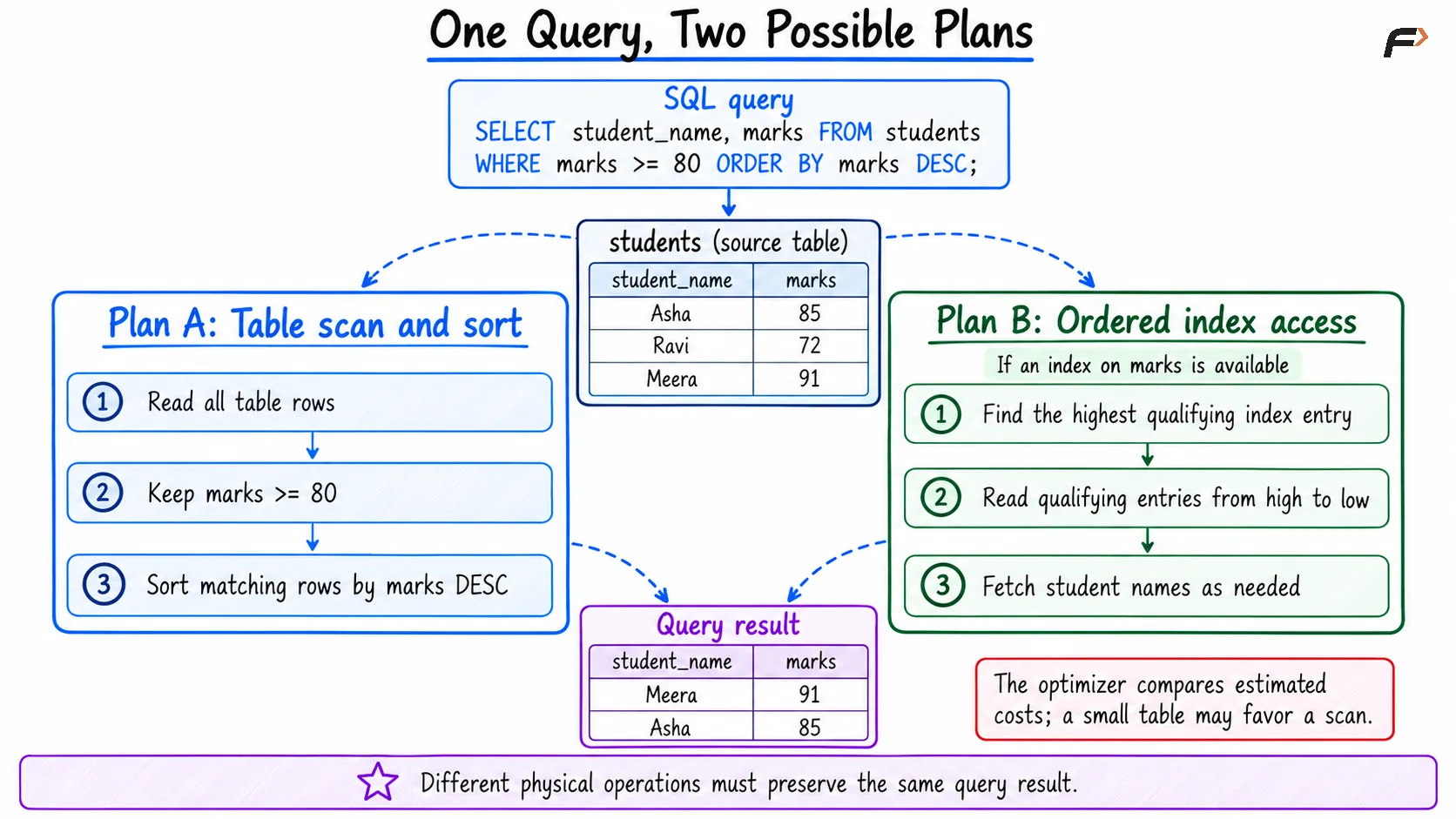
One Query, Two Possible Plans
Query Lifecycle vs Logical Query Order
The query lifecycle describes how the database processes an entire statement. Logical query order describes the conceptual meaning of clauses within a query.
Concept | What it explains | Example |
|---|---|---|
Query lifecycle | Processing stages inside the database | Parsing, optimization, execution |
Logical query order | How query clauses conceptually produce a result |
|
Physical execution plan | Operations selected to implement the query | Scan, filter, sort |
For the example, rows conceptually come from students, are filtered by marks, projected into the requested columns, and ordered.
The physical plan can arrange or combine work differently while preserving the query’s required meaning. SQL’s written clause order is not a step-by-step storage-access program.
Inspecting an Execution Plan
Many database systems provide EXPLAIN to display their planned execution strategy:
EXPLAINSELECT student_name, marksFROM studentsWHERE marks >= 80ORDER BY marks DESC;The output format depends on the database. It can help identify access methods, estimated row counts, and sorting operations.
A basic EXPLAIN shows planning information rather than measured execution performance. Supported forms of EXPLAIN ANALYZE execute the statement and report runtime information, so their behavior and syntax should be checked for the database in use.
Summary
The query lifecycle turns declarative SQL into operations the database can execute. Its main stages include parsing, analysis, rewriting, optimization, execution, and result delivery.
Keep this lifecycle distinct from logical clause order and the physical execution plan. Understanding all three helps explain query behavior and provides a foundation for studying indexes and query optimization.
Be the first to add a comment.