Introduction
As a database grows, keeping every record in one large structure can make storage management and workload distribution harder. Dividing data can help, but different techniques solve different problems.
Partitioning organizes data into smaller parts, sharding distributes data ownership, and distributed IDs support record identification across independent writers. Their effectiveness depends on the chosen keys and the queries the application needs to run.
Partitioning: Divide a Logical Table
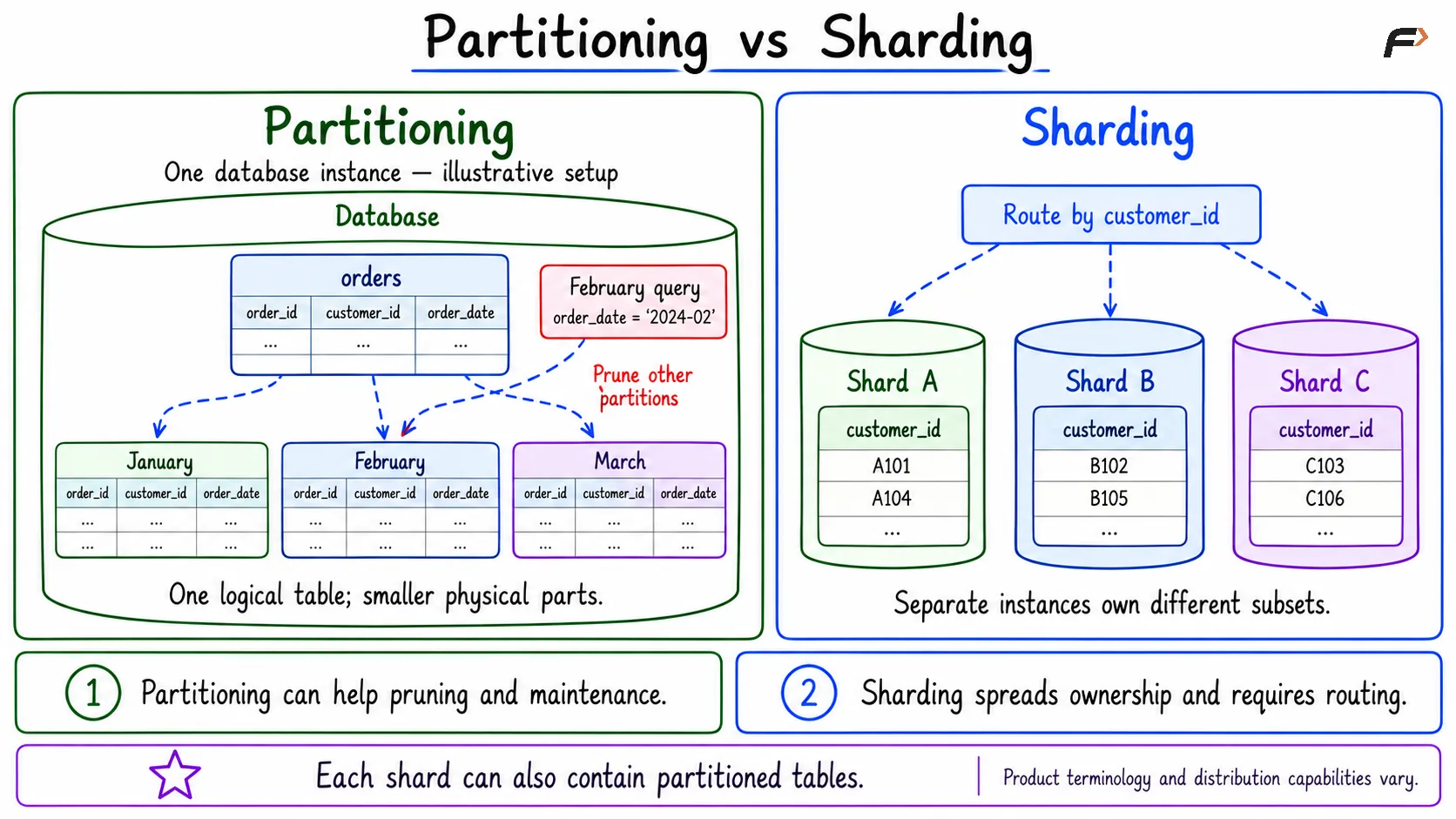
Partitioning divides a logical table into smaller physical parts according to a rule.
An orders table could use monthly partitions based on created_at:
Partition | Records assigned to it |
|---|---|
January | Orders created during January |
February | Orders created during February |
March | Orders created during March |
Applications can still query the logical orders table.
When a query contains a suitable date condition, the database may use partition pruning to skip irrelevant partitions.
For example:
SELECT order_id, totalFROM ordersWHERE created_at >= '2026-02-01' AND created_at < '2026-03-01';With compatible monthly partitioning, the database can potentially examine only the February partition.
Partitioning can also simplify maintenance, such as removing an old partition when its records are no longer needed. Exact capabilities and restrictions depend on the database.
Partitioning does not automatically distribute traffic across independent servers. Some database systems can distribute partitions, but that is an additional architectural capability.
Sharding: Distribute Data Ownership
Sharding divides a dataset across separate database instances or groups of instances.
Each shard owns a subset of the records. An application or routing layer determines where a request should go.
Suppose orders are sharded by customer_id. Orders for customer 101 belong to one shard, while another customer’s orders may belong elsewhere.
A request containing the customer ID can be routed directly to its owner. A request without the routing key may need to contact several shards.
Sharding can spread storage and traffic, but it also introduces distributed coordination, operational work, and failure handling.
Partitioning vs Sharding
The terms can overlap across products. The following distinction is useful for understanding their usual roles:
Aspect | Table partitioning | Sharding |
|---|---|---|
Main division | Parts of a logical table | Subsets owned by separate database instances |
Routing | Usually handled by the database | Requires shard-aware routing somewhere in the system |
Typical benefit | Pruning and data management | Distribution of storage and workload |
Cross-group operations | Managed within the database’s partitioning model | May require distributed execution |
A shard can also contain partitioned tables. The two techniques can therefore be used together.
Replication is different: it creates additional copies of data rather than dividing ownership.
Partitioning vs Sharding
Choosing a Partition or Shard Key
The division rule influences both balance and query efficiency.
Strategy | How it divides data | Main trade-off |
|---|---|---|
Range-based | Uses intervals, such as dates or customer ranges | Supports locality, but some ranges can become busy |
Hash-based | Maps key values through a hash function | Can spread values, but range queries may contact many groups |
Directory-based | Looks up ownership in a mapping | Flexible routing, with mapping-management overhead |
A good shard key should distribute work while allowing important queries to reach a limited number of shards.
For example, keeping a customer’s orders together can support customer-order queries. However, one exceptionally busy customer can still overload its shard.
Even record counts do not guarantee even traffic. Hot records and uneven workloads matter too.
Cross-Shard Queries and Growth
A query targeting one shard is generally simpler than one needing every shard.
For example:
SELECT SUM(total)FROM orders;Across shards, each shard may calculate a local sum, followed by a coordinator combining the partial results.
Cross-shard joins and transactions can require additional data movement or coordination.
Growth also requires planning. Adding shards may involve moving records and updating ownership information.
A simple rule such as hash(key) MOD shard_count changes many assignments when the shard count changes. More flexible routing schemes can reduce disruption, but rebalancing still needs to be managed.
Why Distributed IDs Matter
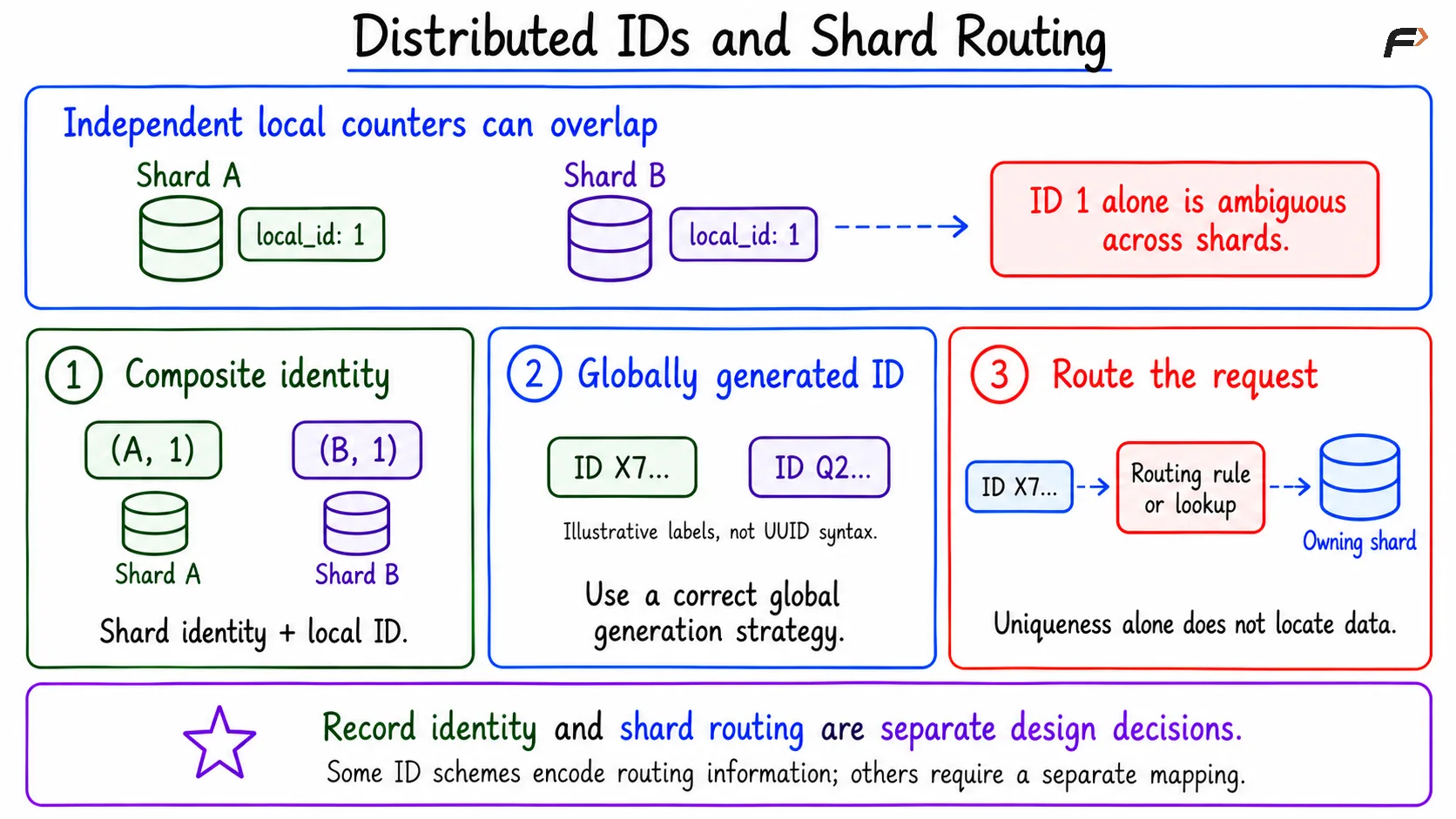
A local auto-increment counter can identify records within one database. If several shards independently start counting from 1, their generated IDs can overlap.
Two common approaches are:
Use a composite identity, such as
(shard_id, local_id).Generate an identifier intended to be unique across all writers.
Global uniqueness is useful when records move between shards or are referenced outside their original database.
However, a unique ID does not automatically reveal the correct shard. Record identity and routing are separate design decisions.
Common Distributed ID Strategies
Strategy | Basic idea | Important consideration |
|---|---|---|
Central allocator | One service assigns IDs or ranges | Availability and coordination |
UUID | Writers generate identifiers independently | Generation quality, representation, and index behavior |
Time-and-worker ID | Combines time, worker identity, and a sequence | Clock handling, worker uniqueness, and sequence limits |
Time-and-worker schemes are often called Snowflake-style IDs.
Their uniqueness depends on correct operation: worker identifiers must not conflict, and clock movement or sequence exhaustion must be handled.
Time-oriented IDs can improve insertion locality compared with fully random values, but they do not necessarily represent exact commit order.
Also, avoid using an increasing ID as a naive range-sharding key when it sends nearly all new writes to the newest shard.
Common Distributed ID Strategies
Summary
Partitioning divides a logical table into manageable parts, while sharding distributes ownership across database instances. Both depend on keys that fit the workload and avoid unnecessary access or concentration.
Distributed IDs support identification across independent writers, but they do not solve routing or balancing by themselves. Storage division, shard ownership, and ID generation should be designed together.
Be the first to add a comment.