Introduction
Relational databases organize data into tables and support queries through SQL. NoSQL databases provide other ways to represent and access data, including documents, key-value entries, wide-column structures, and graphs.
Choosing between them begins with the application’s requirements. The important questions concern relationships, queries, consistency, transactions, and the work required to operate the system.
What Does NoSQL Mean?
NoSQL is an umbrella term for databases that use models other than, or in addition to, the traditional relational model. It is often expanded as “Not Only SQL.”
It does not describe one architecture or set of guarantees.
A document database and a graph database may differ substantially in how they store data, execute queries, and handle transactions.
Likewise, SQL is a query language, not a guarantee of one deployment model. Relational databases can support replication, partitioning, and distributed execution.
Key-Value Model
A key-value database associates a unique key with a value.
Key | Value |
|---|---|
| Session details |
| Shopping-cart contents |
| User preferences |
The main access pattern is retrieving or updating a value through its key.
This model fits workloads with direct lookups, such as session storage or cached application data. Some systems provide richer value types and additional operations.
The limitation appears when queries need attributes inside many values. Searching all carts for a particular product may require additional indexing or a different representation.
Document Model
A document database stores records as structured documents, often using a JSON-like format.
{ "customer_id": 101, "name": "Asha", "addresses": [ { "city": "Pune", "type": "delivery" } ]}A document can group related information into one unit. This can suit product catalogues, content records, and application objects frequently retrieved together.
Documents can have varying fields, but that does not mean data design disappears. Applications still need rules for types, required attributes, validation, and changes over time.
Embedding data can reduce separate lookups. However, duplicating shared information creates update responsibilities, and unbounded embedded collections can become difficult to manage.
Wide-Column Model
A wide-column database commonly organizes records around partition keys and ordered rows or columns within those partitions. Exact terminology varies by system.
For example, device readings might be organized by a partition key combining device_id and a time bucket, with readings ordered by timestamp.
This design can suit known access patterns such as retrieving recent measurements for one device.
The model often encourages query-driven design: arrange data for the reads the application must perform.
Poor partition-key choices can create hot or oversized partitions. Queries that do not match the data organization may need additional tables or access paths.
Wide-column databases should not be confused with analytical columnar storage. The terms describe different concepts.
Graph Model
A graph database represents data using nodes, relationships, and properties.
For example:
A customer purchased a product.
A product belongs to a category.
A customer knows another customer.
Graph models can suit relationship-heavy workloads such as network analysis, recommendations, and fraud investigation.
They make connected data explicit, but efficient traversal still depends on query design, starting-point selection, and the size of the explored graph.
A graph model is useful when relationships are central to the workload, rather than simply because the data contains some relationships.
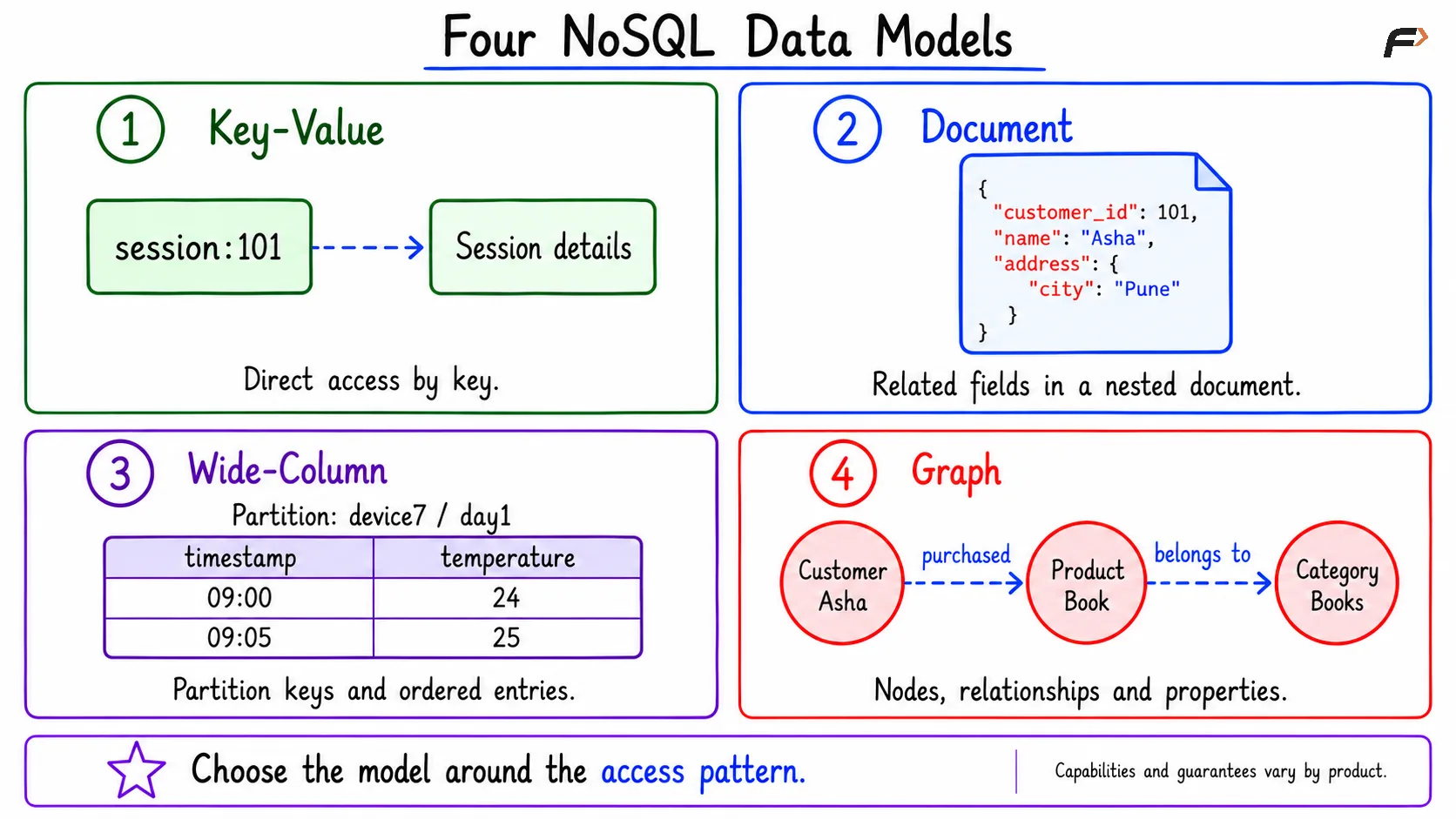
Four NoSQL data models
Comparing SQL and NoSQL Approaches
Requirement | Relational approach | NoSQL considerations |
|---|---|---|
Structured relationships | Tables, keys, and joins | Representation depends on the model |
Flexible record shapes | Can use optional columns and document types | Document models often accommodate variation naturally |
Transactions | Commonly supports multi-row transactions | Scope and guarantees vary by product |
Query flexibility | SQL supports many combinations of filters, joins, and aggregation | Often strongest when queries match the model |
Distribution | Available through several architectures | Common in many systems, but not automatic or effortless |
These are considerations, not universal rules.
NoSQL does not mean “no transactions,” and SQL does not mean “cannot scale.” Product capabilities and configurations matter more than the category label.
Start with Access Patterns and Guarantees
Before selecting a database, ask:
What must the application read and write? List important queries and their expected frequency.
Which relationships must be maintained? Consider joins, traversal, and duplicated data.
What must change atomically? Identify operations that cannot safely complete only halfway.
How fresh must reads be? Specify acceptable staleness and read-after-write behavior.
How will data grow? Consider volume, hot keys, large records, and distribution.
Who will operate it? Include backups, recovery, migrations, monitoring, and team experience.
For example, an order-processing system may benefit from relational constraints and transactions. A session store may fit direct key-value access. Neither example removes the need to evaluate the actual workload.
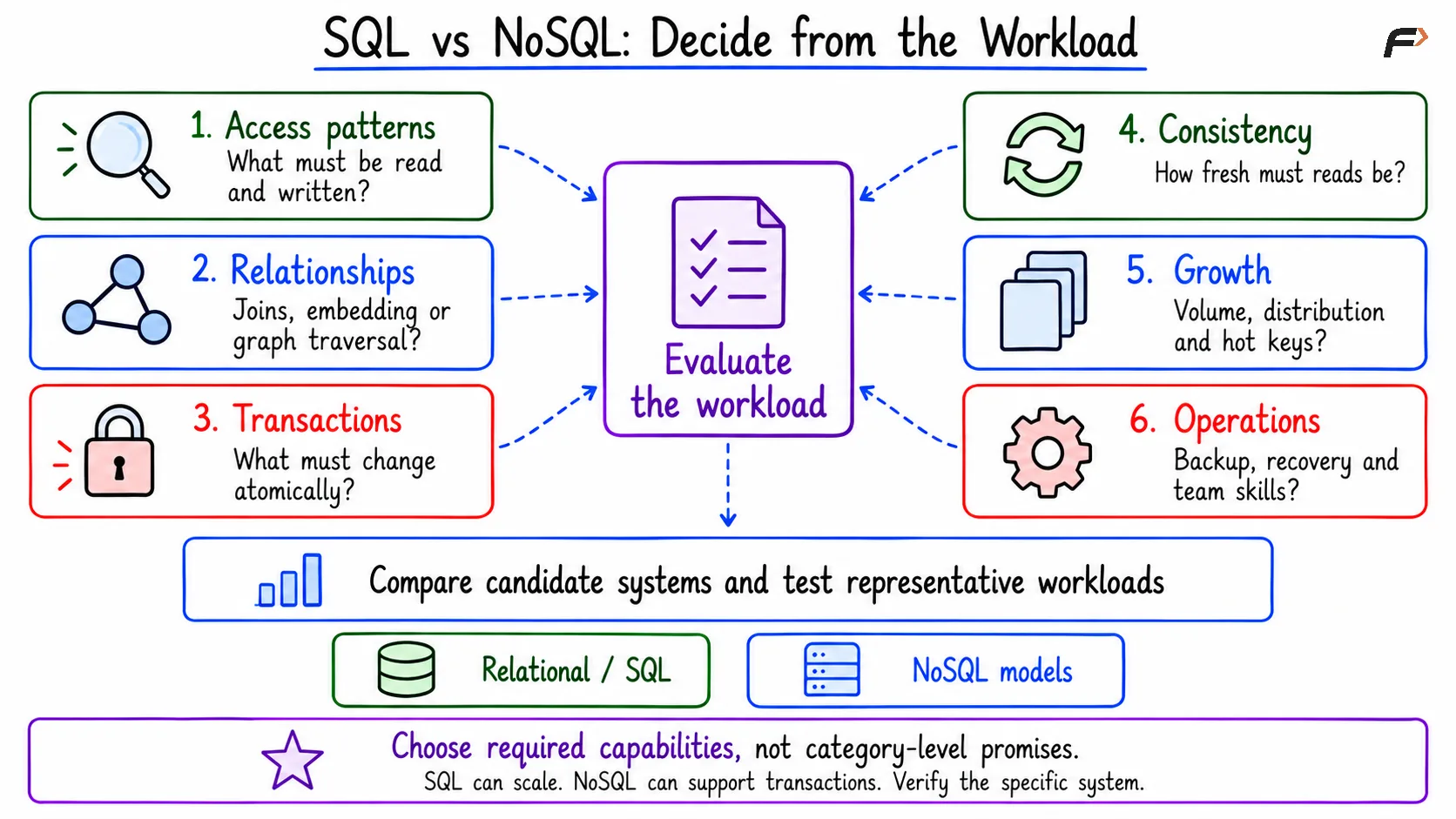
SQL-vs-NoSQL decision framework
Using More Than One Model
An application can use different databases for different responsibilities.
A relational database might hold orders, a key-value system might cache frequently requested results, and a graph system might support relationship analysis.
This is sometimes called polyglot persistence.
However, additional systems introduce synchronization, recovery, and operational complexity. Cached or copied data can become stale, and changes spanning systems require explicit coordination.
Start with the simplest architecture that meets the requirements. Add another model when its benefits justify the extra responsibilities.
Summary
Key-value, document, wide-column, and graph databases organize data around different access patterns. Relational databases offer another approach, with tables, relationships, and SQL-based querying.
Choose based on the workload and required guarantees rather than category-level promises. Data modeling, transaction boundaries, query flexibility, and operational costs remain important whichever database is selected.
Be the first to add a comment.