Introduction to SQL
An introduction to SQL begins with a simple idea: stored data becomes useful when it can be retrieved and changed precisely.
SQL provides a common language for communicating with relational database systems. Banking applications use SQL to find transactions, online stores use it to manage orders, and analysts use it to transform stored records into useful reports. Beyond just basic queries, SQL serves as the foundational building block for modern data architecture.
Whether you are a software developer building robust backend services, a data scientist uncovering market trends, or a product manager tracking user metrics, understanding SQL empowers you to interact directly with the data that drives decision-making. Despite being decades old, its declarative nature and standardized syntax make it an enduring and indispensable tool in today’s data-driven world.
SQL Fundamentals
SQL at a Glance
SQL, commonly expanded as Structured Query Language, is a language used to work with data in relational database systems.
SQL can:
Retrieve stored data
Add new records
Modify or remove records
Create database structures
Control database access
Manage related changes as transactions
Term | Meaning |
|---|---|
Database | An organized collection of data |
Table | Data arranged in rows and columns |
Row | One complete record |
Column | One property of a record |
Query | A request sent to a database |
Result set | The rows and columns returned by a query |
SQL is declarative. An SQL statement describes the required result, while the database management system determines how to produce it.
How SQL Works with Relational Data
A relational database commonly organizes related information into tables.
Consider an employees table:
employee_id | name | department | salary |
|---|---|---|---|
101 | Asha | Sales | 55000 |
102 | Kabir | Engineering | 72000 |
103 | Meera | Sales | 61000 |
Each row represents one employee. Each column stores a particular attribute, such as the employee’s name, department, or salary.
An SQL statement refers to these tables and columns to describe an operation. The database management system receives the statement, checks it, processes the required data, and returns a result.
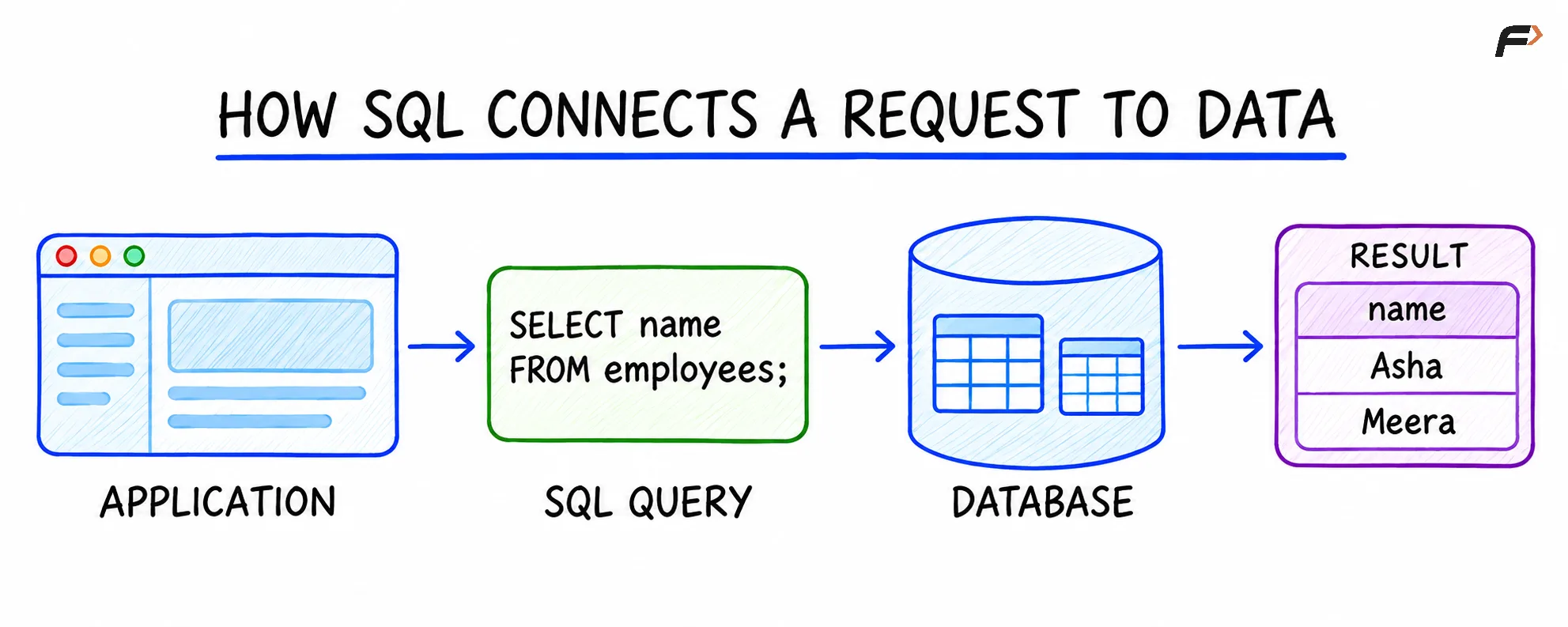
How SQL Connects a Request to Data
A First SQL Query
The following query retrieves the names and salaries of employees in the Sales department.
SELECT name, salaryFROM employeesWHERE department = 'Sales';Both database systems return the same result:
name | salary |
|---|---|
Asha | 55000 |
Meera | 61000 |
Parts of the Query
Clause | Purpose |
|---|---|
| Specifies the columns to return |
| Identifies the source table |
| Keeps only matching rows |
The syntax is identical in MySQL and PostgreSQL because the query uses standard SQL features.
SQL keywords are commonly written in uppercase for readability. Keyword case is generally not significant in MySQL and PostgreSQL, although identifier and text-comparison behavior can depend on database configuration.
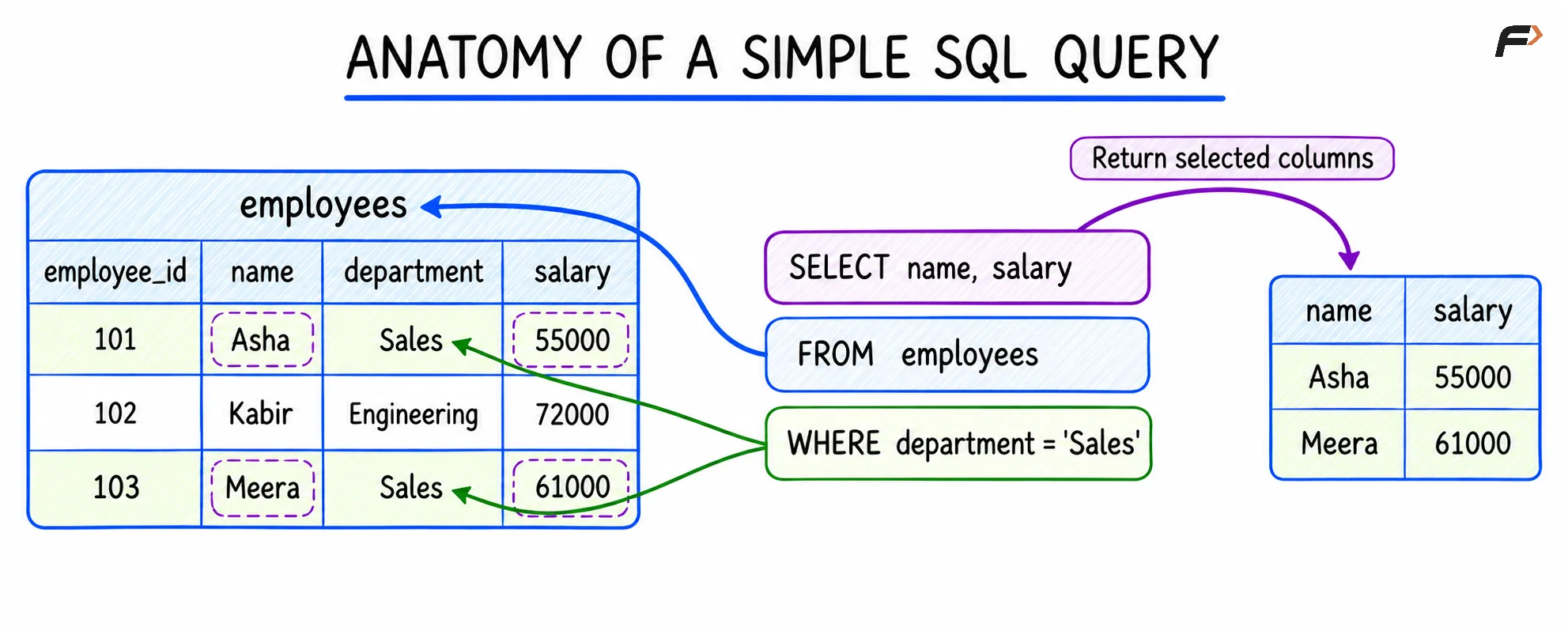
Anatomy of a Simple SQL Query
Core Capabilities of SQL
SQL is often introduced as a query language, but its purpose extends beyond retrieving data.
Capability | Purpose | Common statements |
|---|---|---|
Querying data | Retrieves selected information |
|
Adding data | Stores new rows |
|
Changing data | Modifies existing rows |
|
Removing data | Deletes rows |
|
Defining structure | Creates or changes database objects |
|
Controlling access | Grants or removes permissions |
|
Managing transactions | Confirms or reverses related changes |
|
These capabilities allow SQL to support application development, data analysis, reporting, and database administration.
The detailed syntax and classification of these statements belong to later lessons on SQL commands, data definition, data manipulation, permissions, and transactions.
SQL and Database Management Systems
SQL is a language, not a database product.
MySQL and PostgreSQL are database management systems that understand SQL. Other SQL database systems include SQLite, Microsoft SQL Server, and Oracle Database.
SQL | Database management system |
|---|---|
A language for expressing data operations | Software that stores and manages data |
Includes statements such as | Executes SQL statements |
Has a standardized foundation | Provides storage, security, concurrency, and recovery |
Describes the required operation | Determines how to perform the operation |
SQL provides the instructions, while MySQL or PostgreSQL processes those instructions.
SQL Dialects
SQL has a standardized core, so many basic statements work in both MySQL and PostgreSQL.
Each database system also provides product-specific features. These variations are known as SQL dialects.
Differences commonly appear in:
Data types
Date and time functions
Text-processing functions
Automatic ID generation
Row-limiting syntax
Stored procedure syntax
JSON operations
Administrative commands
MySQL commonly uses AUTO_INCREMENT to generate numeric identifiers. PostgreSQL commonly uses identity columns or sequence-based behavior.
Core SQL knowledge transfers between systems, but product documentation remains important when dialect-specific features are involved.
SQL as a Set-Based Language
SQL is designed to operate on sets of rows.
A single SQL statement can retrieve, modify, or remove many matching records. This differs from programming styles that process records individually through loops.
The Sales query does not request Asha and Meera separately. It defines a condition:
department equals SalesThe database applies that condition to the relevant rows and returns every match.
Set-based operations make SQL concise and effective for structured data. They also require careful conditions because an UPDATE or DELETE statement can affect multiple rows.
SQL Strengths and Trade-Offs
Strength | Practical value | Trade-off |
|---|---|---|
Declarative syntax | Keeps attention on the required result | The execution strategy is controlled by the database |
Set-based operations | Processes many rows with one statement | Row-by-row thinking can cause early confusion |
Standardized foundation | Core knowledge transfers between systems | Dialect differences limit complete portability |
Integrated data operations | Supports structures, records, permissions, and transactions | Careless statements can affect many records |
Relational model support | Makes relationships between records easier to query | Poor table design can make queries inefficient |
SQL is particularly effective for structured data and relationships. It does not replace a general-purpose programming language.
Applications commonly combine SQL with languages such as Java, Python, JavaScript, C#, Go, or PHP. The application handles business logic and user interaction, while SQL communicates with the database.
Common SQL Confusions
SQL and SELECT are not the same
SELECTretrieves data, but SQL also creates structures, inserts records, updates values, removes records, manages permissions, and controls transactions.Tables and databases are different
A database can contain many tables and other objects. A table is one structured part of the database.
SQL and MySQL are different
SQL is a language. MySQL is a database management system that implements SQL.
The same distinction applies to PostgreSQL. PostgreSQL is a database management system with its own SQL dialect and additional features.
SQL does not specify every execution step
An SQL statement describes the required operation. The database engine chooses a physical strategy based on indexes, statistics, table sizes, available memory, and other factors.
SQL dialects are similar but not identical
Basic queries often work without changes across database systems. More specialized operations may require different syntax in MySQL and PostgreSQL.
Summary
SQL (Structured Query Language) is the industry-standard language for interacting with relational database management systems. It empowers users to efficiently retrieve, insert, update, and delete structured data through intuitive, declarative statements. Rather than replacing general-purpose programming languages, SQL specializes in set-based data operations, leaving the complex execution strategies to the database engine (such as MySQL or PostgreSQL).
Be the first to add a comment.