Introduction
A shop records purchases, customer details, payments, and stock changes throughout the day. These records support everyday questions: What was sold? Which orders remain unpaid? How much stock is available?
Collecting records is only the beginning. Their value depends on whether people can find, understand, update, and trust them. Raw data provides the recorded facts, while poor organization creates the practical difficulties that make database management important.
Raw Data and Useful Information
Data consists of recorded facts or observations, such as a product identifier, purchase quantity, or payment timestamp. Raw data refers to records in their collected form before processing for a particular purpose.
Raw data can already be structured and accurate. An order table can contain valid rows and columns while still requiring processing to answer a business question.
Adding Context and Processing
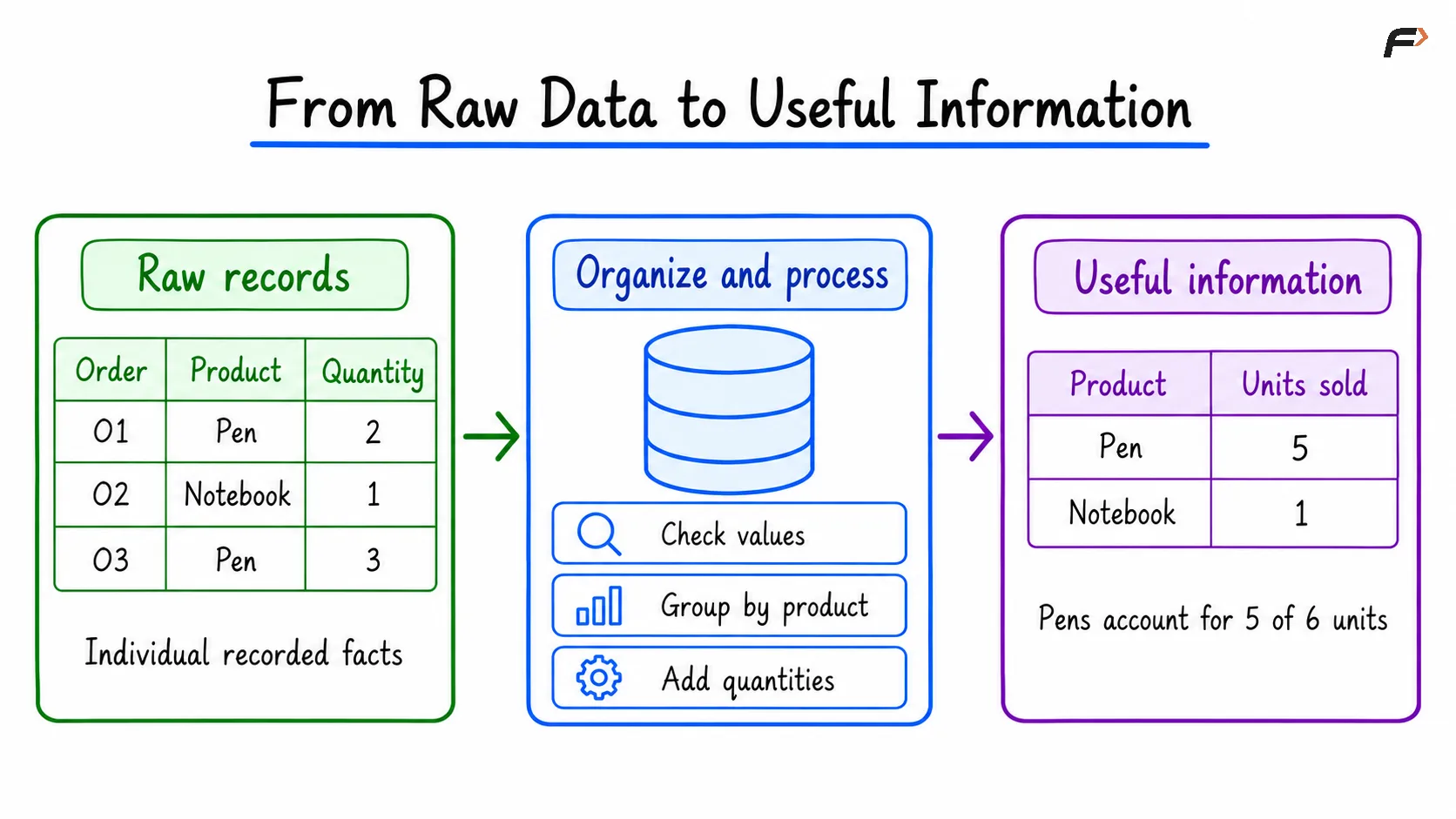
Consider three purchases: two pens, one notebook, and another three pens. Each purchase records an individual event. Grouping the records by product and adding their quantities answers a different question: how many units of each product were sold?
The following illustration shows that transformation.
From Raw Data to Useful Information
Information is data interpreted or organized in a way that answers a question. Processing may involve checking values, combining related records, filtering, grouping, or calculating totals. Data management brings these activities together with storage, access, and protection.
Context remains essential. “Five pens sold” describes the illustrated purchases, but it does not establish a monthly trend or determine how many pens should be reordered. Those decisions require additional facts, such as the time period, current stock, and supplier delivery time.
Raw Data and Data Quality
Raw data and poor-quality data are different concepts.
Raw describes processing status: A newly collected record may be correct but not yet summarized or prepared for a report.
Quality describes fitness for use: Missing quantities, incorrect product identifiers, or duplicate orders can make a report unreliable.
Context explains meaning: A value such as 100 needs a definition. It could represent units, a price, or a stock balance.
Processing does not automatically correct incorrect inputs. Reliable information depends on both suitable processing and trustworthy records.
The Pain of Poorly Managed Data
Small collections of records may be manageable in simple files. Difficulties grow when several applications maintain separate copies, different people update them, and reports require combining them.
File-based approaches can create redundancy, inconsistent records, difficult integration, scattered validation rules, and challenges with shared access.
Common Problems
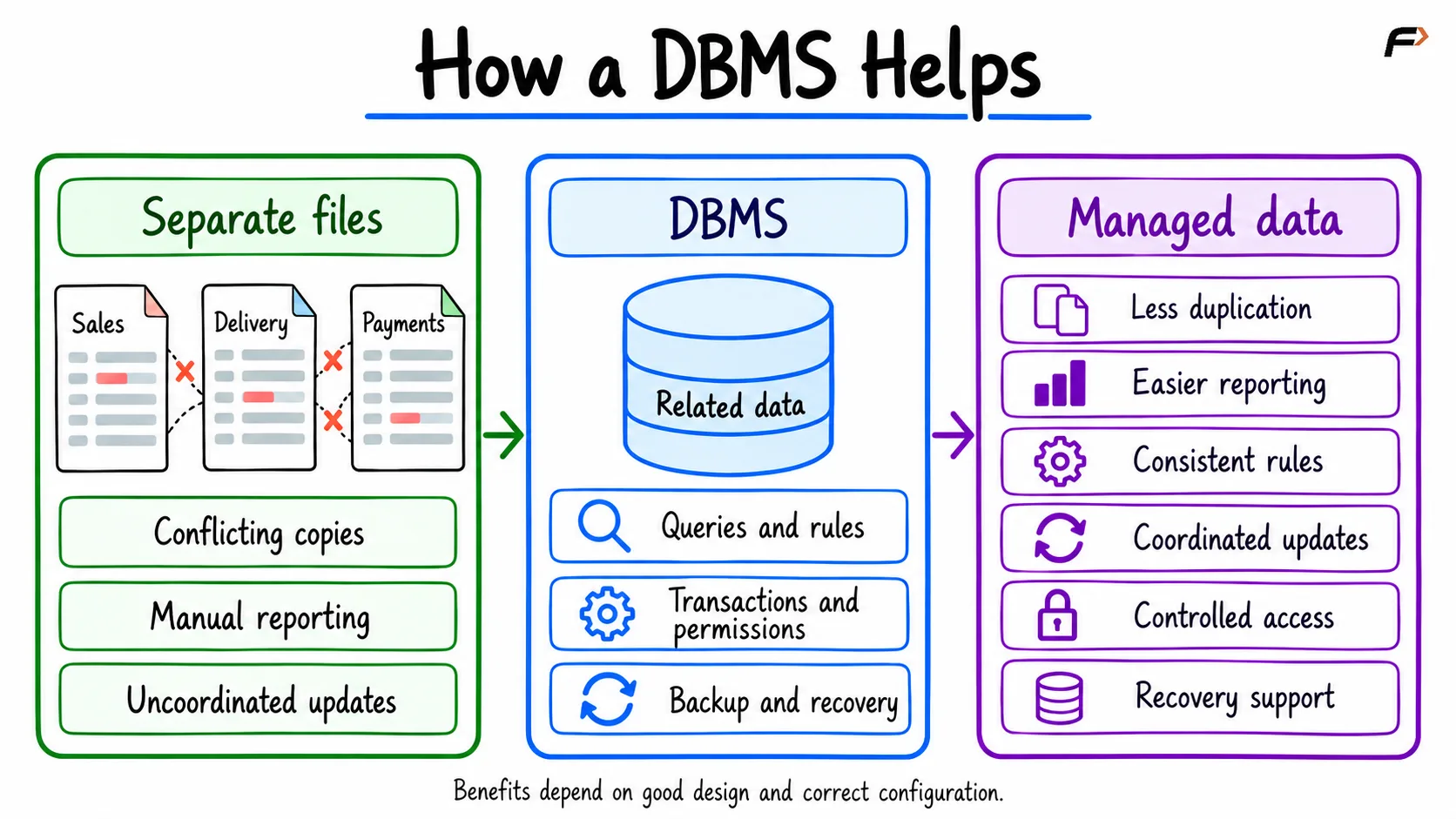
Repeated data and conflicting copies: Customer details may appear in the sales file, delivery file, and payment file. Updating one copy without updating the others leaves different answers to the same question.
Difficult reporting: A simple request, such as identifying unpaid orders, may require matching separate sales and payment records manually. Different identifiers or formats make that work harder.
Rules enforced inconsistently: One application may reject negative quantities while another accepts them. When validation is scattered across programs, a changed rule must be implemented consistently in every relevant place.
Conflicting updates: Two staff members may read the same stock balance and independently change it. Without appropriate coordination, one update can overwrite another or produce an incorrect result.
Unclear access boundaries: Sharing an entire file may expose more information than a person needs. Sales staff might need order details without needing access to every customer’s sensitive information.
Fragile recovery: If current records exist only in one working copy, accidental deletion or corruption can interrupt operations. Recovering dependable data requires a planned and tested recovery process.
A Small Example of Growing Pain
Suppose the shop has one pen remaining. Two sales assistants each see a stock balance of one and promise it to different customers.
The problem is not the size of the number. It is the need to coordinate decisions against shared data. Even a small dataset can require strong controls when multiple operations depend on the same facts.
The consequences extend beyond extra clerical work. Conflicting records can produce incorrect deliveries, misleading reports, and lost confidence in the system.
Why Databases and DBMSs Matter
A database is an organized collection of related data. A database management system, or DBMS, is the software used to define, retrieve, update, and administer that data.
The database contains the records; the DBMS manages how applications and users interact with them. Database software also provides capabilities for access control, administration, backup, and recovery.
How a DBMS Helps
A DBMS helps address these challenges by organizing related data, reducing unnecessary duplication, and making reports easier to generate. It also provides tools to enforce rules, coordinate simultaneous updates, control access, and recover data after failures. These benefits depend on a well-designed database and correctly configured controls.
How a DBMS Helps
Choosing an Appropriate Approach
A spreadsheet or simple file remains useful for a small, independent task. A DBMS becomes particularly valuable when records are shared, relationships matter, rules must be enforced consistently, or updates must be coordinated.
Introducing a DBMS also brings responsibilities. Someone must design the data model, define permissions, maintain the system, and verify recovery procedures. Storing incorrect or poorly defined records in a database does not make them trustworthy.
The benefit comes from combining database capabilities with clear requirements, accurate inputs, and disciplined operation.
Summary
Raw data contains recorded facts that can become useful information through context and processing. Poorly managed records create conflicting copies, difficult reporting, inconsistent rules, and unsafe updates. Databases and DBMSs provide structures and controls for managing these problems, but reliable results still depend on appropriate design, data quality, and operational practices.
Be the first to add a comment.