Introduction
An online store operating in several regions may struggle to serve every request from one database server. Customers far from that server experience network delays, while growing order traffic puts more pressure on the same machine.
Distributing the database can spread this work across connected servers. The difficulty is keeping those servers working together when requests overlap, messages arrive late, or part of the system becomes unreachable.
What Is a Distributed Database?
A distributed database stores logically related data across multiple connected computers, called nodes. Those nodes may run in one data center or in different geographic regions.
A distributed database management system, or DDBMS, coordinates access to the data. Depending on its design, it handles request routing, remote queries, replicated copies, and transactions involving multiple nodes.
Several applications connecting to one database server do not make the database distributed. The distribution concerns where database data is stored and how those locations cooperate.
How Data Is Distributed
Consider a store serving customers in India and Europe. It could place orders near the customers who create them, while keeping product information available in both regions.
Two decisions shape this arrangement:
Technique | What it does | Store example |
|---|---|---|
Partitioning | Divides a dataset into smaller parts | Indian orders and European orders belong to different partitions |
Replication | Maintains copies of the same data | Both regions hold a copy of the product catalog |
These techniques can be used together. Each order partition might also have replicas so that its data is not held on only one node.
Horizontal partitioning divides rows, such as orders grouped by region. Vertical partitioning separates columns, such as customer contact details and customer preferences, while retaining a key that connects the pieces. When partitions are placed across separate servers, the arrangement is commonly called sharding.
Data placement matters as much as data division. Keeping related records together can reduce network communication; separating records that are frequently joined can make those queries more expensive.
Following a Request Across Nodes
Suppose a customer requests order 501, which belongs to the India partition. The application sends the request to a database endpoint, and the system uses its partition information to locate the responsible node.
The work depends on the request:
One order: Route the lookup to the partition containing that order.
Orders from every region: Ask multiple partitions for results and combine their responses.
A product update: Apply the change and propagate it according to the replication rules.
An operation touching multiple partitions: Coordinate the changes so they meet the required transaction guarantees.
A query returning one number can still involve several nodes. For example, a global order count may require each partition to calculate a local count before the system adds those counts together.
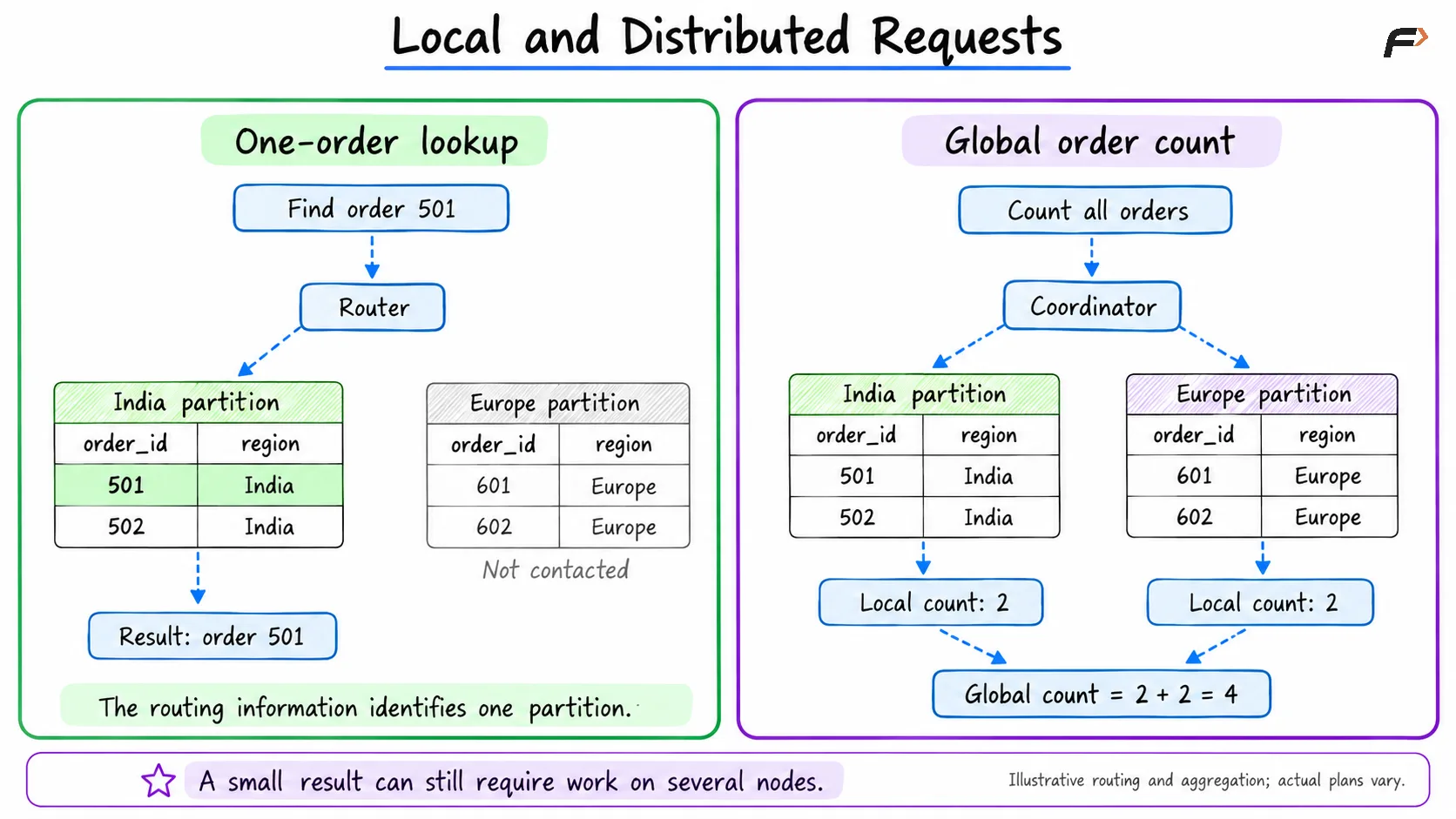
Local and Distributed Requests
What Distribution Should Hide
Applications should not need to track every movement of data between machines. Distribution transparency describes how much of that complexity the database hides.
Three useful forms are:
Location transparency: Applications can access data without naming its physical server.
Fragmentation transparency: Applications can work with a logical table even when its data is divided into fragments.
Replication transparency: Applications can use data without manually selecting and maintaining its copies.
The amount of transparency varies. Some systems present a unified database interface, while others require applications to supply a partition key or explicitly access remote data.
Distributed environments can also be homogeneous, using the same database technology across sites, or heterogeneous, combining different database systems. Heterogeneous environments need additional handling for differences in data types, query capabilities, and transaction behavior.
Why Network Failures Change the Problem
On one server, a failed process is usually easier to distinguish from a running one. Across a network, a missing response leaves uncertainty: the remote node may have failed, the connection may be broken, or the operation may have completed before its reply was lost.
Suppose the store sends a payment request and receives no response. Retrying immediately could charge the customer twice if the first request succeeded. A unique request identifier can help the system recognize a retry and avoid applying the same operation again.
Replication introduces another question. If a product price changes on one node, another copy may not have received that update when a customer reads it. The system’s consistency guarantees determine what that read is allowed to return. Waiting for coordination can provide stronger guarantees, but it adds communication and may delay requests when nodes cannot communicate.
Distribution therefore does not automatically guarantee availability or faster queries. Its benefits depend on replica placement, routing, workload, and the coordination required by each operation.
When Distribution Is Useful
A distributed database becomes useful when there is a concrete requirement that one server cannot comfortably meet:
Capacity: Data or traffic must be spread across machines.
Regional access: Frequently used data should be closer to users.
Resilience: Replicas can help the system tolerate particular node or location failures.
Organizational needs: Separate sites need local data access while participating in shared operations.
These benefits come with operational costs. Backups, schema changes, monitoring, and recovery must account for several nodes. Uneven traffic can also overload one partition while others remain lightly used.
For a modest workload in one region, a well-designed single-server database may remain easier to operate. Distribution should solve an observed requirement rather than serve as a default design choice.
Summary
A distributed database places related data across connected nodes. Partitioning decides how data is divided, replication decides where copies exist, and query processing coordinates access across those locations.
The main challenge is managing communication and partial failure. A sound design keeps common operations local where possible and chooses consistency, replication, and transaction guarantees around the application’s actual requirements.
Be the first to add a comment.