Introduction
Every action in a Wi-Fi network happens through 802.11 frames. When a phone finds a Wi-Fi network, joins an access point, confirms delivery, or sends actual internet traffic, it is exchanging frames over the wireless medium.
A frame is the basic communication unit in IEEE 802.11 Wi-Fi networks. It carries either network management information, control information, or actual user data.
IEEE 802.11 frames are divided into three main categories:
Management frames: Help devices discover, join, maintain, and leave Wi-Fi networks.
Control frames: Coordinate access to the wireless medium and confirm delivery.
Data frames: Carry actual user and application traffic.
Why Wi-Fi Needs Different Frame Types
Wi-Fi is not only about sending user data. Before a device can send a website request or stream a video, it must first discover nearby access points, join the correct network, complete authentication and association, coordinate channel access, and receive delivery confirmations.
Different frame types exist because each part of Wi-Fi communication has a different job.
Frame Type | Main Purpose | Simple Meaning |
|---|---|---|
Management Frames | Build and maintain Wi-Fi connections | Find and join the network |
Control Frames | Coordinate medium access and reliability | Decide who can transmit and confirm delivery |
Data Frames | Carry actual user traffic | Send real network data |
Together, these frame types make wireless communication organized and reliable.
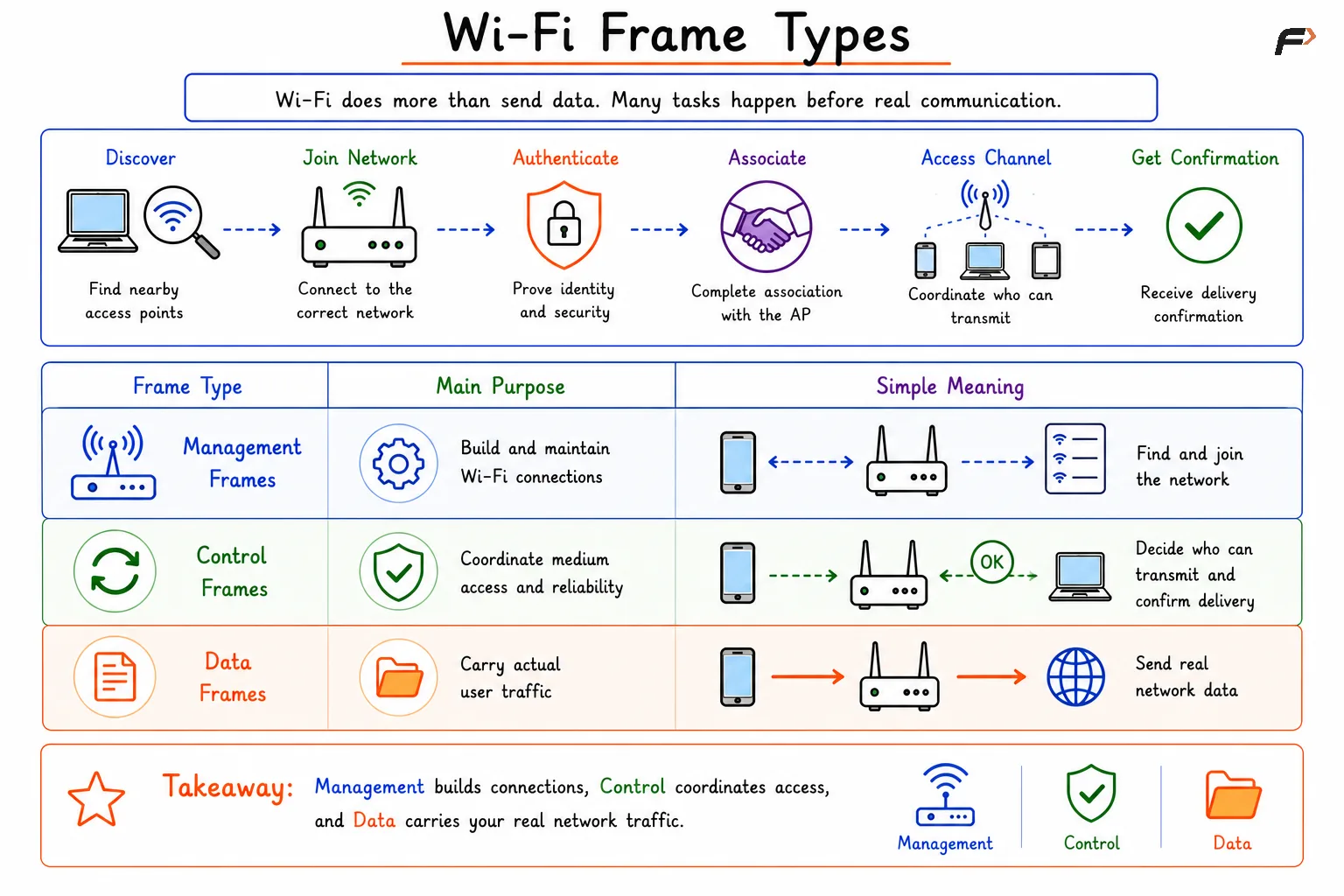
Wi-Fi Frame Types
Management Frames
Management frames are used to manage Wi-Fi connectivity. They help clients find wireless networks, authenticate with access points, associate with the network, roam between access points, and disconnect when required.
Without management frames, a device would not know which Wi-Fi networks are nearby or how to join them.
Common management frames include:
Beacon frame: Sent by an access point to announce that a Wi-Fi network is available.
Probe request: Sent by a client to actively search for a network.
Probe response: Sent by an access point in response to a probe request.
Authentication frame: Used during the initial Wi-Fi authentication process.
Association request: Sent by a client to join an access point.
Association response: Sent by an access point to accept or reject the association.
Disassociation frame: Used when a client or access point ends an association.
Deauthentication frame: Used to terminate authentication with the network.
Management frames mainly support the “find and join the network” part of Wi-Fi operation.
Control Frames
Control frames help Wi-Fi devices share the wireless medium. Since Wi-Fi uses radio waves, many devices may compete for the same channel. Control frames reduce confusion, support reliability, and help avoid unnecessary collisions.
Control frames are usually short, but they are very important for stable wireless communication.
Common control frames include:
ACK: Confirms that a frame was received successfully.
RTS: Request To Send, used by a device to request permission before transmitting.
CTS: Clear To Send, used to grant permission and reserve the medium.
Block ACK: Acknowledges multiple frames together instead of one at a time.
PS-Poll: Used by power-saving clients to request buffered data from the access point.
ACK, RTS, and CTS are especially important because they directly support reliable delivery and collision avoidance.
For example, after a device sends a data frame, the receiver sends an ACK if the frame was received correctly. If the sender does not receive an ACK, it assumes failure and tries again later.
Data Frames
Data frames carry the actual user traffic. Once a device has joined the Wi-Fi network and medium access has been coordinated, data frames transport the real information users care about.
Data frames may carry:
IP packets: Network-layer packets moving between devices.
DNS traffic: Queries and responses for domain name resolution.
TCP segments: Reliable transport-layer communication.
UDP datagrams: Lightweight transport traffic.
HTTP and HTTPS traffic: Web browsing and API communication.
Voice and video traffic: Calls, meetings, streaming, and media.
Application data: Cloud apps, messaging, file transfers, and online services.
When a user opens a website, the browser creates an HTTP or HTTPS request. That request is carried through TCP or UDP, placed inside an IP packet, and then transmitted over Wi-Fi inside a data frame.
Summary
Wi-Fi communication is built around three major IEEE 802.11 frame types: management frames, control frames, and data frames.
Management frames help devices discover, join, maintain, roam, and leave Wi-Fi networks. Control frames coordinate access to the shared wireless medium and support reliable delivery using frames such as ACK, RTS, and CTS. Data frames carry the actual user traffic, including IP packets, DNS, TCP, HTTP, HTTPS, voice, video, and application data.
Be the first to add a comment.