Introduction
Modern networks carry traffic for billions of devices at the same time. People stream videos, open websites, send messages, call APIs, attend meetings, play games, and download files, all on the same global infrastructure.
A communication model built on dedicated paths for every user would not scale well in that environment. Packet switching won because it matched the real nature of computer traffic: shared, bursty, unpredictable, and constantly changing.
What Packet Switching Changed
Packet switching introduced a simple but powerful idea. Instead of reserving a dedicated communication path for a full session, the network divides data into packets and sends those packets over shared links as needed.
This means the network does not have to keep bandwidth locked for one user all the time. Capacity is used only when data is actually being transmitted.
That one idea made modern Internet-scale communication practical.
Why Dedicated Circuits Could Not Scale
If the Internet had relied on dedicated circuits for every communication session, it would have faced a huge scalability problem. Every active user would need reserved resources, even during moments of silence or inactivity.
At small scale this may seem manageable, but at global scale it becomes inefficient.
Some major problems with dedicated circuits are:
Too many users: Billions of devices cannot each rely on permanently reserved paths
Idle resource wastage: Reserved bandwidth remains unused during inactive periods
Low flexibility: The network becomes harder to adapt when traffic changes
Difficult growth: Expanding such a system becomes expensive and complex
That model may work for traditional voice systems, but it does not fit the Internet well.
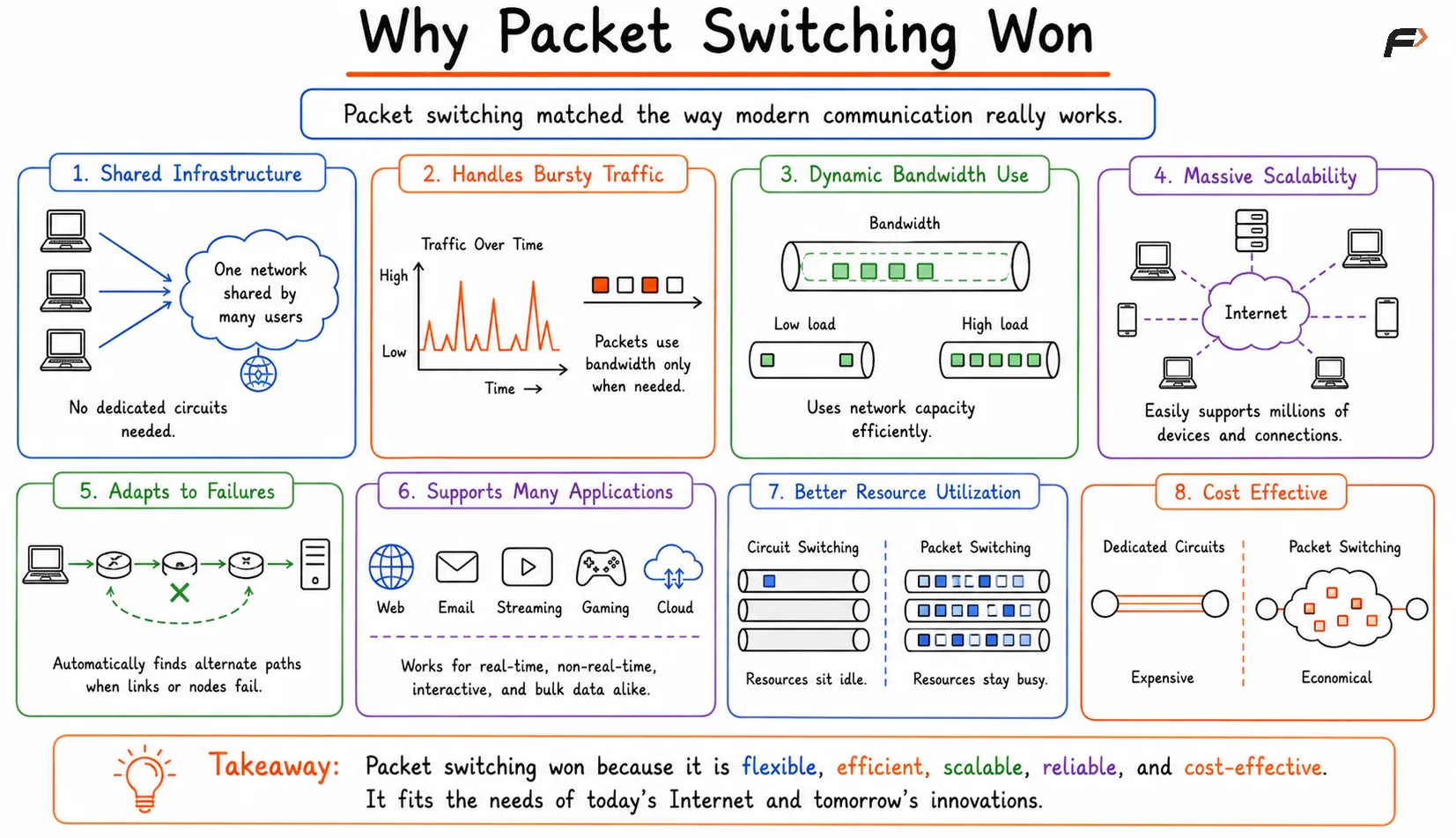
Why Packet Switching Won
The Internet Runs on Bursty Traffic
One of the biggest reasons packet switching won is that computer traffic is usually bursty, not continuous.
A user may:
Open a webpage
Read for a while
Click again
Pause a video
Send one message
Stay idle for several minutes
This means users do not continuously consume bandwidth. If the network reserved a full path for every such session, much of that capacity would sit unused most of the time.
Packet switching avoids that waste.
Shared Infrastructure Made the Difference
Packet-switched networks allow all users to share the same infrastructure. When a device has data to send, packets use the available links. When the device becomes idle, no unnecessary bandwidth remains reserved.
This is one of the most important reasons packet switching became the foundation of the Internet.
It allows:
Efficient sharing of links
Support for many users at once
Better use of network capacity
More practical large-scale network design
Instead of separate resources for each user, the network behaves like a common platform shared dynamically.
Packet Interleaving Improved Efficiency
Packets from different users can travel across the same link one after another. This is often called packet interleaving.
For example, the same shared link may carry:
A packet from a video stream
A packet from a web request
A packet from a chat message
A packet from a cloud application
The link is not reserved for only one user. It keeps serving many users in small units of transmission, which greatly improves efficiency and scalability.
Adaptation to Network Changes
The Internet is not static. Links fail, routers go down, congestion appears, and traffic patterns change all the time. A global network needs to survive those changes without collapsing.
Packet switching handles this better because packets can be routed through alternative paths when conditions change. If one route is unavailable, routing protocols can help shift traffic toward another usable path.
This flexibility is essential for a worldwide network.
Why Packet Switching Became the Backbone
Packet switching became the backbone of the Internet because it solved the exact problems that large-scale digital communication creates.
It supports:
Shared infrastructure
Bursty traffic
Dynamic bandwidth usage
Massive scalability
Failure adaptation
Support for many application types
Better resource utilization than dedicated circuits
In short, packet switching won because it matched how modern computer communication actually behaves.
Summary
Packet switching became the backbone of the Internet because dedicated communication paths do not scale well for billions of devices and bursty traffic patterns. By dividing data into packets and allowing many users to share the same links, packet switching made network communication efficient, flexible, and globally scalable.
Its ability to support shared bandwidth, interleave packets from many users, adapt to failures, and carry many applications on the same infrastructure is the main reason the modern Internet is built on packet-switched communication.
Be the first to add a comment.