Introduction
A computer network is a system that enables multiple computing devices to communicate and share information with each other. A powerful computer without a network is like a smart person locked in a room. Networking exists because computing becomes truly powerful only when machines talk to each other.
Limitations of a Standalone Computer
A single computer is useful, but is isolated. It can compute locally but has several limitations as it operates independently without any form of interconnection. Some of the Limitations are as follows:
No Communication: Technologies like email, messaging, and video conferencing would not exist, making long-distance collaboration extremely difficult.
No Internet Access: Websites, search engines, cloud services, and most online applications would be unavailable.
No Resource Sharing: Every user would require dedicated hardware and software, increasing costs and reducing efficiency.
Limited Scalability: Applications would be restricted to a single machine, preventing large-scale services such as social media and e-commerce platforms.
No Distributed Systems: Technologies such as cloud computing, microservices, and big data processing would not be possible.
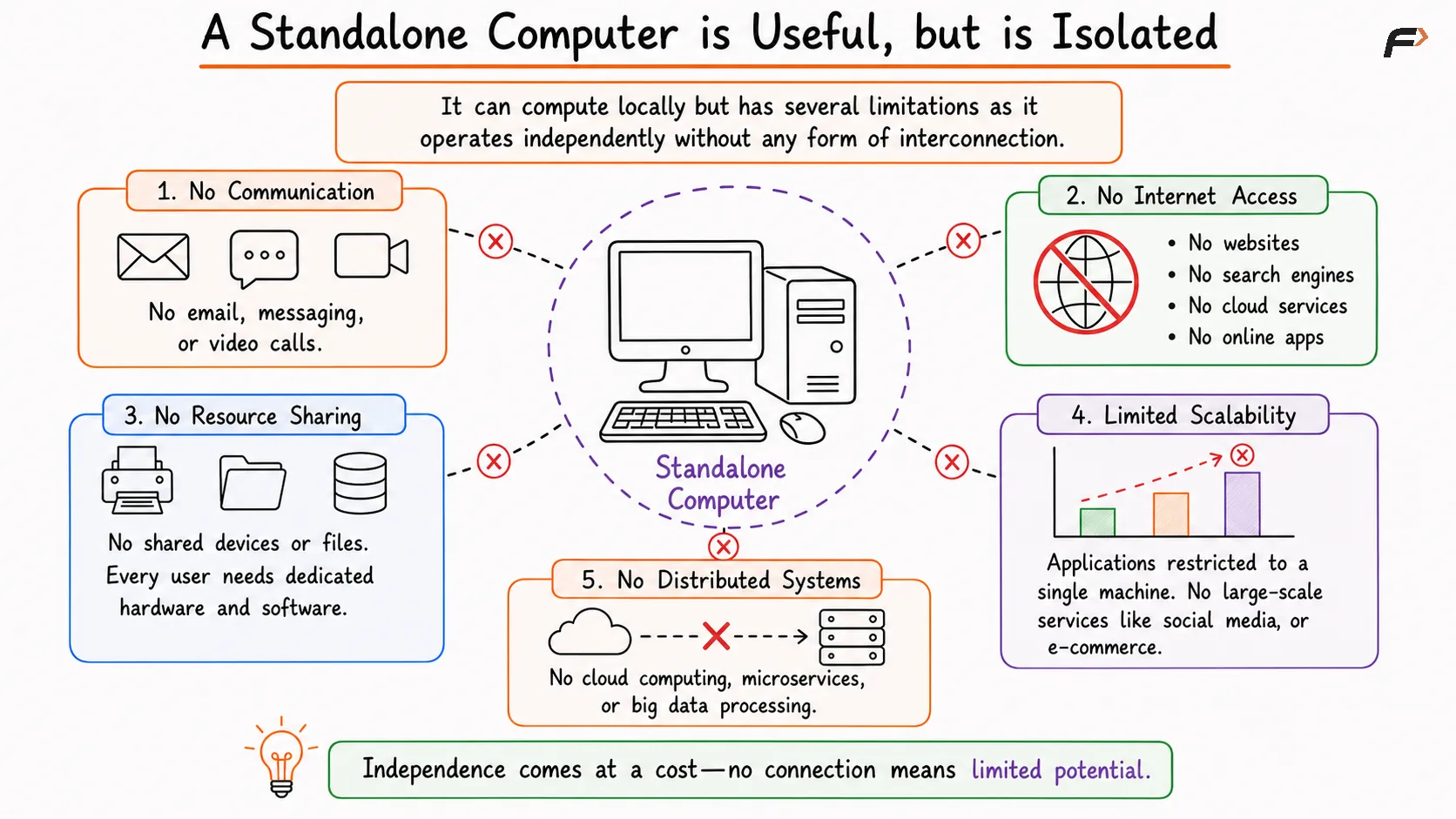
Illustration showing the limitations of a standalone computer. A single computer is isolated without any network connection, highlighting problems such as inability to share files, no internet access, limited communication, no resource sharing (like printers), and restricted collaboration with other devices.
A frequent misconception is the belief that the term “network” is synonymous with the Internet. In reality, a computer network is a broader concept that refers to any collection of interconnected devices capable of communicating with each other using standardized protocols. This can include small, private setups such as a home Wi-Fi network, an office Local Area Network (LAN), or a campus network, none of which necessarily require Internet connectivity.
The Internet, on the other hand, is a global system of interconnected networks, essentially a “network of networks”, that uses the TCP/IP protocol suite to enable worldwide communication. All devices connected to the Internet are part of a network, but many networks operate independently without being connected to the Internet.
Networking Is Broader Than Internet
A network and the Internet are not the same thing. A network is any group of devices that can communicate with each other, whether or not they are connected to the public Internet.
The Internet is the largest example of a network, but smaller networks can exist inside a room, home, office, building, or organization.
The relationship is simple:
Every Internet connection uses networking: Devices must communicate through networks to access the Internet.
Not every network uses the Internet: Devices can communicate locally without public Internet access.
A local network can work independently: Devices in the same LAN, Wi-Fi, or Bluetooth connection can exchange data.
The Internet is a network of networks: It connects many smaller networks across the world.
For example, AirPods connected to a smartphone form a small network because the phone sends audio data and the AirPods send back connection or battery information. This communication happens over Bluetooth and does not require Internet access.
Challenges of Computer Networking
While computer networks provide numerous benefits, they also introduce several challenges that must be carefully managed. As networks grow in size and complexity, ensuring performance, security, and reliability becomes increasingly difficult. Understanding these challenges is essential for designing robust and efficient network systems.
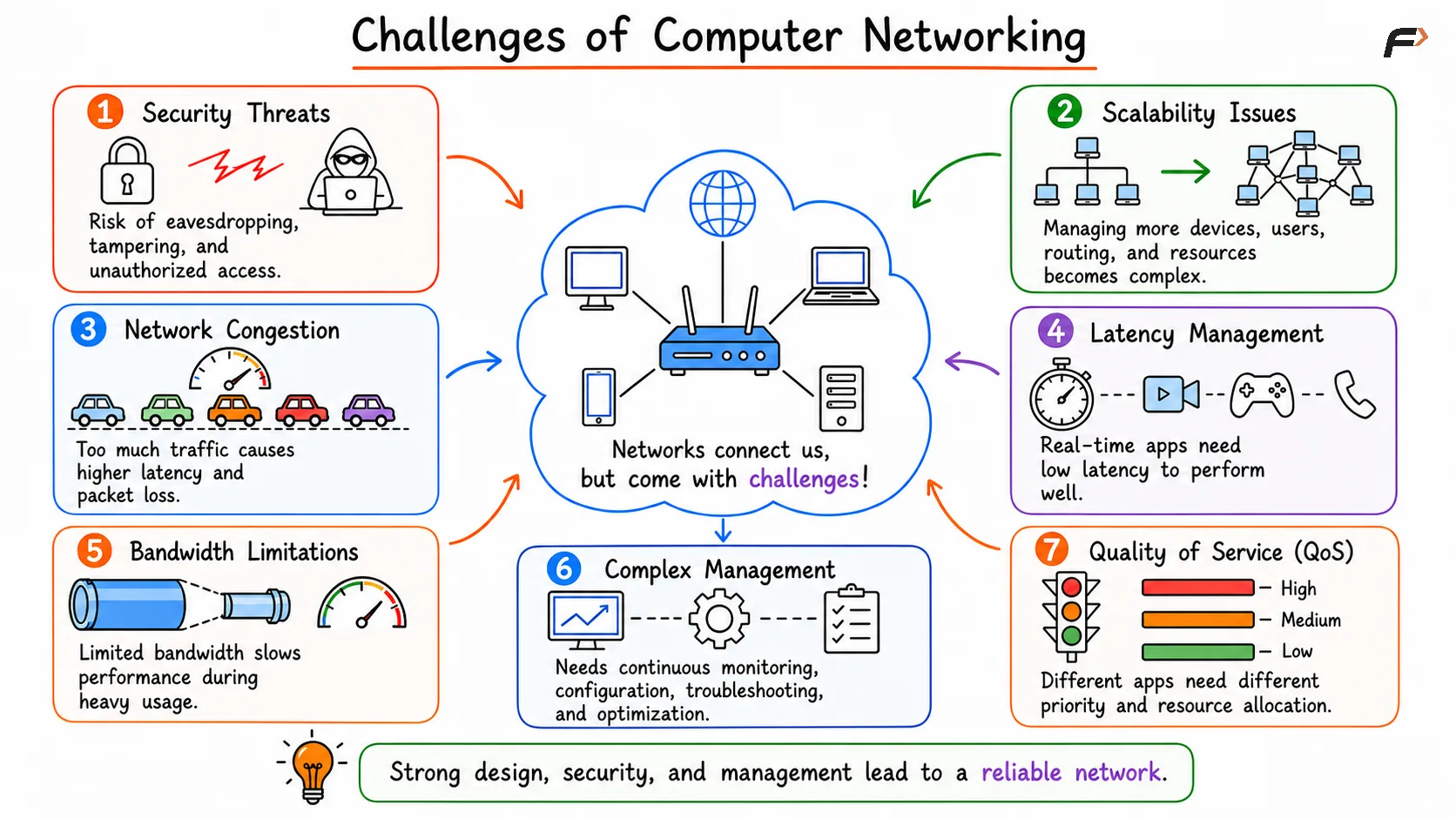
Diagram highlighting the major challenges of computer networking. Connected devices are accompanied by icons representing security threats, network congestion, hardware failures, latency, configuration complexity, maintenance, and reliability issues, emphasizing common obstacles in modern computer networks.
Network Security Threats: Data traveling across networks is vulnerable to eavesdropping, tampering, and unauthorized access, making security a major challenge.
Scalability Issues: As networks grow, managing devices, users, routing, and resources becomes increasingly complex.
Network Congestion: Excess traffic can exceed available capacity, causing higher latency, packet loss, and lower throughput.
Latency Management: Real-time applications such as video calls, gaming, and VoIP require low latency to function effectively.
Bandwidth Limitations: Bandwidth is a finite resource, and shared networks can experience reduced performance during heavy usage.
Complex Network Management: Large networks require continuous monitoring, configuration, troubleshooting, and optimization.
Quality of Service (QoS): Different applications have different performance requirements, making traffic prioritization and resource allocation challenging.
Addressing these challenges is crucial for building efficient, secure, and scalable networks that can meet the demands of modern applications and users.
Summary
Computer networks enable devices to communicate, exchange information, and share resources. From a Bluetooth connection between a phone and AirPods to office networks, data centers, and the Internet, all networks serve the same fundamental purpose i.e. connecting devices to facilitate communication.
Be the first to add a comment.