Introduction
Network security exists for one main reason: data is always moving. Every time someone opens a website, sends a message, makes a payment, logs into an app, or connects to a backend service, information travels through a network.
That information is valuable. It may include passwords, personal details, business records, payment data, or internal service communication. Once data starts moving across a shared and exposed network, it becomes a target. That is exactly why network security is needed.
What Is Network Security?
Network security is the set of practices, technologies, and controls used to protect data, devices, services, and communication paths inside a network.
Its purpose is not only to block attackers. It also helps ensure that communication remains:
Confidential: Data is not read by unauthorized people
Accurate: Data is not changed without permission
Available: Services remain usable when needed
These three ideas are often summarized as confidentiality, integrity, and availability.
Data Is Everywhere in a Network
A network carries many different kinds of communication at the same time. For example:
A browser sends requests to a web server
A phone sends messages to a messaging platform
A payment app sends transaction data to an API
A backend service communicates with a database
Employees connect through office Wi-Fi or VPN access
All of these activities involve data moving across infrastructure. That data may be personal, confidential, financial, operational, or security-sensitive.
The more valuable the data is, the more important network security becomes.
What Can Go Wrong Without Network Security
If communication is not protected properly, many kinds of problems can happen.
Data theft: Login credentials, payment details, or private records may be stolen
Data tampering: A request may be changed before it reaches the server
Spoofing and redirection: Users may be sent to fake systems
Service disruption: Websites or applications may become unavailable
Unauthorized access: Attackers may enter internal systems
Malicious requests: Harmful traffic may reach backend services
This is why a network cannot be treated as automatically safe just because it appears to work normally.
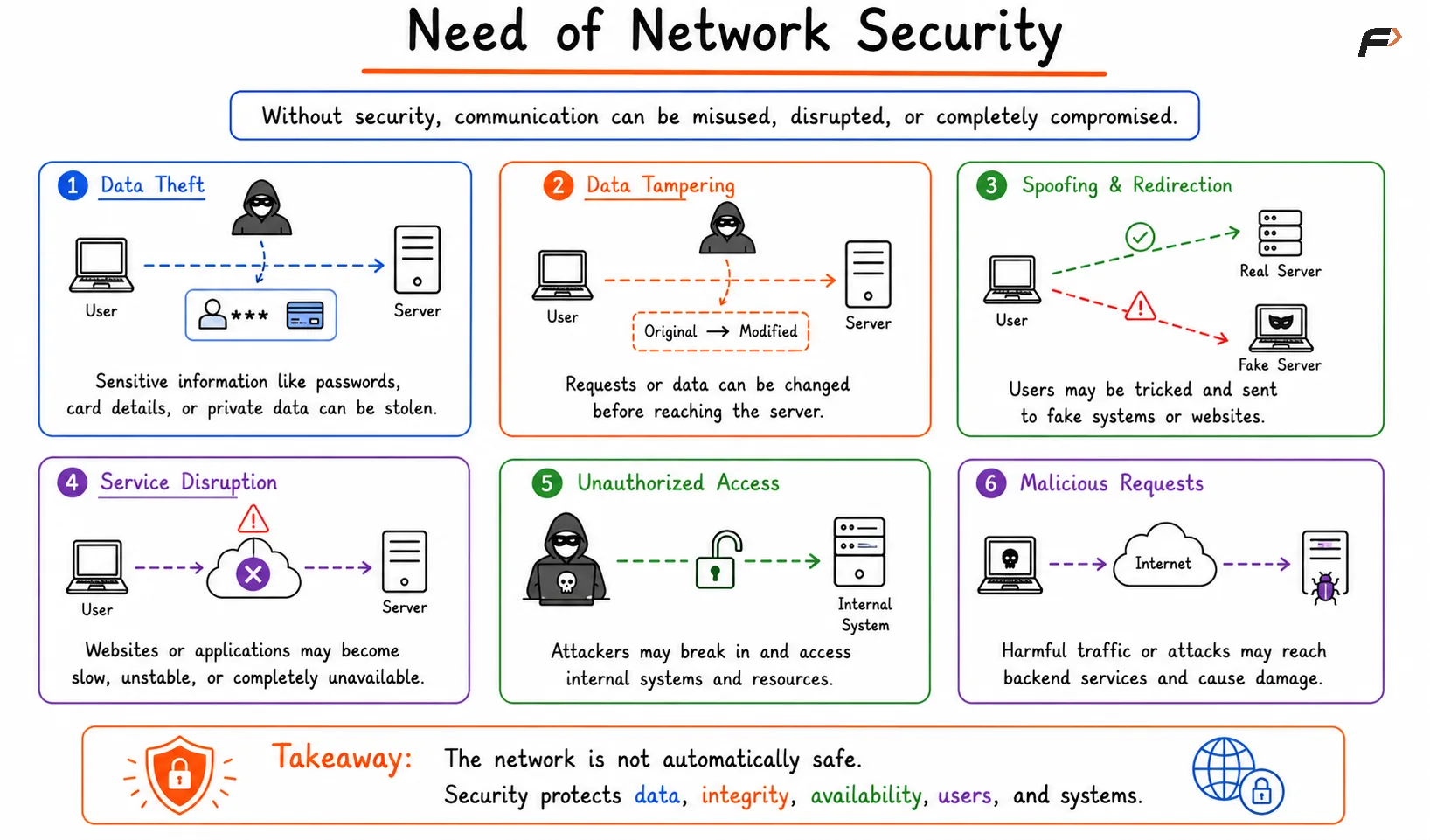
Need of Network Security
Every Point Can Be a Target
Data does not simply move from source to destination without touching anything else. It often crosses multiple components, and each one can become a target.
Common target points include:
Laptop or phone: A compromised endpoint may expose user data
Wi-Fi router: Weak wireless security may allow unauthorized access
DNS resolver: Spoofing or poisoning can redirect traffic
Router or gateway: Traffic can be observed or disrupted
Firewall or proxy: Misconfiguration can expose services
Application server: Malicious requests may target backend logic
Database server: Sensitive stored information may be stolen
This is why network security must be layered rather than relying on only one protective control.
Why It Matters More Today
Network security has become more important because modern infrastructure is larger and more connected than ever before. Organizations now depend on cloud systems, APIs, remote work, mobile devices, third-party platforms, and internet-facing applications.
As connectivity increases, the attack surface also increases. That means weak network security can lead to:
Data breaches
Downtime
Financial loss
Reputation damage
Regulatory problems
Loss of customer trust
So network security is no longer optional support work. It is a basic requirement for safe digital operation.
Summary
Network security is needed because data constantly moves across shared and exposed networks, and that data can be read, changed, blocked, or misused if communication is not protected. Modern networks connect users, devices, applications, APIs, servers, and databases, which creates many points of risk.
At its core, network security protects confidentiality, integrity, and availability. It helps prevent unauthorized access, tampering, malicious requests, and service disruption. In simple terms, the moment data starts traveling through a network, security becomes necessary.
Be the first to add a comment.