Introduction
IPv6 was introduced because IPv4 could not keep supporting internet growth forever. IPv4 worked well for many years, but its 32-bit address space was limited, and the modern internet expanded far beyond what early designers expected.
Today, networks include smartphones, cloud servers, home broadband users, enterprise systems, IoT devices, streaming platforms, and always-connected applications. That scale made it necessary to move toward a protocol that could offer more addresses, better scalability, and a cleaner design. That protocol is IPv6.
Why IPv4 Became a Limitation
The biggest problem with IPv4 is address exhaustion. IPv4 uses 32-bit addresses, which means the number of possible public addresses is limited. As the internet kept growing, that pool became too small for long-term global expansion.
IPv4 survived much longer because of NAT, which allowed many devices to share a smaller number of public IP addresses. NAT was useful, but it was still a workaround. It helped delay the problem, not solve it at the protocol level.
This is why IPv6 became necessary:
More connected devices: Phones, laptops, servers, sensors, and cloud instances all need connectivity.
Public IPv4 scarcity: The available global address space is limited.
NAT dependence: IPv4 often relies on address translation to stay practical.
Internet growth: Large-scale expansion needs a more future-proof design.
How IPv6 Improves on IPv4
IPv6 is not just IPv4 with a bigger address size. It is a redesigned protocol with several important improvements.
The most obvious improvement is its 128-bit address space, which is vastly larger than IPv4. But beyond that, IPv6 also improves protocol efficiency, reduces dependence on NAT, simplifies routing behavior, and supports cleaner end-to-end communication.
Some of the main reasons IPv6 is preferred over IPv4 are:
Massive address space: Greatly reduces address scarcity concerns.
Better scalability: Supports long-term internet expansion.
Reduced NAT dependence: Makes direct end-to-end communication more practical.
Cleaner packet design: Simplifies forwarding and processing.
More efficient traffic handling: Removes some older IPv4 overhead.
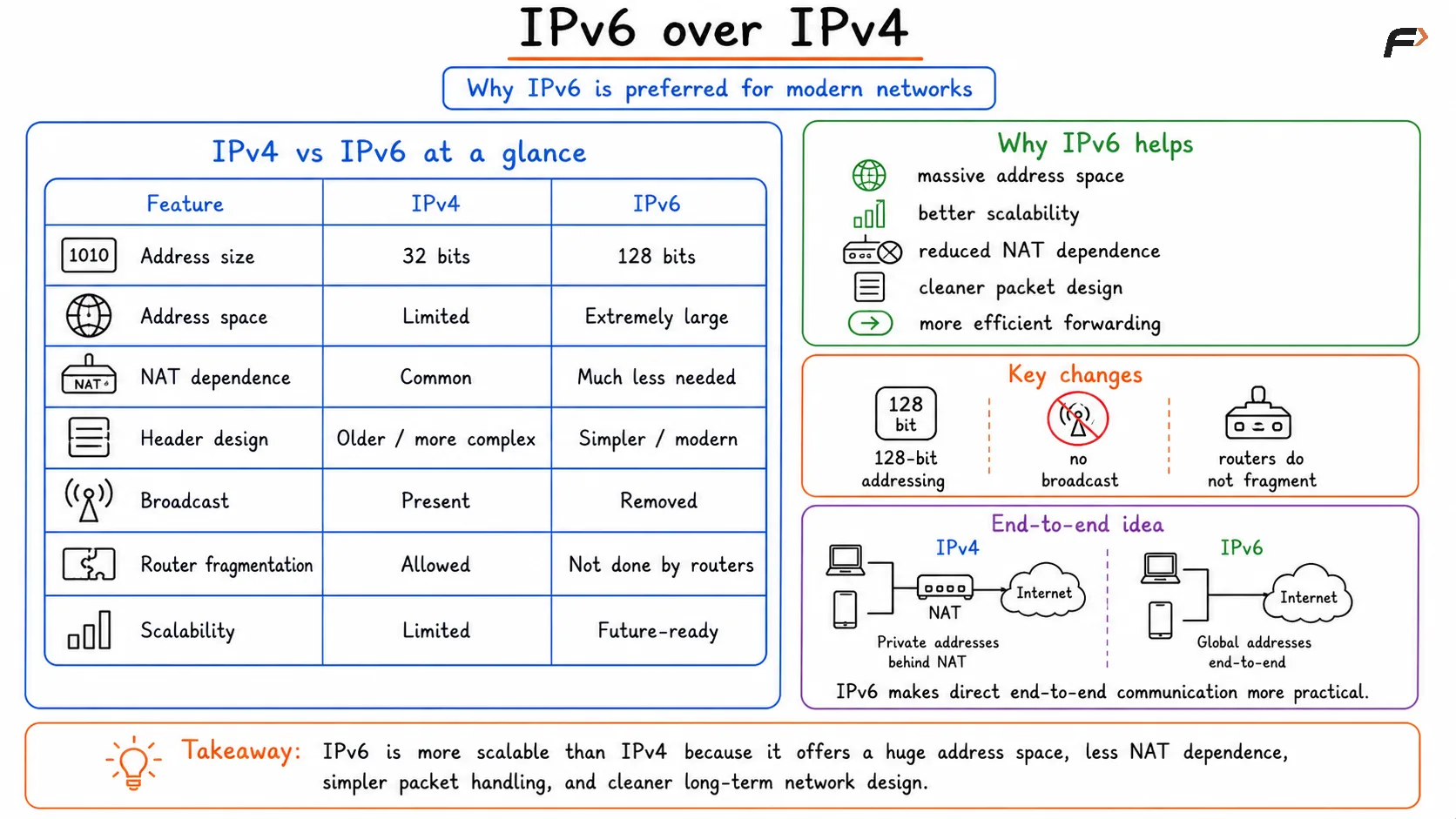
IPv6 over IPv4
IPv4 vs IPv6 at a Glance
Feature | IPv4 | IPv6 |
|---|---|---|
Address size | 32 bits | 128 bits |
Address scarcity | Limited and exhausted in many contexts | Extremely large address space |
NAT dependence | Common and often necessary | Usually much less necessary |
Header design | Older and more complex | Simpler and more modern |
Broadcast support | Present | Removed |
Router-side fragmentation | Allowed | Not done by routers |
Long-term scalability | Limited | Designed for future growth |
Why the IPv6 Header Is Simpler
One of the biggest architectural improvements in IPv6 is the base header design. IPv6 was created at a time when engineers already understood the weaknesses of the IPv4 header, so they removed several things that created unnecessary processing overhead.
The IPv6 base header is simpler because it avoids several older design burdens:
No header checksum: Routers do not have to recalculate a checksum at every hop.
No IHL field: The IPv6 base header has a fixed size of 40 bytes, so routers do not need to calculate where the header ends.
No fragmentation fields in the base header: Fragmentation information is moved out of the main header and used only when required.
No broadcast: IPv6 uses multicast and anycast instead of sending traffic to every device unnecessarily.
Extension headers for optional features: The base header stays clean, while extra features are added only when needed.
These changes reduce processing complexity and make packet forwarding more efficient.
Why No Header Checksum Matters
In IPv4, every router decreases the TTL value, and because the checksum covers header contents, the checksum has to be recalculated at every hop. That creates repeated work for routers.
IPv6 removes the header checksum completely. Instead, it relies on error detection already available at other layers, such as transport-layer checksums and link-layer error detection.
This means:
Less per-hop processing: Routers do less repeated work.
Cleaner forwarding path: Fewer mandatory header operations.
Better efficiency: Especially important in large-scale routing environments.
How IPv6 Handles Fragmentation
IPv4 allows routers to fragment packets in transit. That adds complexity to forwarding because routers may need to split packets while handling traffic.
IPv6 changes this model. Routers do not perform fragmentation during forwarding. If fragmentation is needed, the source device handles it, and IPv6 uses a separate extension header instead of placing fragmentation fields in every packet.
That improves efficiency because:
Routers stay simpler: They forward instead of fragmenting.
The base header stays smaller: Fragment-related fields are not forced into all packets.
Processing becomes cleaner: Only packets that actually need fragmentation carry that information.
Why IPv6 Removes Broadcast
IPv4 uses broadcast for some local communication tasks, but broadcast has a cost. Every device in the broadcast domain receives the packet, even if most of them do not need it.
IPv6 removes broadcast completely and relies instead on:
Multicast: Delivers traffic only to interested receivers.
Anycast: Delivers traffic to one best or nearest receiver among many equivalent systems.
This is more efficient because traffic is more targeted and less unnecessary work is forced on every device in a local segment.
If IPv6 Is Better, Why Is IPv4 Still Used
Even though IPv6 is technically better for long-term growth, IPv4 is still deeply embedded in global infrastructure. Enterprises, cloud platforms, applications, security systems, network tools, and operational workflows have all been built around IPv4 for many years.
That is why migration is slow. The main reasons IPv4 still remains widespread are:
Legacy infrastructure: Existing systems already run on IPv4.
Operational inertia: Organizations are slow to replace systems that already work.
NAT extended IPv4 life: Address sharing delayed urgent migration.
Compatibility concerns: Applications, tools, and policies must all support IPv6 correctly.
Migration cost: Transitioning large networks takes time and money.
Because of this, many environments run in dual-stack mode, where IPv4 and IPv6 coexist during a long transition period.
Summary
IPv6 is better than IPv4 because it solves address exhaustion at the protocol level and improves overall network design at the same time. It offers a 128-bit address space, reduces dependence on NAT, simplifies packet forwarding, removes broadcast, avoids router-side fragmentation, and uses a cleaner base header.
IPv4 is still widely used because of legacy systems, migration costs, and years of operational dependence, but IPv6 is the stronger long-term protocol for global internet growth. That is why modern networks increasingly support both, while the industry continues moving toward IPv6.
Be the first to add a comment.