What Is STP?
STP stands for Spanning Tree Protocol. It is a Layer 2 network protocol used to prevent loops in Ethernet networks.
STP allows switches to have redundant paths for backup, but it makes sure that only one active path is used at a time. If the active path fails, STP can automatically activate a backup path.
In simple words, STP gives us both:
Loop prevention
Network redundancy
The Problem Without STP
Imagine three switches connected in a triangle. This design gives multiple paths between switches, which is good for backup. However, if STP is not running, frames may keep circulating endlessly between the switches.
Ethernet frames do not have a TTL field like IP packets. So once a frame enters a loop, it can continue moving around the network again and again.
This can cause serious problems.
1. STP Prevents Switching Loops
The main reason we need STP is to prevent Layer 2 loops.
A switching loop happens when there are multiple active paths between switches. Since switches forward frames based on MAC addresses, a loop can confuse the switching process and cause frames to travel endlessly.
STP solves this by logically blocking some redundant paths. The physical link still exists, but STP prevents it from forwarding traffic unless it is needed.
2. STP Prevents Broadcast Storms
Switches forward broadcast frames out of all ports except the one on which the frame was received.
If there is a loop in the network, a broadcast frame can keep circulating continuously. As more broadcasts are created and repeated, the network becomes overloaded.
This situation is called a broadcast storm.
A broadcast storm can consume network bandwidth, increase CPU usage on switches, and make the network extremely slow or completely unusable.
STP prevents this by ensuring that there is only one active path between switches.
3. STP Prevents MAC Address Table Instability
Switches maintain a MAC address table to know which device is connected to which port.
In a looped network, the same frame may arrive at a switch from different ports again and again. As a result, the switch may keep updating its MAC address table incorrectly.
This is called MAC address table instability or MAC flapping.
When this happens, the switch cannot reliably decide where to forward frames. This leads to poor network performance and packet loss.
STP avoids this problem by removing loops from the active topology.
4. STP Prevents Duplicate Frames
Without STP, a device may receive the same frame multiple times because the frame travels through multiple looped paths.
Duplicate frames can confuse applications and protocols running on the network. It also wastes bandwidth and processing power.
By blocking redundant paths, STP ensures that frames follow a single loop-free path.
5. STP Provides Redundancy Without Loops
Redundancy is important in networks. If one cable, switch port, or switch fails, the network should still work.
However, redundancy creates multiple paths, and multiple paths can create loops.
STP solves this conflict. It allows redundant links to exist, but keeps some of them in a blocked state. If the main link fails, STP recalculates the topology and activates a backup link.
So, STP helps networks stay reliable without becoming unstable.
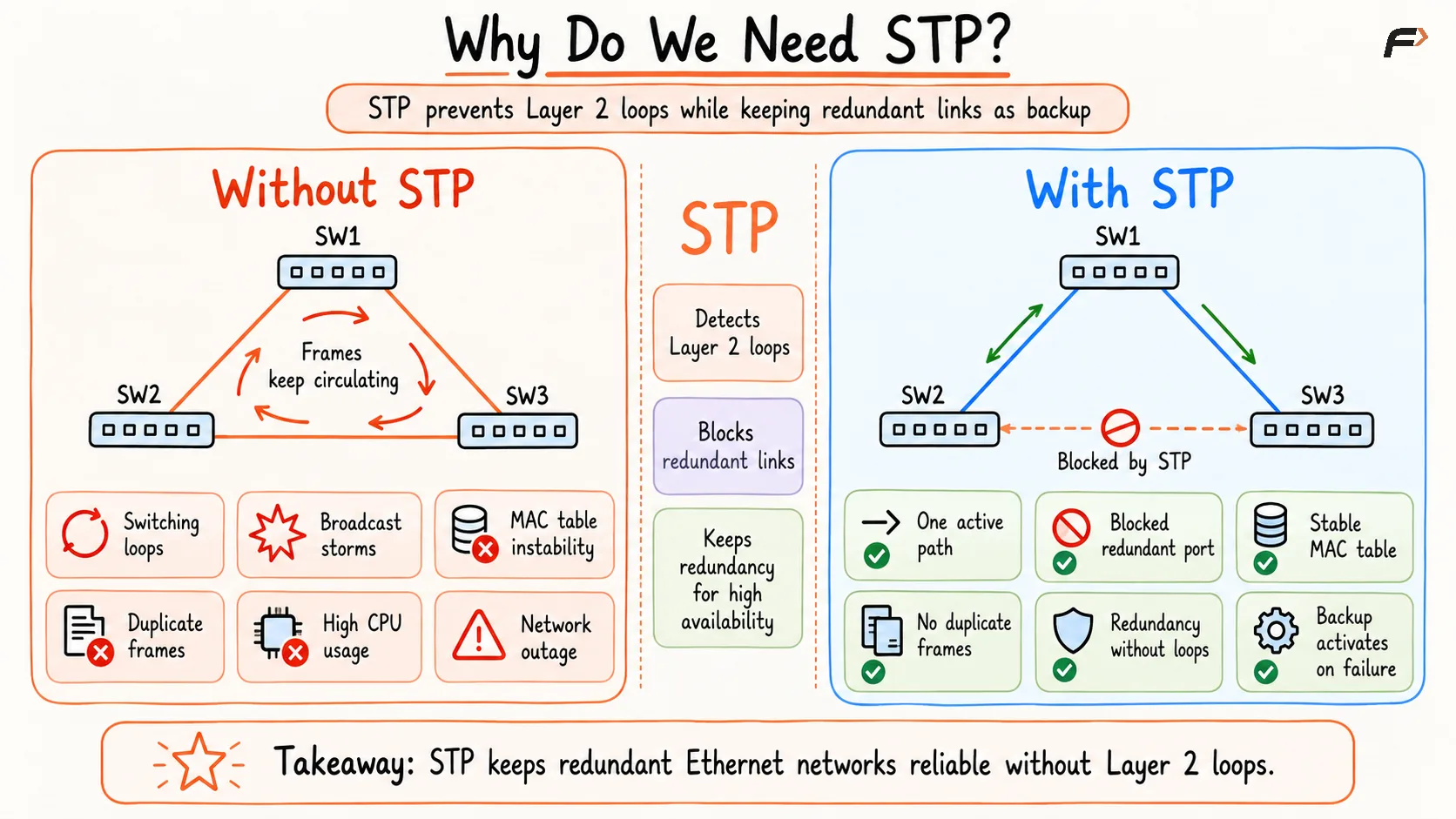
Why we need stp
Be the first to add a comment.