Introduction
Layered architecture is used in computer networking to simplify communication by dividing complex networking functions into smaller, manageable layers. Each layer performs a specific task and interacts with adjacent layers through well-defined interfaces, improving modularity, scalability, interoperability, troubleshooting, and protocol standardization.
Models such as the OSI Model and TCP/IP Model enable different hardware, operating systems, applications, and network technologies to communicate efficiently.
Why Layered Architecture?
Consider a scenario where a laptop communicates with a web server. Although the process appears straightforward from a user's perspective, several distinct networking functions must work together behind the scenes.
Instead of combining everything into one system, the communication process is split into different levels:
Application & Presentation: The application must generate data (such as an HTTP request), and this data may require formatting, compression, or encryption.
Reliability & Transport: Reliability mechanisms must be implemented to ensure correct delivery and error recovery.
Routing & Network: Packets must be efficiently routed across multiple interconnected networks.
Physical Transmission: The underlying hardware must transmit the information using electrical, optical, or wireless signals.
Combining all of these functions into a single protocol would create an extremely complex system that would be difficult to design, maintain, troubleshoot, and standardize. A modification to one function, such as encryption or routing, could potentially affect every other part of the communication process.
What is a Protocol?
A protocol is a set of communication rules between computers. It defines how data is formatted, transmitted, and interpreted.
Examples include:
HTTP: Defines how web pages, images, and APIs are requested and delivered between clients and servers.
TCP: Provides reliable communication through connection management, packet ordering, retransmissions, and flow control.
IP: Handles device addressing and routes packets across networks to their destination.
Need for Layered Architecture
A layered architecture divides networking into separate responsibilities, where each layer focuses on a specific task. This is very similar to software modularity, where complex systems are broken into smaller, manageable components.
Instead of one large system handling everything, each layer solves a specific problem and interacts with the layers above and below it.
How Layers Work
Think of networking as a stack of responsibilities:
The browser cares about HTTP requests and responses.
TCP cares about delivery, ordering, and retransmission.
IP cares about routing packets across networks.
The physical layer cares about transmitting bits over wires or air.
Each layer does not need to know how the other layers are implemented internally. It only needs to follow a defined interface.
Why Layers are Powerful
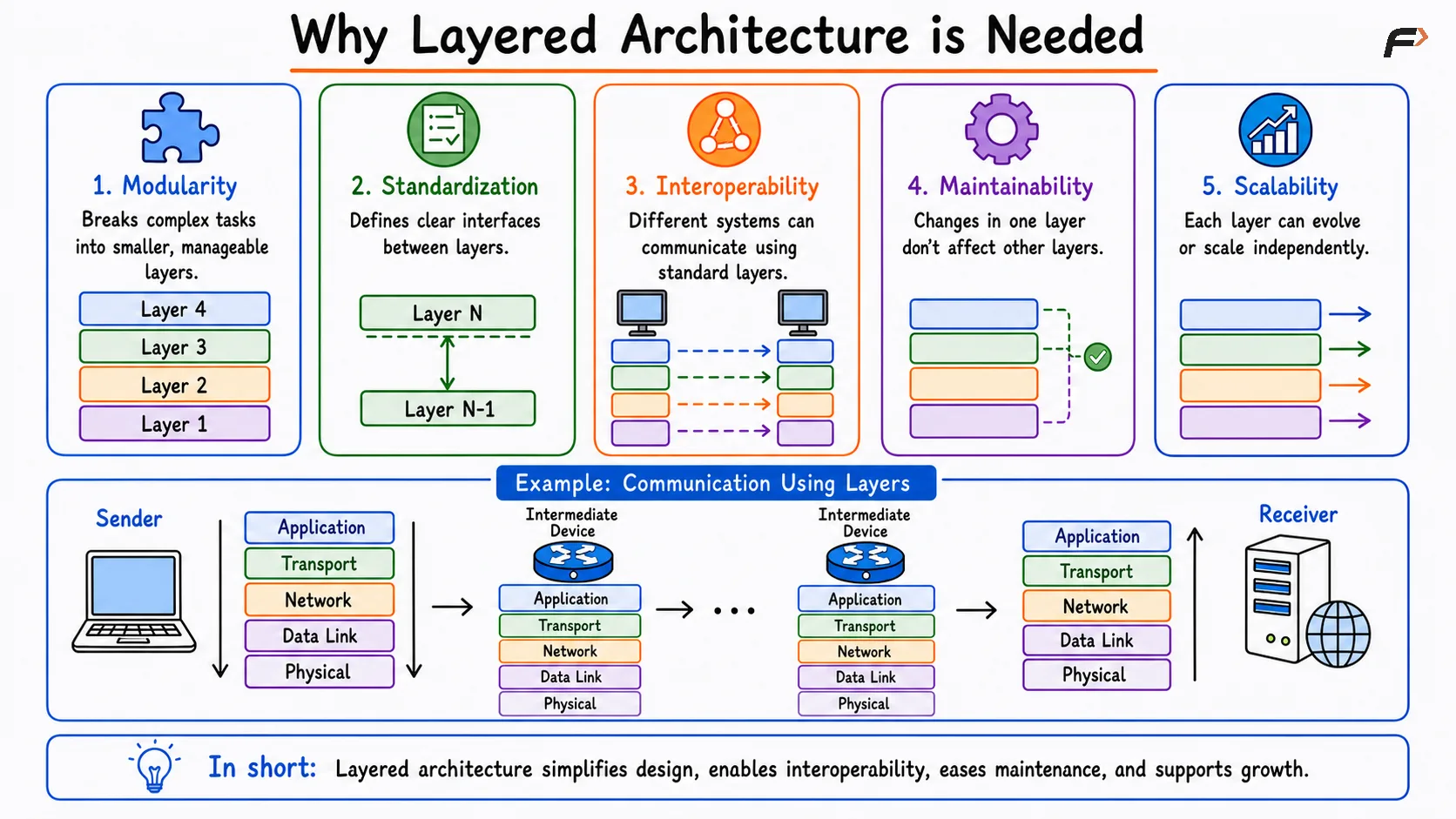
Five key reasons for using a layered architecture are presented: modularity, standardization, interoperability, maintainability, and scalability, along with an example showing data flowing through communication layers between a sender and a receiver.
Modularity: Each layer performs a specific function, making the network easier to design, manage, and maintain.
Interoperability: Devices and applications from different vendors can communicate using common protocol standards.
Easier Upgrades: Changes in one layer can often be made without affecting the rest of the networking stack.
Easier Debugging: Problems can be isolated to a specific layer, simplifying troubleshooting and fault diagnosis.
Standardization: Well-defined protocols ensure compatibility, consistency, and global adoption across networks.
Summary
Networking is not one single system, instead it is a stack of cooperating responsibilities. Each layer solves a specific problem and works together with others to enable reliable, scalable, and efficient communication. Without layering, modern networking, especially the Internet, would be impossible to build, maintain, and evolve.
Be the first to add a comment.