Introduction
A hybrid topology is exactly what the name suggests: a network design built by combining two or more different topologies in the same network. Instead of forcing the entire network to follow only one structure, we use different layouts in different parts of the network based on what those parts actually need.
This is why hybrid topology feels much closer to the real world than many other topologies. In practice, not every section of a network has the same goals. One part may need low cost and simple management, while another may need higher redundancy, better fault tolerance, or easier scalability.
What Is Hybrid Topology?
A hybrid topology is a physical network topology that combines two or more other topologies, such as star, mesh, bus, ring, or tree topology.
The main idea is simple: different network segments can use different designs, and together they form one larger network. This gives network designers more freedom and makes the network more practical for real business requirements.
Why Hybrid Topology Is Needed
If we used the same topology everywhere, the network would often become either too expensive or too limited. For example, using mesh topology across an entire office network would provide strong redundancy, but it would also be costly and difficult to manage.
On the other hand, using only star topology everywhere may be easy and cost-effective, but some critical parts of the network may still need multiple communication paths and stronger reliability. Hybrid topology solves this by allowing each part of the network to use the most suitable design.
In simple words, hybrid topology helps when:
one part of the network needs simplicity
another part needs redundancy
another part needs scalability
the full network must balance performance and cost
Understanding Hybrid Topology with an Example
Imagine an organization with two major areas:
an employee network for desktops and laptops
a data center for critical servers and applications
These two environments do not have the same requirements. The employee side usually needs simple expansion, easy maintenance, and lower cost. For that reason, star topology is often a good fit there.
The data center, however, may need higher availability, stronger fault tolerance, and multiple communication paths. In that case, a mesh-like design may be more suitable.
So the final network may look like this:
Employee Network => Star Topology
Data Center => Mesh Topology
When both of these exist inside the same overall network, the result is a hybrid topology.
Common Hybrid Topology Combinations
A hybrid network does not mean just one fixed pattern. Different combinations are possible depending on the environment.
Some common examples are:
Star-Bus Topology: Several star networks are connected through a common backbone.
Star-Ring Topology: Devices may connect through a central device, while communication structure includes ring-based sections.
Star-Tree Topology: Multiple star segments are arranged in a hierarchical layout.
Star-Mesh Topology: Access networks may stay simple with star topology, while critical backbone or server-side sections use mesh connections.
This flexibility is one of the main reasons hybrid topology is so common in modern network design.
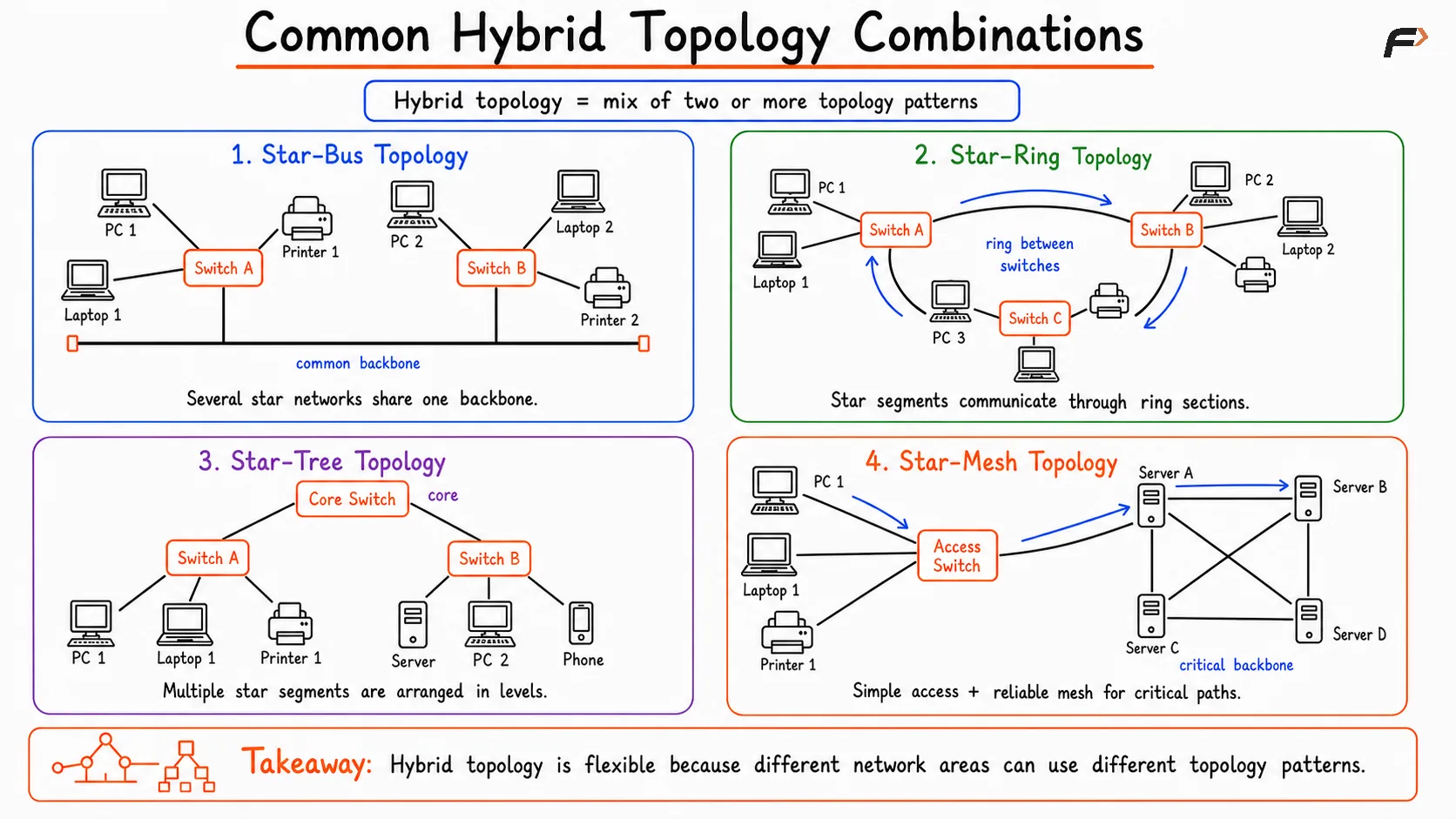
Comparison of common hybrid topology combinations, illustrating how star-bus, star-ring, and mesh-star networks combine the strengths of different topologies to improve scalability, reliability, and network performance.
Advantages of Hybrid Topology
Hybrid topology is popular because it combines the strengths of multiple topologies instead of depending on only one.
Some important advantages are:
Flexible design: Different topologies can be used for different network requirements.
Better scalability: New segments can be added as the organization grows.
Improved fault tolerance where needed: Critical sections can use more redundant designs.
Better cost control: Expensive topology designs are used only where they are necessary.
Practical for real-world deployment: Most enterprise networks, campus networks, and large infrastructures naturally grow into hybrid designs.
Supports performance optimization: Different parts of the network can be tuned for different workloads.
Disadvantages of Hybrid Topology
Even though hybrid topology is very practical, it is not always simple to build or manage.
Its main disadvantages are:
Higher design complexity: Combining multiple topologies requires more planning.
Harder troubleshooting: Problems can involve different network behaviors in different sections.
More documentation is needed: Clear diagrams and records become very important.
Potentially higher infrastructure cost: More devices, links, and integration work may be required.
Different sections behave differently: Performance, failure handling, and expansion rules may vary across the network.
So while hybrid topology is powerful, it works best when the network is designed carefully.
Where Hybrid Topology Is Commonly Used
Hybrid topology is widely used in environments where the network is large or has mixed requirements. It is especially common in places where one simple topology cannot satisfy the whole system.
You will often see hybrid topology in:
enterprise networks
university and campus networks
office buildings with multiple departments
data centers
cloud and large-scale infrastructure
industrial or mission-critical environments
In all of these cases, the network usually grows in stages. As new requirements appear, different sections are built differently, and the overall result becomes hybrid.
Summary
Hybrid topology is a network topology that combines two or more different physical topologies inside the same computer network. Its biggest strength is flexibility, because it allows each part of the network to use the design that suits it best.
As a result, hybrid topology helps organizations balance scalability, redundancy, fault tolerance, performance, manageability, and cost. That is why it is one of the most practical and commonly used approaches in real-world network design.
Be the first to add a comment.