Introduction
Traditional HTTP communication follows a request-response model. The client sends a request, the server replies, and then the interaction ends unless the client sends another request. This works well for webpages, forms, and normal API calls, but it becomes inefficient when updates need to appear instantly.
That is where WebSockets become important. WebSockets create a persistent connection between client and server so both sides can send messages whenever needed, without repeatedly creating new HTTP requests.
Why WebSockets Are Needed
In a normal HTTP setup, the server usually cannot send data on its own whenever something changes. If a browser wants live updates, it often has to keep asking again and again.
This repeated checking is called polling.
For example, in a chat app, the browser may keep asking:
Is there a new message?
Is there a new message now?
Is there a new message now?
Polling works, but it creates unnecessary traffic because many requests return no useful update. WebSockets solve this by keeping one long-lived connection open, so the server can send information immediately when something changes.
What Is a WebSocket?
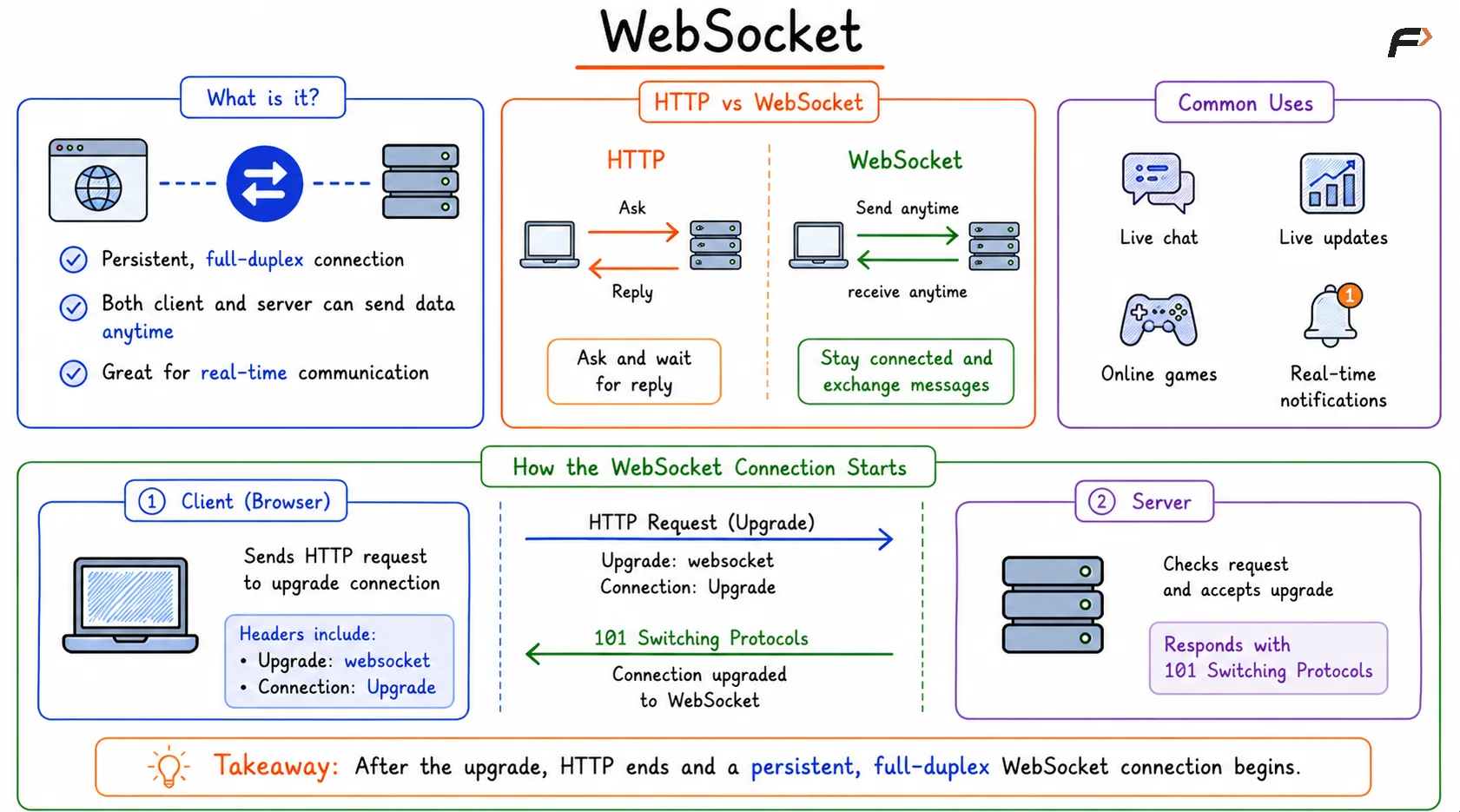
A WebSocket is a communication protocol that provides a persistent, full-duplex channel over a single connection. Full-duplex means both client and server can send data independently and at the same time.
This makes WebSockets very different from traditional HTTP request-response communication.
A simple idea to remember is:
HTTP: Ask and wait for reply
WebSocket: Stay connected and exchange messages anytime
Because the connection remains active, WebSockets are well suited for real-time communication.
WebSocket
How the WebSocket Connection Starts
A browser-based WebSocket connection usually begins as a normal HTTP request. The client asks the server to upgrade the connection to the WebSocket protocol.
The request includes headers such as:
Upgrade: websocketConnection: Upgrade
If the server accepts, it responds with status code 101 Switching Protocols. After that, the communication moves away from normal HTTP request-response behavior and becomes a persistent WebSocket connection.
Key Characteristics of WebSockets
WebSockets are popular because they provide a communication model that fits modern interactive applications.
Persistent connection: One connection stays open during the session.
Full-duplex communication: Client and server can send data independently.
Low latency: Messages travel quickly because the connection is already established.
Server push: The server can send updates immediately without waiting for a fresh request.
Reduced overhead: Repeated HTTP requests and repeated headers are avoided.
These features make communication more efficient when the application needs live, ongoing updates.
HTTP vs WebSocket
Feature | HTTP | WebSocket |
|---|---|---|
Communication style | Request-response | Bidirectional real-time communication |
Connection behavior | Separate request-response interactions | Long-lived persistent connection |
Server push | Not natural in the basic model | Supported directly |
Real-time updates | Often needs polling or repeated requests | Immediate updates are possible |
Latency | Higher for repeated live checks | Lower for continuous interaction |
Best use | Standard web pages, forms, REST APIs | Chat, live updates, real-time apps |
This is why WebSockets are not a replacement for all HTTP communication. They are mainly useful when continuous two-way communication is actually needed.
Common Use Cases of WebSockets
WebSockets are especially useful in applications where delays matter and updates must appear instantly.
Chat applications: Messages can appear immediately without page refresh.
Live notifications: Alerts and updates can be pushed in real time.
Multiplayer games: Players can exchange game state with low delay.
Stock price tracking: Price changes can be streamed continuously.
Live dashboards: Metrics and monitoring panels can update instantly.
Collaborative editors: Multiple users can see changes as they happen.
Coding platforms: Real-time code sync, status updates, and collaboration become easier.
In all these cases, repeated polling would be less efficient than a persistent bidirectional connection.
Secure WebSockets
WebSockets use two common URL schemes:
ws: Unencrypted WebSocket connectionwss: Secure WebSocket connection
In practice, secure WebSockets using wss are preferred for real applications, especially when user data, authentication, or private communication is involved.
Summary
WebSockets provide a persistent full-duplex communication channel between client and server, making them ideal for real-time web applications. Unlike traditional HTTP, they allow both sides to send messages at any time over the same long-lived connection.
This makes WebSockets a strong choice for chat systems, live dashboards, multiplayer games, notifications, and collaborative tools. In simple terms, HTTP is best for request-response communication, while WebSockets are designed for continuous real-time interaction.
Be the first to add a comment.