Introduction
Virtual circuit packet switching is a form of packet switching in which the network establishes a logical path before actual data transfer begins. Even though the data still moves as packets, those packets do not choose their path independently at every hop.
This makes the communication more predictable than datagram packet switching, while still keeping the basic packet-switched nature of the network.
What Is Virtual Circuit Packet Switching?
Virtual circuit packet switching is a packet-switching technique where a logical route is selected between sender and receiver before packets are transmitted. Once that path is created, all packets belonging to that communication follow the same route.
So the communication is still packet-based, but the forwarding behavior changes.
In simple terms:
Data is divided into packets
A logical path is established first
All packets follow that same path
The path is removed when communication ends
That is why it is called a connection-oriented form of packet switching.
Virtual Circuit vs Circuit Switching
Virtual circuit packet switching is often confused with circuit switching because both create a path before communication begins. But they are not the same.
Aspect | Circuit Switching | Virtual Circuit Packet Switching |
|---|---|---|
Data form | Continuous stream | Packets |
Path type | Dedicated communication path | Logical predefined path |
Resource usage | Resources are reserved exclusively | Physical network is still shared |
Forwarding style | Continuous circuit-based transfer | Packet-based transfer over a logical path |
The important difference is that virtual circuit switching still belongs to packet switching, not traditional circuit switching.
Why Virtual Circuits Are Used
Datagram packet switching gives high flexibility, but it can also create uncertainty because packets may take different routes and experience different forwarding behavior.
Virtual circuits were introduced to make communication more controlled and predictable. They are useful when a network wants:
Consistent packet path
Simpler forwarding
Better traffic control
Support for QoS and traffic engineering
More predictable network behavior
That is why virtual circuit ideas are important in technologies used by telecom networks, enterprise backbones, and MPLS-based environments.
How Virtual Circuit Packet Switching Works
The operation usually happens in three broad phases:
Setup phase
Data transfer phase
Teardown phase
A simple flow looks like this:
Logical path setup => packets follow the same path => communication ends => path is removed
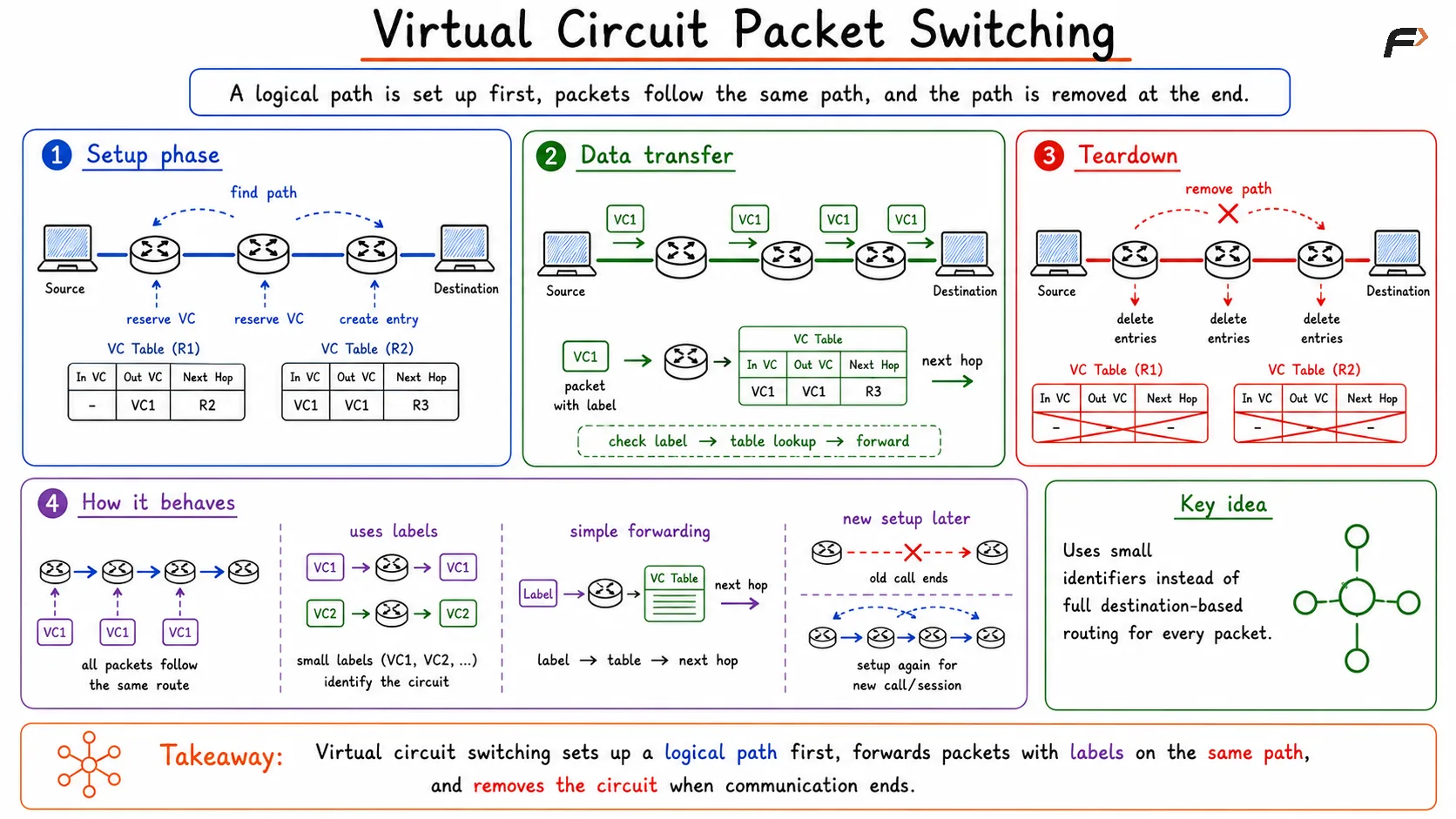
Virtual Circuit Packet Switching
Setup phase
Before data is sent, the network first determines the path that should be used between source and destination. Each intermediate device creates a forwarding entry for that virtual circuit.
This means the routers or switches on the path already know how packets belonging to that communication should be handled.
Data transfer phase
Once setup is complete, actual packet transmission begins. Every packet carries a small identifier or label that tells the network which virtual circuit it belongs to.
At each device:
The identifier is checked
The forwarding table is consulted
The next hop is selected immediately
The packet is sent onward
Because the path is already known, forwarding becomes simpler and more predictable.
Teardown phase
When communication ends, the virtual circuit is removed. The network deletes the related table entries and releases the identifiers associated with that communication.
If communication starts again later, a new setup phase is needed.
Labels and Virtual Circuit Tables
A key idea in virtual circuit switching is that the network often uses small identifiers instead of full destination-based routing decisions for every packet.
These identifiers may be called:
Virtual circuit identifiers
Labels
Connection identifiers
Each intermediate device keeps a table that maps an incoming identifier to an outgoing interface and, in some systems, a new outgoing identifier.
This is why virtual circuit switching can reduce forwarding complexity compared with pure datagram forwarding.
Advantages of Virtual Circuit Packet Switching
Virtual circuit packet switching offers several practical benefits:
Predictable path: All packets follow the same logical route
Simpler forwarding: Devices do not need a full destination lookup every time
Lower processing overhead: Identifier-based forwarding is faster
Better traffic engineering: Administrators can influence path selection
QoS support: Known paths help in providing more controlled service
These advantages make it useful in networks where path consistency matters.
Limitations of Virtual Circuit Packet Switching
Even though it provides better control, virtual circuit packet switching also has some limitations:
Setup is required first: Communication cannot always begin instantly
Less flexible than datagram switching: Packets do not freely adapt hop by hop
Path dependency: If the chosen logical path fails, the communication may be interrupted until a new path is established
More control state in the network: Devices must maintain virtual circuit information
So it gives more predictability, but at the cost of added setup and management overhead.
Real-World Example: MPLS
A well-known example related to virtual circuit behavior is MPLS, or Multiprotocol Label Switching. In MPLS networks, packets are forwarded using labels across a predefined label-switched path.
This helps provide:
Faster forwarding
Predictable routes
Traffic engineering support
Better control over large backbone traffic
MPLS is one of the most practical modern examples of virtual-circuit-like packet forwarding.
Summary
Virtual circuit packet switching is a connection-oriented form of packet switching in which a logical path is established before data transfer begins. Packets still exist, but instead of being routed independently at every hop, they all follow the same predefined route.
This gives the network better predictability, simpler forwarding, and stronger traffic control than datagram packet switching. At the same time, it remains more flexible than traditional circuit switching because the network is still fundamentally packet-based and shared.
Be the first to add a comment.