Introduction
UDP stands for User Datagram Protocol. It is one of the two main transport layer protocols, alongside TCP, and it is built for situations where speed matters more than reliability.
Instead of spending time setting up a connection, checking acknowledgements, or retransmitting lost packets, UDP sends data quickly with very little overhead. That makes it a strong fit for real-time communication and lightweight request-response traffic.
What Is UDP?
UDP is a connectionless transport layer protocol that sends data in the form of independent datagrams. Each datagram is handled separately, and the protocol does not maintain an ongoing session in the way TCP does.
This means UDP does not first establish a connection between sender and receiver. The sender simply prepares the data, adds the UDP header, and passes it to IP for delivery.
Core Idea Behind UDP
The basic design goal of UDP is simplicity. It avoids extra transport-layer mechanisms so that communication stays fast and lightweight.
Connectionless: No handshake or session setup before sending data.
Low overhead: Only a small fixed-size header is added.
Low latency: Packets are sent immediately without waiting for acknowledgements.
Best effort delivery: UDP tries to send data, but it does not guarantee success.
Independent datagrams: Every packet is treated as a separate unit.
This design is useful when delayed data is less valuable than fast data.
What UDP Does Not Provide
UDP is fast because it leaves out many features that TCP includes. That trade-off is the most important thing to understand.
No delivery guarantee: A packet may be lost and UDP will not recover it.
No ordering guarantee: Packets may arrive out of order.
No retransmission: Lost data is not sent again by UDP itself.
No flow control: UDP does not slow down based on receiver capacity.
No congestion control: UDP does not manage network congestion by itself.
So UDP is not unreliable because it is badly designed. It is intentionally minimal so that applications can use speed when that matters more than perfect delivery.
UDP Header Format
A UDP datagram contains two parts:
UDP header
Payload data
The UDP header is always 8 bytes, which is one of the reasons UDP is considered lightweight.
Field | Size | Purpose |
|---|---|---|
Source Port | 16 bits | Identifies the sending application |
Destination Port | 16 bits | Identifies the receiving application |
Length | 16 bits | Total size of UDP header and data |
Checksum | 16 bits | Used for error detection |
Because the header has only four fields, packet processing is simple and quick.
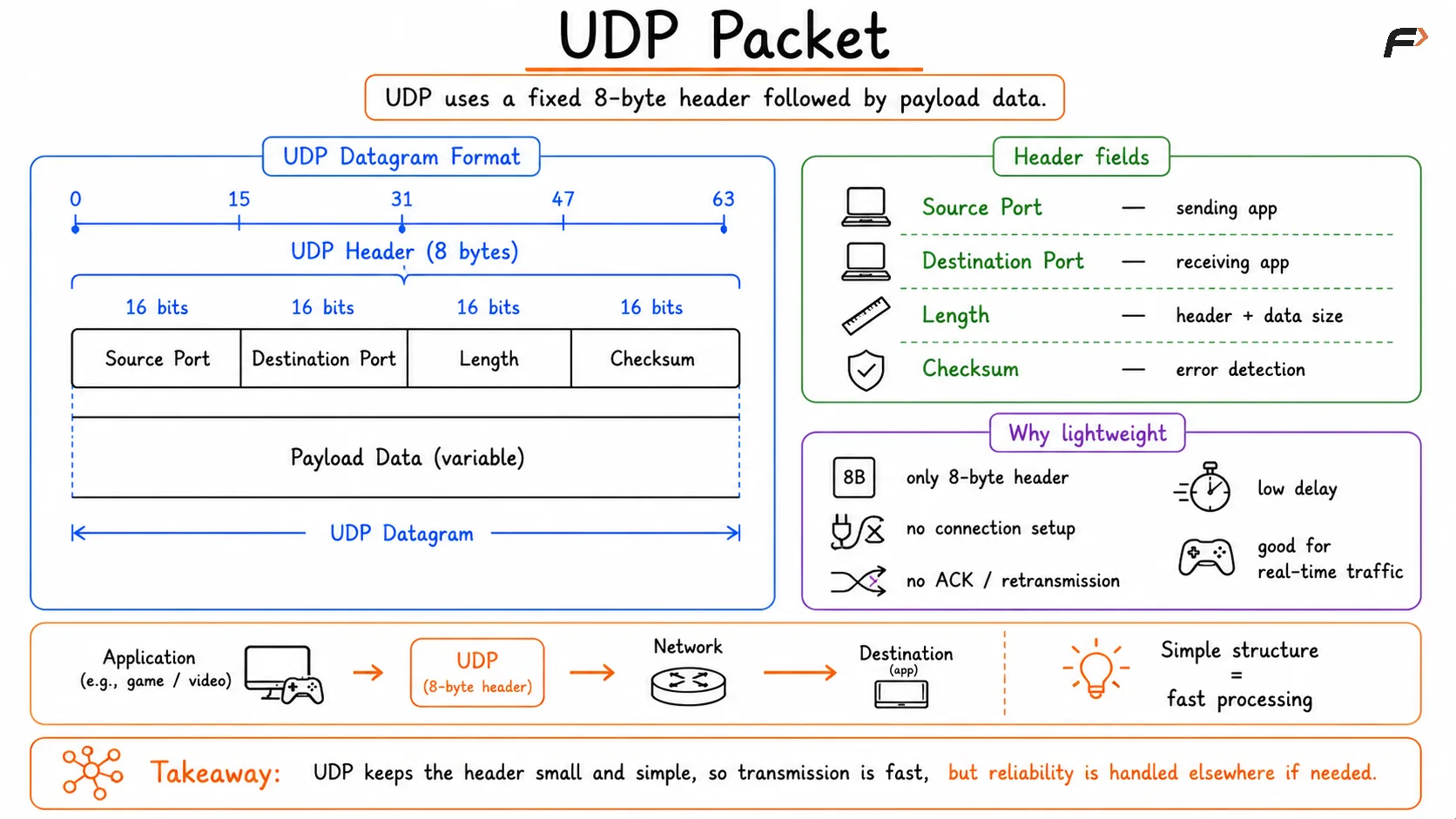
UDP Packet
Why UDP Is Lightweight
UDP keeps both its structure and behavior simple. It does not handle connection establishment, acknowledgements, sequence tracking, retransmission, or delivery management.
That simplicity gives UDP some clear practical advantages:
Smaller header: Only 8 bytes of transport-layer overhead
Faster processing: Routers and hosts do less transport-layer work
Lower delay: No need to wait for connection setup or acknowledgements
Better fit for real-time traffic: Late data is often less useful than immediate data
The trade-off is that reliability must be handled elsewhere if the application needs it.
Common Uses of UDP
UDP is used where low delay is more important than perfect delivery. In many real-time applications, receiving the latest data quickly is more useful than waiting for an old lost packet to be retransmitted.
Common uses include:
DNS: Fast query-response communication for name resolution
VoIP: Voice traffic where delay is more noticeable than small packet loss
Live streaming: Real-time audio and video delivery
Online gaming: Quick updates and low-latency interaction
Broadcast and multicast traffic: Efficient one-to-many communication
DHCP: Automatic network configuration messages
Modern protocols such as QUIC also run on top of UDP, adding their own reliability and control features at higher layers.
Broadcast and Multicast Support
One important advantage of UDP is that it works well with broadcast and multicast communication.
Broadcast: One sender can send data to all devices on a local network segment.
Multicast: One sender can send data to a selected group of receivers.
This makes UDP useful in services where the same information needs to reach multiple destinations efficiently.
When UDP Should Be Used
UDP should be chosen when the application can tolerate some packet loss and values speed, simplicity, or real-time delivery.
It is a good fit when:
Fresh data matters more than old data
The application can handle reliability on its own if needed
Low latency is more important than guaranteed delivery
The traffic pattern is short, simple, or time-sensitive
If the communication needs guaranteed delivery, ordering, and strict reliability, TCP is usually the better choice.
Summary
UDP is a fast, lightweight, connectionless transport layer protocol that sends independent datagrams with very little overhead. It uses a fixed 8-byte header and supports process-to-process communication using port numbers.
Because UDP does not provide delivery guarantee, ordering, retransmission, flow control, or congestion control, it is best suited for DNS, VoIP, live streaming, gaming, multicast, and other low-latency applications where speed matters more than perfect reliability.
Be the first to add a comment.