Introduction
Twisted pair cable is one of the most widely used transmission media in computer networks. It consists of pairs of insulated copper wires twisted around each other to carry electrical signals. The twisting helps reduce interference and improves the reliability of data transmission, making twisted pair cables a common choice for Ethernet networks, homes, offices, and enterprise environments.
Why Are the Wires Twisted?
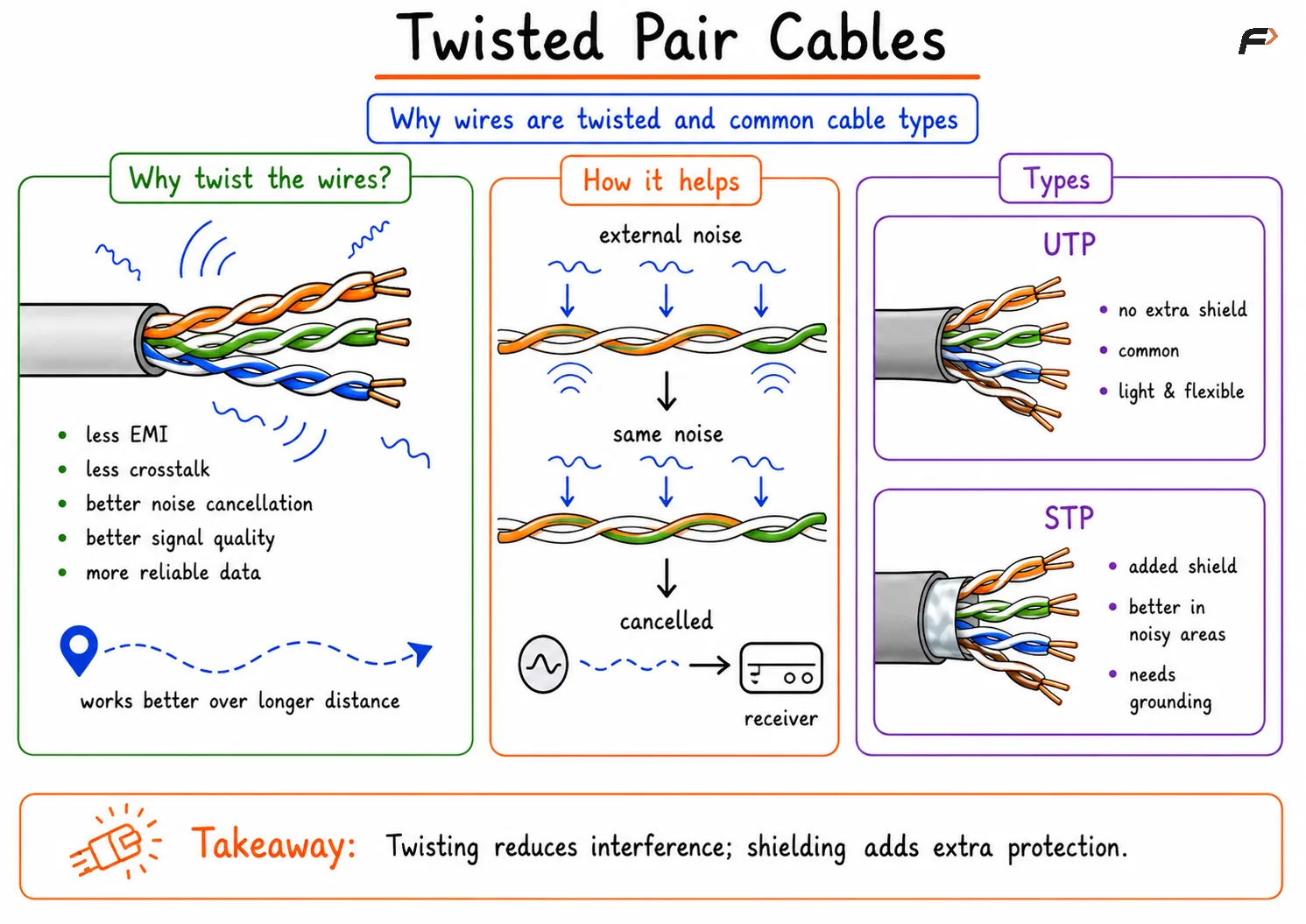
The primary purpose of twisting the copper wires is to improve signal quality and reduce interference during transmission. By twisting the wires together, both conductors are exposed to nearly the same external noise, allowing the receiver to cancel much of the unwanted interference.
Twisting provides several benefits:
Reduces electromagnetic interference (EMI) from nearby electrical devices.
Minimizes crosstalk between adjacent wire pairs.
Improves noise cancellation by exposing both wires to similar interference.
Helps maintain signal quality over longer distances.
Reduces transmission errors and improves communication reliability.
Types of Twisted Pair Cables
Unshielded Twisted Pair (UTP)
UTP cables do not include additional metallic shielding and rely primarily on wire twisting to reduce interference. They are the most commonly used twisted pair cables in Ethernet networks because they are cost-effective, lightweight, flexible, and easy to install. UTP cables are widely used in homes, offices, and general networking environments.
Shielded Twisted Pair (STP)
STP cables include an additional metallic shield that provides extra protection against electromagnetic interference and crosstalk. They are generally more expensive and heavier than UTP cables but offer better performance in environments with high electrical noise. Proper grounding is important for shielded cables to function effectively.
Twisted Pair Cables
UTP vs STP
UTP | STP |
|---|---|
Uses twisting alone to reduce interference. | Uses twisting along with metallic shielding. |
Lower cost and widely used. | Higher cost due to additional shielding. |
Lightweight and flexible. | Heavier and less flexible. |
Easier to install and maintain. | Requires more careful installation. |
Typically does not require grounding. | Proper grounding is important. |
Common in homes and offices. | Suitable for high-interference environments. |
Common Connectors
RJ11
RJ11 (Registered Jack 11) is commonly used for telephone lines and traditional voice communication systems. It typically uses 4 or 6 pins and is designed for low-bandwidth communication such as telephone and DSL connections.
RJ45
RJ45 (Registered Jack 45) is the standard connector used in Ethernet and LAN networks. It typically uses 8 pins and supports high-speed data transmission between computers, switches, routers, and other networking devices.
RJ11 vs RJ45
RJ11 | RJ45 |
|---|---|
Primarily used for telephone communication. | Primarily used for Ethernet networking. |
Typically supports 4 or 6 pins. | Typically supports 8 pins. |
Designed for voice and DSL connections. | Designed for LAN and data communication. |
Smaller connector with fewer conductors. | Larger connector supporting higher throughput. |
Summary
Twisted pair cable is a common networking cable made of pairs of insulated copper wires twisted together to reduce interference and improve signal quality. It is widely used in Ethernet networks because it is reliable, affordable, and easy to install.
There are two main types: UTP, which uses only twisting and is commonly used in homes and offices, and STP, which has extra shielding for better protection in high-interference environments. RJ45 connectors are used for Ethernet networks, while RJ11 connectors are mainly used for telephone and DSL connections.
Be the first to add a comment.